
Aired last night or in the early morning in Cannes, I’ve only managed to watch this. The crowd joining McCartney (whose voice is more than half-gone), Costello, Colbert and the gang on-stage…perfect.
Dhont’s WWI Queer Romance Reps A Massive Miscalculation
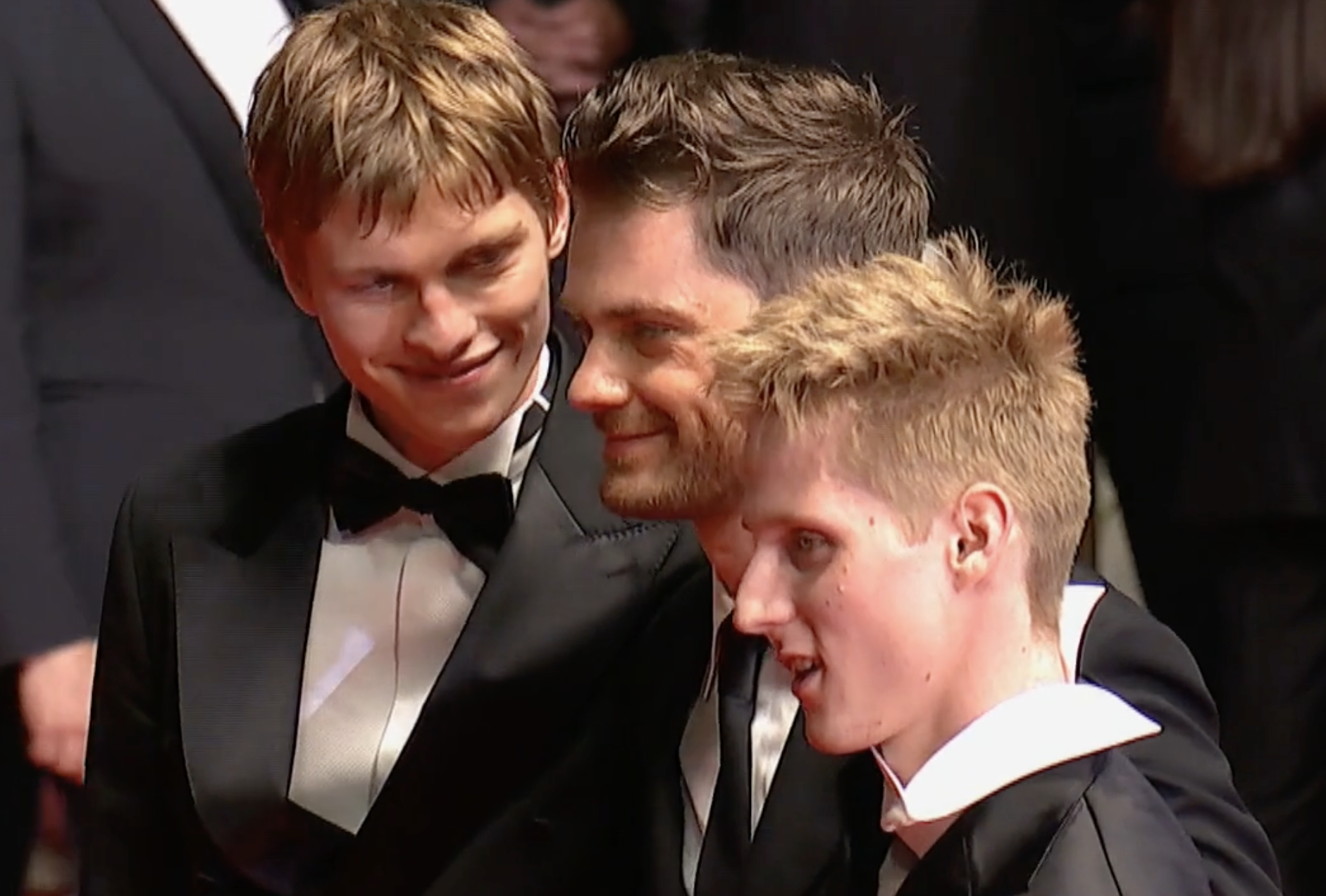
It breaks my heart to confess that Lukas Dhont‘s emotionally flamboyant Coward, set primarily in the horrific slaughterhouse of World War I trench warfare, has struck me as highly disturbing, disorienting and saddening.
A queer romance set amidst the musical drag performances that took place behind the Belgian lines during the war, and more particularly about a profound attraction between closeted farm boy Pierre (Emmanuel Macchia) and son-of-a-tailor Francis (Valentin Campagne), a brazenly effeminate performer who leads the popular troupe of drag entertainers, whom Francis addresses as “ladies”…hold on, losing the thread.
For their spirit-lifting funhouse antics, offering a much-needed respite from the blood, mud and death of the front lines, Francis and his fellow performers are celebrated by the troops (only one or two convey homophobic spite) and, a bit curiously, by their uniformed Belgian commanders.
In his 5.21 review, Screen Daily‘s Tim Grierson, a Coward fan, admits that this reaction “probably runs counter to most viewers’ assumption about how such outrageousness would have been perceived during that era.” Do ya think so, Tim?
For as well crafted and sumptuously mounted as Coward obviously is, it’s a florid swing away from the understated poignance and powerful, less-is-more restraint that characterized Dhont’s first two queer love stories, Girl (’18) and Close (’22), both of which I was deeply moved by, especially by the latter.
After catching Girl at a Manhattan screening in December 2018, I described it as “the most assured, immersive and delicately effective drama about a transgender person that I’ve ever seen in my life, or am likely to see in the future”. Three and a half years later I became an even bigger fan of Dhont’s sophomore effort, a tragic teenaged love story that I called “a devastating grand slam” after seeing it in Cannes in May 2022.
Cut to last night’s 10:15 press screening of Coward in the Salle Debussy, and my agonized, seat-shifting, watch-checking response. For Coward is basically a gay fantasia by way of (in my head at least) Stanley Kubrick‘s Paths of Glory — it’s Ralph Meeker‘s Corporal Philippe Paris meets Ryan Murphy‘s Glee meets Ru Paul’s Drag Race meets Ken Russell‘s The Boyfriend meets Mel Brooks’ “The French Mistake”.
Hollywood Reporter‘s David Rooney: “What really sinks Coward is the self-conscious grandiosity with which the director strains for lofty emotional peaks in moments that instead come off as hollow and artificial.”
Even from my limited fourth-row perspective, I noticed three or four walk-outs during the film’s final third. If you had told me before Coward began that seasoned journos would bail on a film by the obviously gifted Lukas Dhont, I would have been repulsed. But when I saw this with my own two eyes, I half-sympathized.
I was very upset (i.e., expressing myself in a less measured way) when I texted the following just after the screening:
“The Lukas Dhont [film] is a massive, appalling miscalculation — an embarrassing (to me) fiasco in which the bloody horror of World War I trench warfare is subsumed to what amounts to an opulent gay fantasia — a heartfelt, openly sexual love story that not only feels forced and fanciful, but one that dishonors the slaughterhouse realm of that awful war.”
Yes, this sounds like an old-fogeyish response but c’mon, man — I was there, taking it all in, and going “no, no, no” and asking myself “good God, what is this?”
Yes, there was that musical drag show that the Bridge of the River Kwai POWs put on for the troops as William Holden and Geoffrey Horne laid mines around the base of the Kwai bridge, but this? Harumphy patriarchal attitudes about flamboyant queerness surely ruled the roost 110 years ago, and I simply don’t believe that cheers and laughter among all (or even a significant majority) of the Belgian soldiers would have prevailed. Woke presentism has once again reared its head.
Imagine if Pierre and Francis had to submerge their feelings out of the usual old-school concerns. That would have been much more effective. Imagine if Francis didn’t behave like one of Ru Paul’s guests in each and every scene. “Over the top” doesn’t begin to describe his behavior. I felt heartened by a battlefield scene that shows Francis wounded and bloody and crying out “all is lost!” Thank God, I excitedly said to myself — at least this little creep is out of the film. But he’s back in the pink a few minutes later. My heart sank.
In the third act Francis confides to Pierre that he’s actually happy to be in the war realm because at least they can be together when none of their fellow soldiers is looking. Back in the normal civilized world they couldn’t be this expressive, he reasons. Fair enough, but I didn’t believe in their time-off, stolen-kisses moments for a second.
Coward not only condones Pierre’s cowardice (he stabs himself in the hand in order to avoid front-line duty) but cuts him a break when he deserts. None of those Matt Damon-ish feelings of fraternity with his fellow grunts for him! And then Dhont goes the extra mile by granting Pierre and Francis a happy epilogue finale.
Continuing text: “As someone who’s met and personally likes and admires Dhont and who respects the exquisitely refined Girl and Close, I’m in shock that he decided against applying his usual restraint by going with a campy, over-baked Ken Russell aesthetic (one particular Coward performance sequence reminded me of portions of Lisztomania and the grotesque birth-of-Venus opening of The Devils).
“Coward is one of the most absurd, wildly miscalculated misfires of all time. Poor Lukas, who remains a gifted filmaker and who will move on to another project and then another and another, has grotesquely overplayed his hand. It’s not the end of the world and the sun will come up tomorrow, but as far as this grumpy horse is concerned, ‘welcome to the WWI gay follies!’ didn’t settle in with any degree of acceptance or comfort.”
Remember The Keepers
Over the last nine or ten days (5.12 to 5.21) I’ve seen more Cannes ’26 films than the ones I’ve written about. On paper HE’s policy has mostly been to hit the keyboard only about films that I’ve had strongly positive or negative reactions to, but I haven’t followed this regimen strictly.
But the biggies so far are, in this order, Fjord, Fatherland, The Man I Love, Paper Tiger, The Beloved, The Match and (in my estimation at least) Parallel Tales. Seven in all. Plus one high-expectation effort I’ll be seeing tonight, Coward, from Lukas Dhont.
There was one film — Pierre Salavdori‘s The Electric Kiss, which I caught on opening night (5.12) — that I wrote about without any special ardor or disfavor.
I felt generally positive about Kantemir Balagov‘s Butterfly Jam, and said as much.
I adored Juan Cabral and Santiago Franco‘s The Match. I comme ci comme ca‘ed about Charline Bourgeois-Tacquet‘s A Woman’s Life so I wrote nothing. I hated Jane Schoenbrun‘s Teenage Sex and Death at Camp Miasma, and said as much. I saw Diego Luna‘s Ashes and felt next to nothing…couldn’t get it up so I let it go.
And then, two days after the festival began or on Thursday, 5.14, I saw the first masterpiece — Pawel Pawlikowski‘s Fatherland, I filed a rave review, and liked it so much that I caught a repeat showing the following morning (Friday, 5.15).
My approving response to Asghar Farhadi‘s Parallel Tales was a minority opinion, but I found it genuinely clever and intriguing and said so.
Radu Jude‘s The Diary of a Chambermaid wasn’t a negative, but for filing purposes a no-go. Somewhere between flat and unexceptional.
On Friday (5.15) I described Ryusuke Hamaguchi‘s All Of a Sudden (Soudain) as “a 196-minute film that is basically a slow-moving, didactic conversational instructional — a 21st Century counterpart to Jean-Luc Godard‘s Marxist instructional films (1967 to 1974).”
Later that day I endured Marie Kreutzer‘s Gentle Monster, but it seemed like another generically feminist “awful men” flick, this one concerned with a husband who’s been secretly earning extra income by sharing child-porn material. This comes to his wife’s attention via police investigation, but I didn’t find it dramatically persuasive, much less compelling.
The festival’s second big knockout, Rodrigo Sorogoyen‘s The Beloved, arrived on Saturday, 5.16. Javier Bardem‘s performance as a vaguely testy, emotionally simmering film director coping with a difficult if unacknowledged relationship with his 30something actress daughter (the excellent Victoria Luengo) struck me as brilliant. The film was my idea of a solid triple.
Later that evening the third serious triumph screened — James Gray‘s Paper Tiger. I filed a seriously ardent rave with an idea that it might win the Palme d’Or, or at least the Grand Prix award.
Later that evening I composed a generally pleasured response to Barnaby Thompson‘s Maverick: The Epic Adventures of David Lean….”wowed, massaged, comforted, reminded, elevated, amused…a career-profile doc that does everything you want it to do.”
And then came the festival’s fourth heavy hitter as well as the first (and so far only) grand slam — Cristian Mungiu‘s Fjord, which I called “a fascinating assault on socially progressive totalitarianism.” This has to be a major award winner, in my view a Palme d’Or slam dunk. Then again the denial-beset reactions from certain critics indicated that the jury might take a similar view so who knows?
The dual disappointments of Andrey Zvyagintsev‘s Minotaur and Pedro Almodovar‘s Bitter Christmas arrived on Tuesday, 5.19. I was more impressed by the moaning man incident than the Almodovar…sorry.
I was fairly astounded by the flat tedium of Emmanuel Marre‘s Notre Salut, which certain French critics have been praising among themselves.
Yesterday (Wednesday, 5.20) ushered in Mike Mendez‘s entirely pleasant and nourishing Dernsie along with Ira Sach‘s The Man I Love, in my book the festival’s fifth knockout and another possible Palme d’Or winner…maybe.
The curtain goes up on Lukas Dhont‘s Coward this evening at 10:15 pm…great expectations.
That’s 18 or 19 films so far (I haven’t mentioned Garance and one other) with another three or four to go. These include Hope, Machine Gun Kelly, La Biola Negra and The Birthday Party.
Once again, the keepers are Fjord, Fatherland, The Man I Love, Paper Tiger, The Beloved, The Match and Parallel Tales.
HE’s Nice-to-Oslo flight leaves late Saturday afternoon. The Oslo-to-JFK departs just after noon on Sunday.


“Coward” (5.21, 10:15 pm) Is Last Significant Cannes Premiere
A friend caught Lukas Dhont‘s Coward a few days ago, speaks very highly of it. The press line will begin forming outside the Salle Debussy around 9:30 pm or so. There’s an 8 pm Salle Bunuel screening of Roger Corman‘s Machine-Gun Kelly (’58) at 8 pm. I might drop and watch it for 75 minutes or so.
“Dernsie” Does The Necessary Job
Three hours before Wednesday night’s The Man I Love screening, I caught a grade-A Bruce Dern tribute doc — Dernsie: The Amazing Life of Bruce Dern — at the Salle Bunuel.
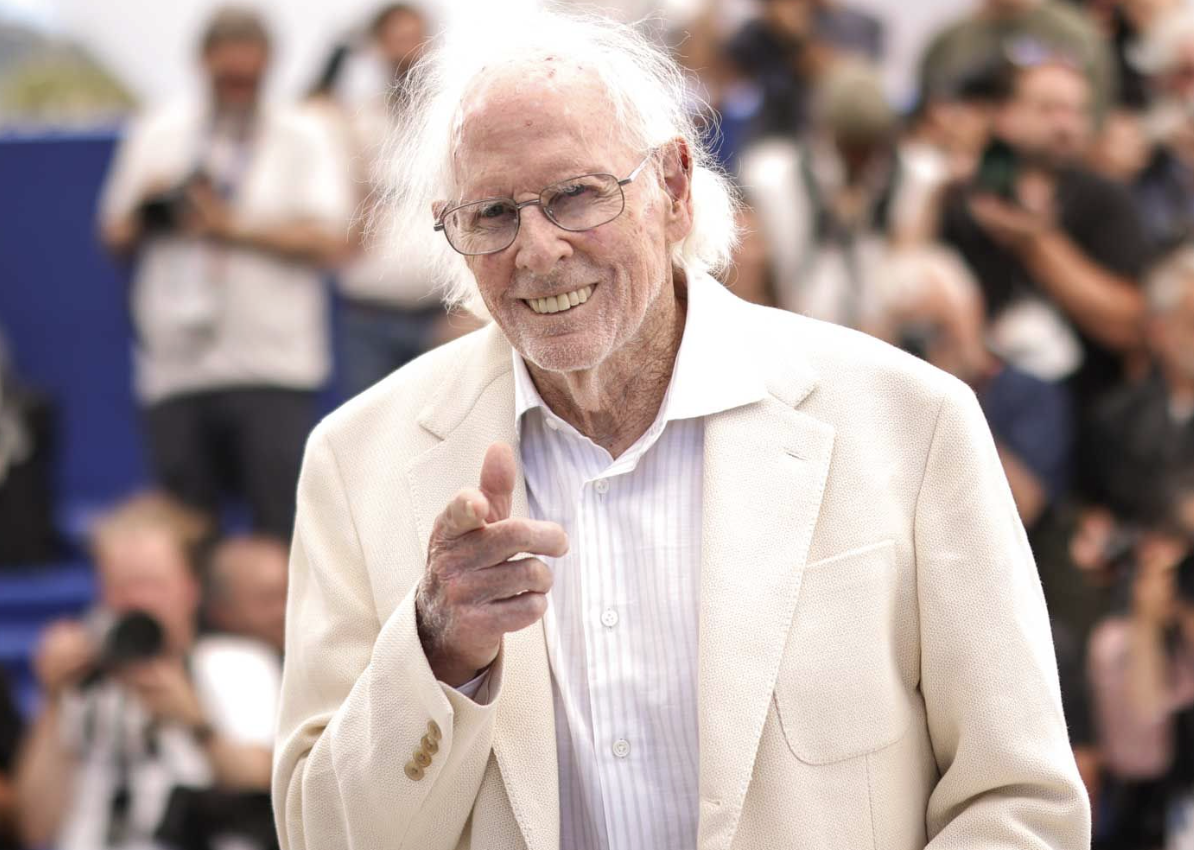
Dernsie is no one’s idea of a mindblowing film but is certainly a highly enjoyable stroll through a good man’s life. Plus the 89-year-old Bruce, whose legs are gone (two guys were holding him up as he walked to the small stage), took a bow and shared a few thoughts before the film began, and that was cool.
I’ve enjoyably chatted with Dern on two occasions (a 2004 press schmooze dinner at the Sundance Film Festival, a 2013 Cannes press junket for Nebraska). He’s a legendary raconteur, of course, and something told me during our Cannes chat that we could’ve continued for hours and hours.
I snapped Bruce when he took the Salle Bunuel stage, and I thought I saw a glint of recognition. Bruce has a kind, proud face.
Directed by Mike Mendez and lasting 111 minutes, Dernsie is one of those generally lively, colorful, “dutifully admiring portrait of a legendary fellow” films…beginning with an obligatory kiss-ass montage, moving into the historical-biographical section (90 or 95 minutes) and finishing up with another kiss-ass montage.


Dern played exactly one semi-lead in his life — the ornery, white-haired codger in Alexander Payne‘s Nebraska (2013). Except it wasn’t a semi-lead, not really — Dern’s codger was a strong character part, and he knew it. But the 2013 Cannes Film Festival jury gave him a Best Actor award, and that set Dern’s mind in stone. If Dern had chosen to campaign stateside for Best Supporting Actor, he would have easily won.
HE’s favorite Dernsie (i.e., seemingly improvised): During a sidewalk scene in The Laughing Policeman, an angry dude of color is staring hard and long at Dern’s racist detective. Dern reply: “What are you gonna do, eyeball me to death?”
Kicker Dern quote on abandoning his early theatre career in favor of Hollywood feature-film gigs: “The reason I never went back to the theater is because what we’re doing here” — capturing special dramatic moments on film or digital bits — “is forever.”
I arrived a bit earlier than necessary and the Salle Bunuel ushers, it seemed, made the earlybirds wait on their feet much longer than necessary….a good 45 or 50 minutes. They derive a certain kind of pleasure from dragging it out as long as possible. They glance at you from the sides of their eyes, silently asking “are you enjoying this endless standing?…heh-heh-heh.”
Dernsie costars many narrators and interpreters — daughter Laura Dern (who’s now acting in Mike White‘s currently-lensing fourth season of The White Lotus, which will use the Cannes Film Festival as a backdrop), directors Quentin Tarantino and Alexander Payne, fellow actor Walton Goggins, etc.
Almost every significant chapter in Dern’s career is covered by Mendez’s film, and it’s all flavored with Dern talk-throughs and interpretations, of course. A whole lot of fun.
Mendez misses one important footnote — Dern’s darkly comedic performance as Lt. Billy Byron Bix in Sydney Pollack‘s Castle Keep (’69). Bix is the leader of a small group of conscientious objectors, and during a conversation with Peter Falk, a soldier who puts on a white apron and becomes a baker for a short time, they all hum a kind of religious hymn. Dern, I realized, was clearly aware of the absurd, dryly comic nature of Castle Keep, and for me his performance was the first conveyance that he was a wise hipster type.
Four years later Dern finally broke out of playing generically intense, crazy-eyed villains. It happened when old pal Jack Nicholson got him a costarring role in Bob Rafelson‘s The King of Marvin Gardens (’73).
HE’s roster of films containing the best Dern performances: The Trip, Castle Keep, Will Penny, They Shoot Horses, Don’t They?, Drive He Said, The Cowboys (drilled John Wayne!), Silent Running, The Laughing Policeman, The Great Gatsby, Family Plot, Black Sunday, Coming Home, That Championship Season, Nebraska.

“The Man I Love”‘s Rami Malek Locked For 2027 Best Actor Oscar Nom
When the right actor has lucked into exactly the right role, a role that not only fits like a glove but serves as a kind of spiritual-emotional springboard that instantly ups the actor’s game, you can sense it within a couple of minutes.
There was never the slightest question that Rami Malek‘s crackling, pocket-drop performance as Freddie Mercury in Bohemian Rhapsody (released seven and a half years ago…time flies!) was one such performance.
Last night I got the same…actually an even bigger snap-crackle-pop from Malek’s quieter, less flamboyant but ultra-delicate and vulnerable performance as gay cabaret performer Jimmy George in Ira Sachs‘ The Man I Love, which I caught at 10 pm in the Salle Debussy.
I’ll be flabbergasted if the Cannes Film Festival jury doesn’t hand Malek the Best Actor prize on Saturday night. And you can bet the farm and your savings account that Malek will be Oscar-nominated next January. It’s obvious. He’s uncorked one here. Malek is James Dean riding his sloppy jalopy over to Reata, hopping out, spreading his arms and taunting Rock Hudson with “my well came in, Vic.”
Will the same critics who sneered at Bohemian Rhapsody while implying that Malek’s Mercury was “some sort of weird crime against humanity”, as Variety‘s Owen Gleiberman wrote yesterday…will these same critics take fresh shots at the seemingly straight Malek (he merged with Rhapsody costar Lucy Boynton between 2017 to ’23, and then with Emma Corrin from 2023 to ’25) for not having the “authority” to play a theatrically queenish devotee of singing and cabaret crooning?
Remember Tom Hanks saying four years ago that he could not play the role of a gay man as he did in 1993’s Philadelphia, and “rightly so”?
But let’s not go off the Malek-y deep end here. For in and of itself The Man I Love, in its emotional and atmospheric totality, is a fascinating, plainly told and fundamentally riveting story of Jimmy’s declining life in late ’80s Manhattan…gradually losing his grip but impulsively joyful and instinctually rebellious, and randomly moody from time to time.
You can feel the directness, the docudrama-like spareness, the no-bullshit honesty from the get-go. This, for me, is Sachs’ best film ever. I’ve never been a big fan of his sometimes deft approach — I frankly didn’t think Sachs was capable of this kind of frank, improv-style filmmaking.
Sustained in part by AZT, which was officially approved in ’87, Jimmy’s tenuous, AIDS-afflicted life is split between rehearsals for his latest show at some lower Manhattan venue, his longterm relationship with the devoted and protective Dennis (perfectly played by Tom Sturridge, who’s also straight…uh-oh!) and a young, carrot-haired, alabaster-skinned sexual vampire named Vincent (Luther Ford) who obviously decides from the very first story beat that he wants to fuck Jimmy and possibly fall in love…love me love me or at least fuck me fuck me cum jism hot-shower anal squishitude and a men’s room quickie…bip bip bip bip.
Rebecca Hall is excellent as Jimmy’s sister Brenda, who’s visiting Manhattan for a brief spell with her bearish husband, Gene (Ebon Moss-Bachrach, the restaurant manager in The Bear). Silent HE muttering: “Jeez, what self-resoecting woman would want to fuck that guy with his bushy beard and all?”
In my Debussy mind the flame-haired Vincent wasn’t just a carniverous slut but some kind of supreme villain…a crocodile looking to eat a nice succulent wildebeest during a major herd crossing…and Dennis is Pat O’Brien in Angels With Dirty Faces. Given this analogy, I was kind of hoping that Vincent would turn out to be James Cagney‘s doomed Ricky Sullivan, but he’s cool and collected in the final shot, sipping a drink at a bar and then writhing on a dance floor with his latest victim, an aspiring, dark-haired actor.
I felt mildly satisfied when Jimmy zones out on Vincent, prompting the latter to ask “what did I do?…Jimmy, what did I do?” But it wasn’t enough.
The mid to late 30ish (or early 40ish) Jimmy is a bit of a sad sack…a personality-driven performer who tasted a potential launch moment in his 20s, but then somehow let the chance slip away. He’s clearly a deeply committed artist with a knack or a flair for turning audiences on, but starting to be hobbled by second thoughts or late-surfacing health tremors. He has the swagger and the confidence of someone who’s been performing for a longish period, but not quite possessing the explosive energy and diamond-cut panache of a serious A-level talent. Inwardly he’s coming apart at the seams, and this, sadly, leaks out on opening night.
I agree with other Cannes critics that The Man I Love‘s big moment arrives when Jimmy, at some kind of gathering for his parents, picks up a mike and gently sings “What Have They Done to My Song Ma”, the 1970 Melanie song. Coming from Jimmy, the lyric about how “it’s turning out all wrong, ma”…you know what he’s sorry about, and it catches you in the throat.
The period tip-offs are a mention of club performer Ann Magnuson, who started to happen in certain downtown venues (Club 57, Mudd Club) in ’89 and ’90, and a Sony 8mm cassette video camera that I captured my two infant sons with during the same period. And Jimmy’s confession to a doctor that he was born in 1947.
“Notre Salut” In A Few; “The Man I Love”’Later Tonight
A last–minute HE choice, Emmanuel Marre’s Notre Salut (A Man of His Time) begins screening at 3 pm. I was told it’s a must-see, that buyers are circling, etc.
6 pm update: My source gave me a bum steer. The flatness of this French-produced WWII film is almost surreal. For me, Notre Salut — a 155-minute, snail’s-pace film about a bureaucratic Vichy government mouse, a mild-mannered, Petain-admiring, ass-kissing go-along who plays the proverbial game with the German partners — was and is eternal nerve gas. It’s one of the most boring, mystifying, inexplicably soul-stifling, ghastly and incomprehensible films I’ve ever seen in my life…FLATLINE!

Zvyagintsev’s “Minotaur” Broke My Heart
I became a devotional admirer of Russian director Andrej Zvyagintsev after seeing the blistering, anti-Putin Leviathan (’14) in Cannes. I didn’t like 2017’s Loveless quite as much, but it’s obviously a scalding, no-bullshit, grade-A reflection of a certain poisoned layer of affluent Russian society.
Four years later Andrej was pulverized by a Covid infection and then sank into a coma (hospitalized for 11 months). He wasn’t out of the woods until ’22. But now, happily, he’s back in the swing with a new film…health restored, onward and upward, etc.
Alas, I’m sorry to report that, for me, Minotaur itself is not very good or certainly not good enough.
Zvyagintsev’s Minotaur is a morally-condemning, socially-reflective remake of Claude Chabrol‘s Le Femme Infidel (’69)…a sexy-but-bored-wife-cheating-on-her-wealthy-husband drama that weaves in a strong vein of anti-Putin and anti-Ukraine War commentary, and is permeated by the usual fumes of moral corruption among the moneyed classes.
Minotaur‘s basic message is that a husband murdering his wife’s boyfriend (the inciting incident in the Chabrol film as well as in Adrien Lyne‘s 24-year-old Unfaithful, an above-average remake, so don’t give me with the spoiler whining) isn’t that much of a moral or legal problem if the murderer belongs to Russia’s wealthy corporate class. All he has to do is ask a politically submissive top-cop friendo to order the investigating detectives to back off, which they do after getting the word.
The problem is that Minotaur is simply not as well made as the Lyne version. I respect the attempt by Zvyagintsev and Simon Liashenko to mesh a bad-marriage saga with the poisoning of Russian society by way of Putin’s criminal malice and the Ukraine War, but the meshing, for me, doesn’t work. The Putin-Ukraine stuff doesn’t feel like it really belongs alongside the infidelity story. They’re not really interwoven.
Plus the cuckold husband Gleb (Dmitriy Mazurov) is an extremely dull pudgebod figure and basically a lousy hang. Two minutes after sizing this guy up I understood why his wife Galina (Iris Lebedeva) was cheating on him. (The lucky lover is a slender, bearded photographer named Grigoriev.) I felt badly for poor Richard Gere in the Lyne version, but zero compassion here.
And the murder and body-disposal scenes are fairly ridiculous. If you’re going to clean up a bloody apartment killing you need to use serious cleaning solvents and disinfectants, and not just wipe the floor with paper towels. And then Gleb throws Grigoriev’s rug-wrapped body off a sixth-story, apartment-building balcony in broad daylight, with God knows how many dozens of residents of nearby apartments potentially watching from their respective windows. And then he casually dumps the body in a river — no attempt to bury it in the country, or chop it into pieces with the head and fingers destroyed, or perhaps reduce it to cinders in an industrial furnace.
I’m glad that other critics have praised Minotaur, and that it will probably connect with general audiences on some level. I’m presuming that Zvagintsev is working on his next couple of films. More power to him. All will hopefully be well.

Lost In Pedroland
Last evening (Tuesday, 5.19) I saw Pedro Almodovar‘s Bitter Christmas in the Salle Bazin, and in the immediate wake of the moaning man incident, I was saying to myself “this new Pedro movie is obviously thin gruel, but at least it’s not the cinematic equivalent of a 60ish frizzy-haired guy dying in his theatre seat.”
For in the usual Pedro style it’s vibrantly colored, emotionally sincere (the performances by Barbara Lennie and Leonardo Sbaraglia are the most compelling), cleanly written and generally well-ordered in terms of editing, production design and musical score. These in themselves are comforting elements, especially when there’s not much else going on.
I am telling you straight and true and with no small amount of attendant cruelty (and I take zero pleasure from saying this about a filmmaker I’ve dearly loved for many decades) that Bitter Christmas is the cinematic equivalent of Randy Newman‘s “I’m Dead and I Don’t Know It.” Pedro to fans: “I have nothing left to say, but I’m gonna say it anyway.”
Bitter Christmas is a movie that is so tangled up in itself you quickly feel lost in a house of mirrors and detours…a script within a script within the head of someone else as they look back upon 2004 while borrowing (i.e., stealing) from the misfortunes of friends and loved ones…l don’t even know what I’m talking about here…Bitter Christmas is basically Pedro’s “Whose Story is This Anyway?”
I for one didn’t care whose story it is. Because the sum of all the threads and tangents simply weren’t adding up. The film feels like an accumulation of vaguely melancholy scenes about some vaguely melancholy characters rather a single compelling narrative that (a) knows itself and (b) knows where it’s going, and (c) skillfully puts the hook in and leads you along.
The original Spanish title is Amarga Navidad, but the French title is Autofiction. Does that tell you anything?
Tell me if this Wiki rundown adds up for you: “Set in a timeline in 2025 but largely taking place in 2004, the plot explores how filmmaker Raúl (Sbaraglia), an Almodovar stand-in in the same fashion that Antonio Banderas played a Pedro-resembling character in Pain and Glory, writes a screenplay that turns out to be the story of Elsa (Lennie), Raúl’s alter ego. Raúl immerses himself in autofiction to overcome his writer’s block, and draws inspiration from his own life, his celibate boyfriend Santi and his assistant Mónica.”
Right away you’re going “good God, what is this…?”
Newman: “I always thought that I would know / When it was time to quit / When I lost a step or two or three or four or five I’d notice it / But now that I’ve arrived here safely / I find my talent has gone / Why do I go on and on and on and on and on and on? And on and on and on and on and on and on and on and on? And on and on and on and on?”
Nobody ever said art was easy. It’s most certainly not. But you know what Pedro needs to do going forward? Stop making autofiction movies about himself and find a good catchy screenplay or adapt a good novel and then weave his personal stuff into the narrative, just like Alfred Hitchcock threaded his pervy ice-blonde obsession along with his control-freak personality into James Stewart‘s Scotty Ferguson in Vertigo. That’s the way out of this thicket.
Sidenote: If I was going to suddenly become gay, I would like this sexual transformation to happen with an Almodovar movie. Because Pedro films are so ripe and delicious and soothing to the soul. I couldn’t be a bottom, but that goes without saying. Nor could I be a top, as the smell of shit is deeply unpleasant. Nor could I blow anyone. But I could at least pretend to be gay.
HE to Mungiu: What Of The Cannes Critics Who Are in Denial Over Your Film? [18:25]
Transcript of HE’s question to Fjord director-writer Cristian Mungiu [starts at 18:25]:


Supplemental thought: The persecution that happens in Fjord is why Trump got elected in ’24.
Salle Bazin Moaning Man
About 13 or 14 minutes into a Salle Bazin screening of Pedro Almodovar’s Bitter Christmas, or roughly around 6:30 pm, and ironically during a scene in a hospital emergency clinic, a 60ish, frizzy-haired journalist with a drab wardrobe…a guy sitting a row ahead, maybe eight or ten feet away…began to bellow with a hearty ”aaaggghhh!” The howl got louder and louder but he was kind of wheezing at the same time.
I thought for two or three seconds that an actor in Pedro’s make-believe hospital was performing some kind of seizure or what-have-you, but then I realized “holy shit, this is for real!”
Many in the rows in front of and behind the frizzy-haired guy reacted in this or that concerned way. Standing up and staring, shouting “stop the film…turn on the lights!” Nobody wanted to touch the poor guy, possibly out of fear of being sued, more likely due to an ick factor…they all just stared. I was thinking of that old Richard Pryor routine about people eyeballing a drunk guy who’d collapsed on a sidewalk with vomit on his chin and shirt collar and his pants halfway down. “Hey, buddy?” Pryor said to the guy. “I don’t think you’re gonna make it.”
The lights came up and Bitter Christmas ceased. Two ushers came over, leaned over and gently asked the guy if he’s okay. Mr. Frizzy was motionless, silent, nothing. His lips were making a half-drooling, half-gurgly sound. A possible heart attack?
The crowd was asked to leave and wait in the outer foyer. As I was shuffling out I snapped a photo of two ushers standing next to the seated Mr. Frizzy, and was immediately admonished by a couple of scolds. Two EMTs arrived and went into the theatre, but they were in there for a while without bringing the guy out. A female usher announced that the film would resume after Mr. Frizzy leaves the seating area. They finally wheeled him out in a wheelchair. He was conscious and seemed nowhere near death’s door. Tragedy avoided.
Deadline reported that “loud yelps were heard from an elderly moviegoer in the Bazin.” The guy didn’t yelp — he moaned and aaahhh’ed like he’d been struck with terrible chest pain, or like he’d been speared on the field during the Battle of Hastings or was taking a giant dump or coping with an attack of stomach gas. Hyenas yelp on the African savannah — this guy definitely didn’t sound like one.
The Salle Bazin ailing man (light brown frizzy hair) is slumped to the far right:

“Fjord” Shakeout, “Minotaur” Next Up (3:30 pm), Followed By Almodovar
Exceptional acting chops aside, Fjord‘s Renate Reinsve is, of course, a classic Norwegian beauty — the kind that time’s natural process has barely touched. And yet during today’s press conference, she somehow looked even more radiant. I guess having a great makeup and beauty consultant helped, but still.