Showing posts with label Politics-National. Show all posts

Friday, 22 May 2026

Why trust them now?

This National-led coalition came to power promising to slash bureaucrats and savage red tape. Since then, the numbers in the coercive sector have declined only slightly (around 2,000-3,000 trough dwellers), and are still well above 2017/2020 levels. The ACT Party, of whom the leader is now Deputy Prime-Minister, went to the election specifically promising massive regulatory reform, and had that written into their coalition agreement. 

On Wednesday, the ACT Party posted a pictorial illustrating how over-regulated we are.  To which the redoubtable Michael Reddell asked the obvious question: 
How many regulatory bodies have been closed down, or substantially hacked back, in the first 2.5 years of this government?
No answer. So he asked again:
How many of the 267+ regulators had been abolished or substantially hacked back under the current govt, 2.5yrs in?
He's still asking.

So here's a question for you: what value is a government who promises to do this term what they promised to do last term, but didn't.

Would that meet the definition of "trustworthy"?

Wednesday, 20 May 2026

Reducing the coercive sector of the economy

While too many pundits still labour under the misapprehension that the primary job of government is to continue subsidising Wellington's economy with make-work jobs, one insightful twitterer offers several good reasons why reducing the size of the public service is a good idea:

  • Reduces complexity 
  • Reduces waste 
  • Reduces cost 
  • Reduces an out-of-control deficit 
  • Stops unnecessary government programmes 
  • Reduces power and influence of the state 
  • Frees up people who work in the coercive sector of the economy to work in the productive sector of the economy

Ideally, it reduces that coercion. As Walter Williams noted: 

Powerful government tends to draw into it people with bloated egos, people who think they know more than everyone else and have little hesitance in coercing their fellow man.

Fewer know-alls given power --> less coercion.

Ideally.

However ... Michael Reddell is exactly right: National's announcement looks more like last-minute electioneering that a genuine plan for improvement.

63657 core public service Full-Time Equivalent employees (FTEs) as at 31/12/25. Of those 24834 are in Corrections, MSD, & Ministry of Children. Seems unlikely there would be material cuts in any of those ... To cut 8000 FTEs off the rest by 2029 would mean a 21% cut.

No doubt it could be done, but over its first 2.5 yrs the govt has done very little to cut public service numbers, so people would reasonably be quite sceptical that the same senior ministers will suddenly sharply change their approach. ...

One might sympathise with the spirit of [Nicola Willis's announcement] (I do) but can't help noticing that there are no specifics (at all) beyond the baseline cuts for 26/27 for some agencies in the Budget. Beyond that is little more than handwaving

Talking up 20% real cuts (2+5+5 + 2% pa inflation) means almost nothing at this point (6 months from an election, with her party averaging say 28% or so in recent polls) without specifics. It has the feel of budget-accounting gimmickry: just enough to get Treasury to count the savings in the forward fiscal projections (& thus avoiding any more slippage in the date for getting back to surplus on the measure the govt likes (but Treasury doesn't). 

Had the speech been given in Dec 2023 it would have been one thing, but they've had 2.5 yrs to work out what they want to cut & still the answer seems to be "not much at all, but perhaps this latest rhetoric might get us beyond the election."

As for track record, recall that in the 2025 Budget, core Crown expenses for 25/26 were to be 32.0% of GDP, UP slightly on the 31.8% for the last full year under Lab.

And simply saying "Cut!" without specifying on which portion of the bureaucratic anatomy the knives should be sharpened leaves the Government, as before in this term, hostage to the decisions of the capital's Sir Humphreys.

[So] simply telling us that you'll cut some spending quite a lot in future (really I will...) brings to mind both the old economist's joke (let's assume a can opener) and St Augustine on continence and chastity ...  but not yet.

Tuesday, 19 May 2026

What's in a name? Are we really a "capitalist command economy"?

WHAT'S IN A NAME?

What do you call an economic system that's neither a free-market economy with a small state and light-handed regulation, nor a state-owned economy run by bureaucratic, politically-driven trading departments -- it's neither, sometimes both, but mostly a mongrel grab-bag of bits from small govt and large. They're wrestling with that question in the UK at the minute -- and we could just as easily ask the same question here:

The left call it neoliberal but neoliberals have had no meaningful influence on British governments for thirty years. The right call it socialist but neither the Tories nor Labour have shown much [recent] interest in seizing the means of production. 
Liberty Scott puts the question:
Of course the Greens, TPM and parts of Labour will say t[that New Zealand] is under the oppressive yoke of neo-liberalism, and their latest scapegoat "billionaires" and "foreign capital"; and, of course, people like me will rail against the "commie kids" on the left in Parliament and in local government, but [in truth] there's little real evidence of NZ embarking on [either] Douglas/Richardson Mk. 2 or becoming the DDR ....
It's not to say the Douglas/Richardson ... reforms have been unwound. New Zealand isn't returning to rampant protectionism, nor has Labour embarked on vast re-nationalisation ... ["but hold my beer!" says Winston], but what has happened is an accretion of central command and control.
This is one reason some pundits are beginning to realise that, beyond the usual vitriol, there's so little separating the two tired main parties that a Grand Coalition would at least be more honest than continuing their pretence of difference. They've both kept the institutional structure established by Douglas/Richardson, while quietly growing an activist state to increasingly dictate how (and by whom) it will be run -- "regulatory control of the private sector remain[ing] at the heart of what the Wellington bureaucracy advances to meet [their] social goals."

Some might call this Fascism, i.e., the pretence of private property with an activist state dictating terms. But we're not there yet.

Ludwig Von Mises, who'd seen and escaped from the Nazi's fascism, would probably have simply called it a Hampered Market:
The system of interventionism or of the hampered market economy differs from the German [i.e., the Nazi] pattern of socialism by the very fact that it is still a market economy. The authority interferes with the operation of the market economy, but does not want to eliminate the market altogether. It wants production and consumption to develop along lines different from those prescribed by an unhampered market, and it wants to achieve its aim by injecting into the working of the market orders, commands, and prohibitions.

BOTH MISES AND HIS student Ayn Rand were quick to point out that the Hampered Market, or what Rand was happy to dub the Mixed Economy, was of course a mongrel mixture on the way to something else -- that no matter how tired the state's representative might seem, it is still their coercion that is pulling the strings. Any analyis of the Mixed Economy must logically, she said, begin by identifying the two elements that are being mixed: A mixed economy, she identified "is an explosive, untenable mixture of two opposite elements,” freedom and statism, “which cannot remain stable, but must ultimately go one way or the other.”

A mixed economy is a mixture of freedom and controls—with no principles, rules, or theories to define either. Since the introduction of controls necessitates and leads to further controls, it is an unstable, explosive mixture which, ultimately, has to repeal the controls or collapse into dictatorship. A mixed economy has no principles to define its policies, its goals, its laws—no principles to limit the power of its government. The only principle of a mixed economy—which, necessarily, has to remain unnamed and unacknowledged—is that no one's interests are safe, everyone's interests are on a public auction block, and anything goes for anyone who can get away with it. ...

A mixed economy is rule by pressure groups. It is an amoral, institutionalised civil war of special interests and lobbies, all fighting to seize a momentary control of the legislative machinery, to extort some special privilege at one another's expense by an act of government—i.e., by force. In the absence of individual rights, in the absence of any moral or legal principles, a mixed economy's only hope to preserve its precarious semblance of order, to restrain the savage, desperately rapacious groups it itself has created, and to prevent the legalised plunder from running over into plain, unlegalised looting of all by all—is compromise; compromise on everything and in every realm—material, spiritual, intellectual—so that no group would step over the line by demanding too much and topple the whole rotted structure. ...

The only danger, to a mixed economy, is any not-to-be-compromised value, virtue, or idea. The only threat is any uncompromising person, group, or movement. The only enemy is integrity.

If there's one thing New Zealand's so-called opposing parties do agree on, beyond their love for the activist state, it's their hatred of the groups their erstwhile opponents appear to favour., their cronies or voting fodder But as Rand points out, 

If parasitism, favouritism, corruption, and greed for the unearned did not exist, a mixed economy would bring them into existence.

ECONOMICALLY, WE LIVE IN a Hampered Market. Politically, we live in a Mixed Economy. Realistically, we should be aware that neither can exist indefinitely. Things "must ultimately go one way or the other."

Tuesday, 12 May 2026

Judith Collins's legacy: image over reality.

A career summarised: no ideas, no direction, no success -- and not one car crushed

What does a career in politics achieve? 

This afternoon Judith Collins will give her valedictory speech in Parliament. Journalists call her career "colourful." They call her "Crusher." Let's review what she's done there over the years.

  • she was one of 23 MPs who rented their home to themselves at taxpayers' expense
  • she was always ready to give the trough a decent nudge -- costing us in 2023 more than $24,200, made up of more than $6000 for accommodation and just over $18,000 on travel (a massive saving for us from 2009 when her limos and international travel were costing us nearly $200,000)
  • need we mention using her position to help the export business for which her husband was a director?
  • brought down for the first time (of many) by her own Entitle-itis, one wag suggested 'Trougher' Collins would be a better nick than 'Crusher'
  • as Police Minister she continued to ensure that gangs could make decent profits on illegal drugs, while also ensuring police focus more on revenue-gathering than resolving real crimes (cementing an image as tough but crushingly ignorant)
  • as the #DirtyPolitics saga did reveal, she maintained a disinterest in ideas, and a consequent obsession with scandals and (ineffectivedirty tricks
  • and as Police Minister (her only real job) what did she actually do beyond asset confiscation; suspension of your right to silence; and expanded search and surveillance powers for an extraordinary range of government departments
  • apart from, of course, bringing in pathetic new laws to "crush" cars instead of simply applying laws already on the books -- the main goal of which "seems to be the generation of positive media coverage for Judith Collins"
  • as opposition MP in 2007 she stood up on the steps of Parliament to swear total opposition to the anti-smacking amendment; and then one month later filed obediently into the lobbies to vote for it
  • in any competition between real action or spin, it was almost always spin she favoured -- even if it made us less safe
  • as Opposition MP in 2005 and desperate to be noticed, she did point out that the Labour Government's Working for Families package is an election bribe paid being paid for with voters' own money -- and then as government MP and minister continued to administer the bribe
  • keeping alive the tradition of promising and reneging, Collins was happy to be photographed firing a pistol to court the gun lobby (posting one on her own Facebook page in case you missed it); before  being the only National MP to support banning semi-automatic weapons for civilian purposes, and to boast about it
  • as Corrections Minister she drove the reintroduction of private prisons -- for the actual privatisation of force, an unconscionable mixing of the dollar and the gun, with all the temptation to corruption and abuse that goes with it
  • as Opposition Leader, Collins did promise the National Party would reverse any attempts by the Ardern government to criminalise speech beyond the threshold of "inciting violence," and warned against ending up with "UK-style hate speech legislation that has ended up with people being criminalised and even imprisoned for foolish and silly comments." All good, except that as (In)Justice Minister she had already drawn up much the same thing under her Harmful Digital Communications Act which hit us in 2015
  • as Police Minister in 2016 she did correctly observe that the primary welfare problem to solve is not a poverty of money, the premise behind Labour's Working for Families programme, but "a poverty of ideas, a poverty of parental responsibility, a poverty of love, a poverty of caring. ... it is not just a lack of money, it is primarily a lack of responsibility." And then sat back as her Government and Party kept the policy, and did nothing to arrest the real poverty she'd identified
  • And just to be clear: 'Crusher Collins never even crushed one car. Not one. (Only three cars in total were crushed under her legislation, all of which were after she was moved on from the job.) Which could be her real legacy: one of image over reality.
On the credit side, 
  • she did, as opposition MP, do a mini-Rosa Parks in walking out when women were refused permission to powhiri except from the back of the room
  • she did, as leader, once proclaim National to believe in property rights (despite it being National who introduced the property-rights-destroying RMA) and did accurately point out that the ACT Party did not, saying "there they are arguing for more planners doing more planning rather than actually letting people get on with building their houses"
  • she did, as leader of that same National Party, lead it to its second-worst-ever election defeat in 2020, with a 19% swing against
  • she was one of the two National MPs who signed up to the bi-partisan accord on housing that helped lower rents and begin the blessed fall in over-priced house prices -- and then disgracefully remained silent has her new boss kicked it into touch, delaying real housing reform now for nearly four years.
Judith Collins arrived in Parliament after a decade in law and (govt-appointed) directorships as a young, fresh-faced MP in 2002, eager to solve the country's problems and to advance her own career. Without any ideas to guide her however she did nothing to solve anything, helped expand the role of government, and spent a life in service to the trough.

So, more exposure than most, but in the end no different to any of the other highly-paid beneficiaries there, really.

And now she's off to another taxpaid trough at the Law Commission ...
Collins in 2002: all promise, no substance
NB: Ele Ludemann posts a contrary assessment ...

Monday, 4 May 2026

"Ironically, New Zealand First did not place New Zealand first."


"We are discussing the soon-to-be ratified NZ-India free trade agreement and the opposition by Messrs Jones and Peters. It’s proving a popular strategy, but it has been my observation, perhaps unfairly, that New Zealand First can sometimes be a little, shall we say, imprecise when it comes to their interpretation of the facts. ...

"[T]he treaty allows for 1000 software engineers, 1000 civil and mechanical engineers, 700 construction managers, 500 teachers and 1200 nurses. That’s 5000 in total. This isn’t 5000 a year. It is 5000 at any one time. And then they have to go home. ...

"[W]hat [else] do we get in this agreement? ... We are talking hundreds of millions of dollars. Not billions. And without dairy this isn’t a game-changer as the Prime Minister describes it but it is, for those industries affected, transformational.

"The other nonsense being peddled by NZ First is the obligation to invest US$20b into India; this is not what the document says. The wording is clear; we shall promote foreign direct investment '…from investors of New Zealand into India with the aim to increase investment by US 20 billion dollars within 15 years…'

"This is an aspiration, not a commitment. I suspect that this was included to give New Delhi cover to justify the internal political cost of reducing tariffs. ...

"It is significant that the Labour Party stepped up to support a treaty that was in the nation’s interest. They [belatedly] placed country ahead of party and for this Labour deserves our appreciation. Ironically, New Zealand First did not place New Zealand first. ...

"Like the trade deal with China, the initial document isn’t the final one. It opens a bilateral economic engagement that will improve the quality of life for residents of both countries.

"Luxon and his trade minister deserve respect and credit for this achievement."

Wednesday, 1 April 2026

Who's to blame for high power prices? It's the usual suspects, of course.

"[I]it frustrates me that our politicians have become victims of short-termism and tribalism. ... But those with the biggest chequebook in town are still responsible for the decisions they make. And this includes 100% responsibility for our high power prices.

"Why are politicians to blame? Because they retain 51% public ownership - and 100% control - of our three biggest power companies - Mercury, Genesis and Meridian.

"And, since they were listed on the stock exchange, no subsequent Government, blue or red-led, has allowed the gentailers to raise the money required to meaningfully expand the supply of power. And this has meant higher power prices. It’s a simple supply and demand thing. ...

"[S]uccessive Crown Ministers have become addicted to the juicy gentailer dividends. Treasury estimates them to have been a combined $5.4 billion since listing. Quid quo pro. And successive Governments have (cunningly) left any political fallout from higher power prices to be their successors’ problem.

"There is a horrible irony in all this. Politicians, with 51% ownership and 100% control of the gentailers, get to blame their management and directors for our high power prices. But, as the majority owners of the gentailers, it’s actually their fault. It’s like your manager making a mistake, but publicly shaming you.

"And there is only one loser in all this: everyone who pays their power bill. ....

"[We have neither] 100% Government ownership of our power companies ... [nor] 100% private ownership. ... Instead, we have a horrible middle ground. 51% ownership by the Government -- with 100% control -- yet starving them of the capital to increase power supplies. Yet, if you were to believe the politicians, high power prices were the greedy gentailers’ fault. Rubbish. ...

"Make no mistake, high power prices are 100% the fault of our successive governments, blue and red. They’ve been starving our power companies of the food they require -- capital -- while also milking them for dividends. Ask any dairy farmer how that works out."

~ Sam Stubbs from his op-ed 'Who should we blame for high power prices?' [Emphasis mine]

Thursday, 19 March 2026

"The Maori seats encourage people to ghettoise themselves"

"It has become starkly obvious that the Maori seats are being used by activists to [ghettoise Māori: to isolate them, separate them, cut them off, according to a cultural identity]. ...

"Ghettoisation can be done to a person or group, or people or groups can do it to themselves. ...

"Israr Kasana, a Pakistani Muslim immigrant to the Canadian city of Calgary, explains why he and his family rejected the temptation to adopt the comfortable way of establishing themselves within a Pakistani community. He says 'Ghettoisation or marginalisation of any kind is bad for society. It creates exclusion, imbalance, envy, anger, ignorance and, more importantly, distrust.' ...

"The Maori seats encourage people to ghettoise themselves according to cultural identity, whereas what we must surely want is a society in which people of all races are able to coexist together in peace and cooperation as equal citizens under the law." ...

"[Then National leader Bill] English said [in 2003] the National Party 'stands for one standard of citizenship for all.' ... 'That’s why a National-led Government will abolish the Maori seats.” Of course, it did nothing of the sort when National came back into government in 2008 under John Key. Instead, the Key government abetted the infiltration of all parts of New Zealand society by elements who would substitute authoritarian tribal rule for a free and democratic society, a process which was accelerated by the Ardern/Hipkins governments. ...

"Under pressure from ACT and New Zealand First, the coalition government has walked this back a bit but not to the extent needed to offer meaningful restraint of the authoritarian tendencies which unthinking acquiescence by most of us has unwittingly allowed. ...

"Leadership is needed. We need a Prime Minister who will say loudly and clearly what English said in 2003 ... Today, when NZ First has advanced a Bill for a referendum and ACT says get rid of the Maori seats now, the opportunity is ripe for that sort of leadership.

"Getting rid of the seats, especially by or endorsed by referendum to show it is peoples’ will, would not only remove an anti-democratic excrescence, but also be a signal that enough is enough and that henceforth we shall be a 'multiracial society [where] people of all races are able to coexist together in peace and cooperation as equal citizens under the law.'

"Yet the National Party is silent. ..."

~ Gary Judd, composite quote from his posts 'Ghettoising the mind' and 'National could signal its support for democracy'

SOME HISTORY

"[T]he Māori seats were created to bring Māori into the parliamentary system and guarantee representation, rather than exclude them.
 
"By 1867, when the Māori Representation Act 1867(1) passed, Europeans outnumbered Māori roughly four to one. ...

"The Māori seats addressed a real problem: under the New Zealand Constitution Act 1852 [2] voting required individual property or household qualification. Most Māori land was communally held, leaving Māori largely unable to meet the franchise. ...

The Māori electorates solved the voting problem by granting all Māori men over 21 the right to vote, decades before universal male suffrage applied elsewhere in New Zealand [3]. Far from limiting Māori rights, the law expanded them. ...

"The seats also guaranteed meaningful participation. Four electorates—three in the North Island, one for the South—were superimposed over existing electorates. Māori with qualifying property could still vote in European electorates, giving many a dual vote. [4] Officials went to extraordinary lengths to ensure participation: in 1890, a returning officer undertook a six-day trek through dense Urewera bush to establish a polling station at Maungapōhatu. [5] Such efforts are hardly consistent with a strategy to suppress Māori voices. ...

"Seats were originally intended as temporary until Māori qualified under the general property franchise [6] ...

"While Māori were under-represented by modern proportional standards [when the Māori seats were created in 1867, each European electorate represented roughly 3,500 people, while each Māori electorate represented around 12,500 people [7]], the four seats ensured guaranteed parliamentary representation, at a time when European immigration was rapidly outpacing Māori numbers. This was enfranchisement, not suppression.' ...

"However today the original rationale for the Māori electorates has disappeared. In the current Parliament 33 MPs identify as having Māori heritage — about 27% of the House — far exceeding Māori’s roughly 17% share of the population. Even without the seven reserved seats, Māori representation would remain substantial, the historical purpose of the Māori electorates has now been fulfilled and, consistent with the 1986 Royal Commission on the Electoral System and with Article 3 of the Treaty of Waitangi, they should now be abolished in favour of equal representation for all voters."
NOTES
1. New Zealand History, “Setting up the Māori seats,” https://nzhistory.govt.nz/page/setting-maori-seats
2. New Zealand Parliament, “History of the Electoral System,” https://www.parliament.nz/en/visit-and-learn/how-parliament-works/history/history-of-the-electoral-system/
3. New Zealand History, “Setting up the Māori seats,” https://nzhistory.govt.nz/page/setting-maori-seats
4. McRobie, Alan, Electoral Atlas of New Zealand, GP Books, 1989.
5. New Zealand History, “Polling in isolated Māori communities,” https://nzhistory.govt.nz/page/setting-maori-seats
6. Ibid.; New Zealand History, “Setting up the Māori seats,” https://nzhistory.govt.nz/page/setting-maori-seats
7. Te Ara, “Māori representation,” https://teara.govt.nz/en/nga-mangai-maori-representation


Tuesday, 17 March 2026

More than a covid's-worth of fiscal incontinence

"[W]hen the pandemic hit Ardern and Robertson had a decision to make. Respond in a fiscally prudent manner or borrow seventy billion, at least thirty of this was spent on non-pandemic frippery, and wrap themselves in a cloak of virtue while leaving an economic calamity to a future set of politicians. ...

"Ardern and Robertson used the pandemic to advance their own agenda ... [John] Key saw a crisis and, lacking an economic agenda or political philosophy, ran to the international money men to maintain the status quo rather than attempt meaningful reform.

"Given the content of the Covid Report the current government is right to highlight Robertson’s fiscal incontinence; pointing to the 70.4 billion total spend as a contrast with their own rectitude.

"Except. Well. ... [Nicola] Willis, who has managed to add over twenty billion new debt in her first two years in office, is projected to increase sovereign debt by more than Robertson achieved over the next five years.

"And this is without a pandemic, major earthquake or outbreak of foot and mouth. ...

"Imagine a company director who has seen revenue fall but maintains payroll by borrowing. Eventually the line of credit ends, staff lose their employment and the director is forced to sell the family home.

"That is our economic policy in one paragraph."

Friday, 13 March 2026

"One long filibuster to keep poor people out of her area"

This is an amusing account below of an important public meeting. Important in the context of making Auckland an affordable city.

Here's some quick context: Auckland's town planners have strangled the city in red tape for years. In recent times however, many planners and councillors (and mayor Wayne Brown) have come around to the realisation that the fewer houses built, the higher the prices for those houses: that, just maybe, people might be allowed to do a bit more on their land, to maybe build a little more densely. 

Opposing this, of course, are the councillors and politicians of the leafier suburbs like Christine Fletcher -- and of course David Seymour, who's dropped his party's alleged principles about property rights to wring his hands instead about there being 'no density without infrastructure.' 

There's no greater hand wringer than Christopher Luxon however, who decided over summer that Auckland Council must 'downzone' their proposed plan change that would allow greater density.

So this meeting Wednesday night was to confirm where the push for greater density would be maintained in the upcoming Plan (where would be upzoned), and where that push would be relaxed a little (where would be downzoned). 

And with that introduction, here's Hayden Donnell ...

When the government’s efforts to intensify Auckland were debated at council back in August last year, critics took turns wringing their hands about the strain it would place on infrastructure. Plan Change 120 [which will allow greater density] could end up putting apartments in places that weren’t set up to handle them, they fretted. “Ultimately you can’t do all this upzoning without making the commitment to provide the infrastructure that will support it,” warned Albert-Eden-Puketāpapa ward councillor Christine Fletcher ...

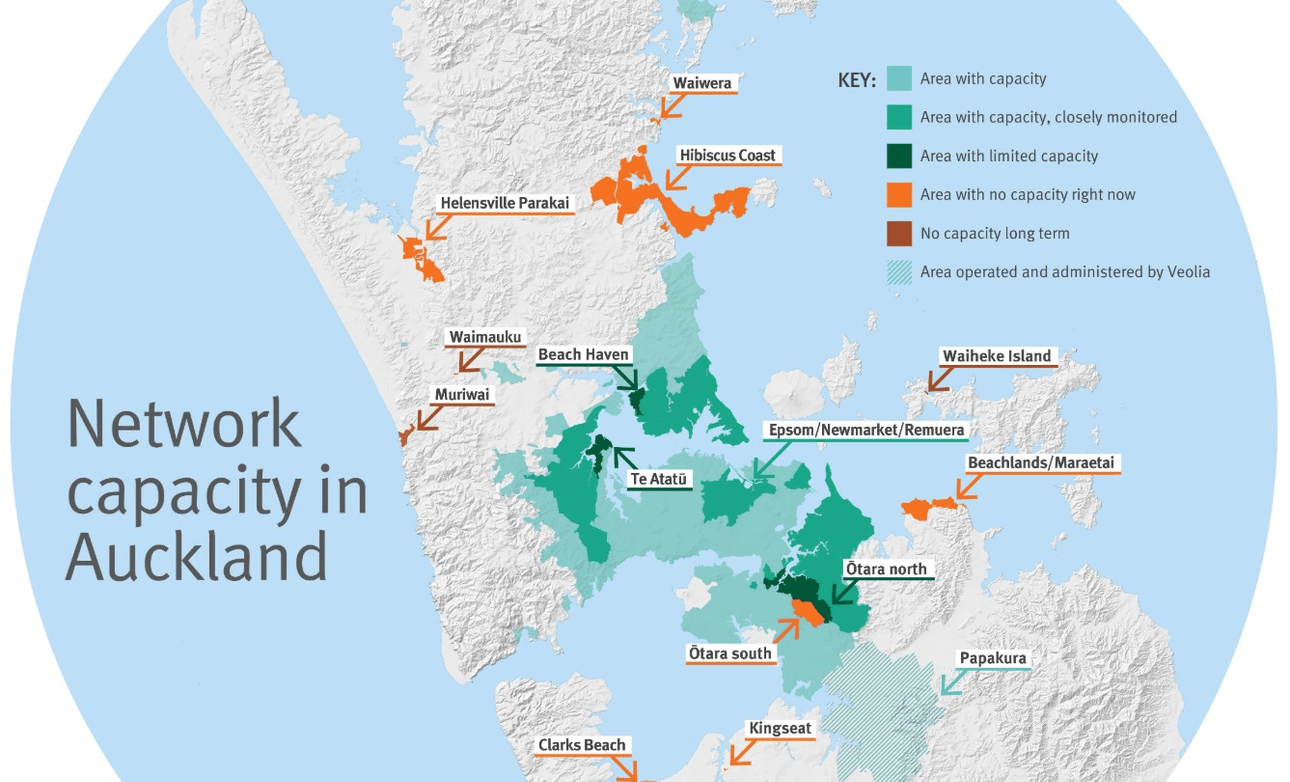
Yesterday the worriers got their wish. Thanks to a government backdown wrangled over chardonnays and summer barbecues, councillors are allowed to reduce the capacity in the new plan from two million to 1.6 million houses. Council’s policy and planning committee was meeting to decide where to make those cuts, and its chair Richard Hills started out explaining the staff recommendations to prioritise places 10km or more from the city centre. Asked why those areas should get first dibs on downzoning, council planner John Duguid was clear: it was because the land within 10km of the city centre had the best access to public transport, employment opportunities, regional amenities like parks and pools and three waters capacity, as measured by Watercare:

Map of Auckland showing water network capacity. Areas are shaded by capacity: green (with capacity), teal (closely monitored), blue-green (limited capacity), orange (no capacity now/long-term), and labeled locations.
Three waters capacity in the central areas is set to improve even more when the Central Interceptor comes online soon. (Image: Watercare)

It should have been a celebration. But what would you know, most of the people who were once so concerned about ensuring housing is near infrastructure weren’t happy. Instead they were stewing over the revelation that the places with the best infrastructure were in their well-to-do wards. North Shore councillor John Gillon had looked at the maps and found that a 10km radius from the city centre would include the entire area he represents. He moved an amendment, seconded by Fletcher, to delete the 10km clause, saying he was “concerned” about the figure.

Waitākere councillor Shane Henderson was having none of it. He pointed out that west and south Auckland had accepted the vast bulk of the new houses in Auckland since the Unitary Plan passed in 2016. As for strain on infrastructure, those areas have limited pipe capacity and less access to public transport, and we see the effects of that outside-in planning in rush-hour congestion, parking shortages and sewage overflows, he said. Henderson argued Fletcher and Gillon were engaged in “a poorly dressed up move to take away intensification from the best-equipped parts of the city”. “The intention is simple: to downzone wealthy suburbs. There is no sensible reason for excluding central isthmus communities – again –  from doing their part.”

The mayor was, if anything, more blunt. He said Gillon’s motion was aimed at putting housing in Pukekohe rather than areas close to “all the infrastructure”. “I don’t want to see endless sprawl just so nimbys in Parnell and politicians can get re-elected,” he said, in what appeared to be a shot at his political nemesis, Act leader David Seymour. “That’s disgraceful, I can’t vote for it.” ...

As Brown saw it, his colleagues’ first purpose was elitism. But if they had a second priority, it was delay. Gillon and Fletcher also put forward an amendment proposing to ask the government for more time to enact Plan Change 120. ...

The demand was familiar. Fletcher has asked for more consultation in just about every planning meeting for years, and the mayor was incensed. “I want to get out of this without further delay and dithering,” he said. “God almighty, it would be great to do something this three-year period.” ...

“For fuck’s sake, get on with it,” he said, as Fletcher spoke for the final time. ...

Afterward, Brown expanded on his frustration with Fletcher, saying the meeting was “one long filibuster to stop poor people living in her area.” 

Read the whole thing here. It's an entertaining lunchtime read.

[Pics from Spinoff]

Tuesday, 3 March 2026

National is a party for business. For *specific* businesses.

"[S]ince we begin this week’s column at this beautiful [convention centre] let’s take a moment to remind ourselves how it was paid for...

"John Key wanted a convention centre. Since he couldn’t get a flag he needed something to show for his eight years in power. To induce SkyCity to build him a legacy, his government increased the number of permitted slot machines, extended their license, and gave the listed operator a regional monopoly until 2048.

"This is how National believe economics is done. Deals. Haggling. Concessions. Foreign visits and handshakes with oligarchs. National is not a party of free enterprise, it is the party of business."

Friday, 20 February 2026

"Everyone wants growth. But will ... they have the courage to upset vested interests on their own side?"

"The problem is that politics is not about good intentions, but trade-offs and results. Everyone wants growth. But will ... they have the courage to upset vested interests on their own side? The government still has promising changes in the pipeline on housing and infrastructure. But elsewhere? ...

"[H]ere’s [a] strategy, one advocated in a fascinating essay from 1989. The author opens by arguing that 'politicians tend, worldwide, to avoid structural reform until it is forced upon them by economic stagnation, a collapse of their currency or some other costly economic and social disaster. Politicians tend to close their minds as long as they can … because they believe that decisive action must inevitably bring political calamity upon their governments.'

"But the writer goes on to make precisely the opposite case: 'Political survival depends on making quality decisions; compromised policies lead to voter dissatisfaction; letting things drift is political suicide.'

"Voters, he argues, 'ultimately place a higher value on enhancing their medium-term prospects than on action that looks successful short-term but which sacrifices larger and more enduring future gains … There is a deep well of realism and common sense among the ordinary people of the community. They want politicians to have the guts and the vision to deliver sustainable gains in living standards.'

"Strategically, he also advises pursuing reform in 'quantum leaps' rather than small steps; 'otherwise the interest groups will have time to mobilise and drag you down.'

"The whole 35-page paper, 'The Politics of Structural Reform',' is worth reading, not least because so much strikes a chord today ('Inadequate politicians see instant popularity as the key to power. If their rating slips, they feel threatened. They look for policies with instant appeal to create continuous public bliss').

"But what is most striking is that the writer is a Labour politician: Roger Douglas, who, as minister of finance — equivalent to [the UK's] chancellor — led New Zealand through one of the most bruising periods of free-market reform in any nation’s history (a programme known as Rogernomics) and saw his party re-elected with an enhanced vote share at the end of it.

"Starmer’s Labour came to power by taking the opposite of Douglas’s advice. It told the public that spending would rise, growth would rise but taxes and borrowing would not. That no one would have to feel any pain. And when that turned out to be a lie, it got hammered for it.

"Wherever the government goes next, it is unlikely to be down a path of Douglas-esque, business-friendly radicalism. But I believe — I have to believe — that the public will still reward politicians who are honest about our country’s problems and visibly try their damnedest to fix them. Because if not, what hope have we got?"
~ Robert Colville from his London Times column 'https://archive.fo/E7HXi'

Tuesday, 9 December 2025

RMA Announcement: Live blogging

1:23pm
It starts badly.

“A core failure of the RMA was the absence of clear direction from central government,”
Mr Bishop says.

No. The core failure of the RMA is the complete absence of private property rights. It's starting position instead being: "You need our permission!"

This "reform" promises property rights, but it looks like it simply delivers more planning documents. And little more, if any, permission.

We're promised "fewer, faster plans"; "30-year regional spatial plans"; "nationally set policy direction"; and "planned national standards." So anyone who's ever said "the problem with this country is not enough planners" will be happy.

And what about property rights? “When you put property rights at the core and remove excessive government rules from people’s lives," says Mr Court, "the benefits will quickly follow." 

I'm still looking for how exactly property rights have been put at the core. I'll let you know when I find where he's put them ...

1:25pm

“The new planning system strengthens property rights and restores the freedom for New Zealanders to use their land in ways that affect nobody else." You keep saying that. Show me the evidence.

"Councils will be required to provide relief to property owners when imposing significant restrictions like heritage protections or significant natural areas." So apparently planners imposing restrictions still have more freedom to "use" your land than you do. Righto.

Not going well so far...

1:32pm

"More than 100 existing plans will be reduced to 17 regional combined plans that bring together spatial, land use and natural environment planning in one place, making it easier for New Zealanders to know what they can do with their property." That's not freedom for New Zealanders to use their land in ways that affect nobody else, is it Mr Bishop. That's the "freedom" to act under permission. 

So let me look at the specifics. I don't see "property rights" as a heading in the major release. So let me begin studying topic 'The New Planning System: Simplifying residential development ...

1:37pm
Blah, blah, "clear national priorities" woof, woof "land will be zoned" whitter, whitter "councils will have to ensure there’s enough land and infrastructure" wank, wank "regional spatial plans will guide future development "... It makes you wonder how anything ever got built here at all before town planning arrived here in 1928. 

<searching for "property rights" gives no hits in the document> <searching for "planning" gives me 18 hits>

1:46pm

"Certainty" is promised through "clear long-term spatial plans" telling investors what council planners will allow, and "front-loading decisions," whatever the hell that means. "This means clear rules and fewer surprises," says the boiler plate. Oh, and there'll be "A digital platform [that] will make it easier for you to access information, apply for consents, and track progress." That's nice, isn't it.

A key feature? "Standardised zones and overlays will make planning rules simpler and more consistent across the country." As if it makes a real difference whether there's 17 or 117 different zones and overlays telling you what you can't do. It hardly gives freedom for New Zealanders to use their land in ways that affect nobody else, does it.

"A new Planning Tribunal will offer you a low-cost way to resolve disputes, with limited council appeal rights." Possibly good, but there are still no details on this.

"Councils will also need to respond more quickly to private plan change requests, making it easier to unlock new areas for growth." Given the many problems with making councils respond quickly, how will this work? Given the cost of applying for a private plan change, how will this work?

1:59pm

The document says there will be "less need for consents." Why? is that because there's freedom for New Zealanders to use their land in ways that affect nobody else

No, it's because "councils will only be able to consider effects that have a minor, or more than minor impact on others or the environment." This, by the way, is precisely what the present "permissive" RMA allows. In other words, it's just the same.

It's also because, says the document, "design details that only affect the site itself, such as building layout, balconies or private views, won’t be regulated..." Except of course for the "guidance" supplied by several councils that tell you what they expect to see in your application. Oh, and "except in areas [which planners have decided enjoy] outstanding natural landscapes and heritage features." So much rurally where you want to build will still be policed to stop you fully enjoying your land; and many of the areas of our cities that were built before town planning came here will still be policed to keep them as museums. Nice.

So far I've yet to see much difference between the replacement and the original.

Let me look at the heading 'Making it easier to build and renovate your home' ...

2:13pm

Here's the promise: "The new planning system will support the Kiwi dream of improving your home or building a new one without unnecessary cost or delay." What's the reality?

"Standardised zones" blah, blah, as above.

"The public will only be notified about your project if the effects of it (the impacts like noise and shading) are more than minor." So, no different to current law then.

"Only people who are directly affected by a project can have a say." It's a lot of work to make this one small improvement.

"A new Planning Tribunal will be set up to help sort out disputes quickly and cheaply." Nice idea. But still no detail.

"You may be able to get ‘relief’, which means a form of support or compensation, if some planning controls or rules have a big impact on how you can use your land." I have a better idea, which would actually be core to protecting property rights. And it's this: outlaw every single planning control or rule that would have a big impact on how you can use your land. What about that?

This is all worse than a disappointment. Rather than a plethora of sackings of the unproductive, Bishop & Court instead propose to keep town planners hard at work. (Well, as hard as they ever get.) ...

2:32pm

Maybe I should have started with their "Overview" document instead of plunging into the details....

"Property rights" are mentioned seven times here, but only in the promises. "The new system is designed to unlock growth, reduce the costs of much-needed infrastructure, protect the environment and improve resilience – all while freeing up property rights so landowners have certainty and control over their land." That's a promise. Not a delivery.

The "expected outcomes" include "enhanced property rights through regulations that focus on only controlling impacts on the environment and other people." I'm surprised this is an "outcome" and not a guarantee. (And see above.)

"There will also be greater availability of relief," we are told, "if property rights are infringed." But here's the thing: the core is to make law that ensures property rights are not infringed.

"The proposed new system will make the enjoyment of property rights a guiding principle of reform," says the document, "so people can do more with their property." How? There are seven points under this heading including narrowing effects, simpler national rules, new national standards, binding environmental limits, better digital systems, and one Plan per region.

Not one of these seven, not one, gives any guarantee at all of protecting the enjoyment of property rights. I don't want one District Plan per region, I want none. I don't want simpler national rules, standards or limits set by planners, I want none at all, and I want the planners who write them unemployed. This idea of making the enjoyment of property rights a guiding principle of reform is less a guiding principle here than an incantation that, repeated often enough, will allow those sufficiently deluded to be convinced.

But it's not real.

The Bills promise "a fairer system for allocating resources," without defining whose those resources are, why a planner is entitled to allocate them, then admits that it will simply retain the RMA's approach to "allocation" anyway.

This is almost farcical.

The two new replacement Bills do promise "greater clarity and certainty," "clearer direction to decision-makers," and "mak[ing] the system more consistent and predictable." That's two of the four good things that objective law should do. (Protecting rights being the major one, of course, without which....) Big question still is: How?

"The Planning Bill and Natural Environment Bill will each have a clear purpose statement that describes what the Bill does." Without seeing the Bill yet, that's just another promise not a delivery.

3:03pm

Am I being too pessimistic? Well, politicians have promised to "fix" this fucking thing for thirty years, and haven't. More than a generation.  They've pledged to "fix," "fudge," "reform," repair," "enhance," and at most they've made changes to make it easier for governments to build. So every promise to date has been bullshit, and this change will likely be the last chance in my lifetime for any genuine change.  To actually have property rights protected in law. And it doesn't look promising.

Tell me I'm wrong. Please.

xxx:00pm

Not much comment in the Twittersphere, which is perhaps a measure of how little interest there is? A few quips that might have legs. Worth pondering ...


It's possible that this last is the only real nod towards property rights—unfortunate really, since 'compensation for takings' is not by any means the same thing as protecting property rights, despite what some people still think.

9:31am:

Twenty hours after the announcement, ACT's Simon Court (said to be ACT's Under-Secretary for Resource Management Reform and praised by his leader as having "driven the change at a detailed level and his contribution is enormous") is barely anywhere to be seen. No press releases on the ACT website cheering about it. No tweets posting about it.  Just two patsy questions to the Minister, two five-minute speeches to the House about infrastructure and transitions, and a three-minute stand-up with his leader.

Is he embarrassed?

One step forwards, three steps back.

"Oops." Luxon-led policy-making takes a tumble

It's a rule in politics. The devils is not always in the details. It's often that the details reveal the real devilry.

If the large print ever giveth, then the small print will surely taketh away.

Let's look at a few examples in an area I know something about: Building.

*** Building Minister Chris Penk seems a jovial character but unfortunately he knows little about his subject area. His first move was to promise faster building consents. Exciting. Encouraging. Mighty work.

Here's hist first step: "requiring councils to submit data for building consent and code compliance certificates every quarter." There are no other steps.

He adds "hope" to the idea of anything being faster. Council inspectors "must" issue building consents in a timely fashion, he insisted.  And yet every council inspector ever employed knows how to legally delay a consent application. In fact, if you fine a council for being legally overtime, they'll just legally delay applications for even longer to give themselves some head room. Which is what they've done.

Score One for the Grey Ones.

*** Another move by Building Minister Penk was "remove barriers to overseas building products." At least, that's what it said in the headline. His idea, sensible enogh on its face, is that if enough similar jurisdictions to ours have passed a product (places like Canada, US, UK, Europe, Australia etc.) then that product would be deemed to pass here too.

Yay? No, not so fast.

First move by the Ministry who oversees these things was to rent several new floors in Wellington.  Because their idea of this (and it is they who are running it) is to set up a committee who will consider, one at a time, every morsel of regulation passed anywhere at any time to decide of we might be so lucky to have it here

So far, in the three months since introduction, they'e okayed some taps from Sydney. Next year, they might look at concrete codes in the US. Done properly, with due consideration, this will take most committee members through to retirement.

Score One More for the Grey Ones. 

** And then the Minister for Regulatory Reform (sic) stepped up to announce a new measure to "liberate" builders and designers. For years, some of us have suggested that instead of applying to councils for permission to build (which asks for more knowledge than council employees really have, and puts ratepayers on the hook for the risk should they fail) we instead use insurance companies to take the risk.

You know, like if you build a hot rod or street racer instead of a bog standard car, then you ask the insurance company to take the risk, and they use their acumen to discern the risk, and charge you accordingly.  

This allows for good design, with risk properly underwritten. 

But you see that word above: instead.

Rather than placing the risk and the onus on designers and builders and insurers instead of on councils and ratepayers, the Minister for Regulatory Reform is doing this as well as. So it's no more "liberation day" than were Trump's tariffs: we end up getting the worst of both worlds: councils assessing risk, and insurers granted a monopoly charging like wounded bulls. And the ratepayers? Still on the hook.

So it's Several More there for the Grey Ones.

** It's like education, where a "regulatory review" by the same Minister for Regulatory Reform intends to "clarify" and "simplify" Childhood Education's overwhelmed sector. One imagines a quick fix might be going back to say, 1996, when things were working tolerably well, and just before regulations began piling on and classrooms and centres became over-regulated, under-performing, and wholly unaffordable for parents.

Instead, the "reform" begins by (and I quote) "establishing a new statutory role, the Director of Regulation, with responsibilities for performing key regulatory functions in the Early Childhood Education system." Which means another red carpet rolled out in yet another floor of a new office building in Wellington.

Back of the Net with another great effort by the Grey Ones.

*** It's a bit like the "cap" on rate rises. 

Let's stop rate rises!! Yay!! Well, not so fast. 

We know that the "cap" will be supplemented for weepy boomers with top-ups for water use, for mayors who plead public transport debts, and councillors who claim infrastructure shortfalls. We also know that the minister "responsible" ( I use the world loosely) is happy with "soaring" council debt, just as long as the effects and the headlines are only felt after he's gone.

Not to mention that the "cap" includes a minimum rate rise as well!

Yes, a minimum. By law, councils must increase rates by at least 2% every year.

It a sop, not a cap.

Grey Ones score again.

** And not to mention that the new-fangled means by which councils can "fix" their bloody awful traffic problems—traffic jams being a clash of capitalism (in the form of car production) confronting socialism (in the form of too few roads). The "new" solution is a tax. A new tax to be called "congestion charging," which will of course not replace any other tax but just be added to all those under which we are already burdened.

And if history is any guide, may help finish off Auckland's CBD altogether.

I'm pretty sure that's a total victory for Grey.
 With this government, as with every other in recent times, it's always one step forwards, and three steps back. Too many ministers with too little nous giving too much help to the unproductive to whom too many of us must seek permission before we can do anything.

I look forward to this afternoon with trepidation.

Tuesday, 2 December 2025

Austerity, what austerity?


"You may have heard a lot of stories about austerity. Consider that both the government and the opposition may want to convey the impression that it has happened, despite it very much not having happened.

"Throughout the 2010s (barring #eqnz), per capita real operating expenditure net of interest expenses ranged from $17,143 to $18,653 - with 2019's jump to $18,653 being well out of line with the prior track. Labour substantially increased spending under its wellbeing focus ...

"Per capita real operating expenditure net of finance cost has been above $21,000 since then; the provisional figure for 2025 is $21,648. ...

"The largest-spend category here by far is social protection [sic]: benefits and superannuation. ...
"Any giant shedding of government staff will show up in General Public Services. The austerity really stands out in this picture. Can't you see it too? ..."


~ Eric Crampton from his post 'The state of the books'

Monday, 1 December 2025

Regional shambles

"Let’s be clear: regional councils deserve to be sent off with a pat on the back and a firm shove. They’ve become expensive holding pens for consultants, issuing bylaws no one asked for, and running consultations no one understands. Water quality down, rates up, and when something goes wrong, they blame climate change and hand out a glossy brochure.

"But what we’re being sold as the solution (this idea of a 'mayoral body' running the show) is not a solution. It’s a camel designed by a committee of camels. It takes the worst aspects of regional councils and fuses them with a structural contradiction that will blow up the first time anything controversial hits the table. ...

"In the name of reform, we’re being handed a muddle. No ultimate authority. No single accountable figure. Just a table full of mayors all claiming to be regional leaders while keeping one eye on the local Facebook page and the other on next year’s campaign posters.

"It’s not just bad governance. It’s impossible governance."

~ Zoran Rakovic from his post 'From Council to Circus: Mayors in a Regional Tent'

Wednesday, 12 November 2025

Have political parties begun to get some rat cunning into how to best manipulate MMP to their advantage? [updated]

I don't want to be conspiratorial here .... but could it be that major political parties have begun to get some rat cunning into how to best manipulate MMP to their advantage.

Both Labour and National may have finally recognised that their odds of winning a full majority in an MMP election are about as likely as Winston Peters agreeing to selling off state assets. So is that why Luxon expressed mild but undefined interest this week in doing just that? Was it to give a hoped-for future coalition party a prop upon which to launch next year's election campaign?

It seems as likely a notion as that Labour and the Māori Party have recognised the huge advantage for them both to be gained by the 'overhang' that happens when a party has more electorate MPs than can be justified by their party vote—so they've done their best to bust their party vote while simultaneously raising the profile of those electorate MPs.

That's a risky game to play, of course, but there's no real risk to Labour. Is that why Willie Jackson is walking around looking so pleased with himself.

UPDATE: I hate to say I told you so. Here's Tākuta Ferris pontificating:

Here’s the truth under MMP:
   When Labour wins Māori seats, it does not create the political leverage of a OVERHANG! It simply reduces the number of MPs they bring in from their party vote. And in doing so, it hands the keys to the Beehive straight back to Luxon, Seymour and Winston.
   The only guaranteed mechanism that increases the potential to actually change who governs is an OVERHANG! Created when independent Māori MPs win electorate seats.

The "principals' revolt" is "a small group of people…making a lot of noise"

"The release of draft primary and intermediate school curriculums prompted 'a revolt' by the Principals Federation. ...

"But today a Christchurch principal is reported to be vigorously defending the changes to the curriculum” [including t
he Government’s intention to remove requirements for school boards to give effect the Treaty of Waitangi] saying many in the profession are supportive. ... and opponents are 'a small group of people…making a lot of noise' ... 
"Education Minister Erica Stanford says of the requirement [for school boards to give effect the Treaty of Waitangi]— introduced in 2020 —'it certainly didn’t make any difference' to student achievement. ... But the reaction was predictable ...
"[This blog] would like to know: In what ways has school governance been enhanced since 2020? And what have been the positive consequences for the performance and achievements of students?"

Tuesday, 21 October 2025

"My strong preference is to disestablish the Broadcasting Standards Authority..."

"Early this year the Ministry of Culture and Heritage issued a discussion paper on media which included a statement to the effect that as the Broadcasting Act 1989 did not cover internet radio like entities such as The Platform, the Broadcasting Standards Authority’s scope should be extended to them. ...

"Instead of waiting for the government to decide on whether to proceed down this route the Broadcasting Standards Authority decided existing law did give them jurisdiction over The Platform and presumably Reality Check Radio. This is extraordinary.

"One might have thought [Media + Communications] Minister Goldsmith would have said that, as we do not believe it has that authority, it should await a government decision. But no ... he told RNZ’s Media Watch programme: ... 'I’m happy to let that flow through the system and see how it goes.'

"I hope the Minister will regret these words because they won’t be career enhancing. ...

"My strong preference is to disestablish the Broadcasting Standards Authority and allow all media entities to decide whether or not to come under a voluntary entity such as the NZ Media Council ...

"ACT and NZ First have laid out their positions. Is it too much to hope the National Party will end its dismal 80 year record and do the right thing? Or will it be more muddle through?"

~ Barry Saunders from his post 'The BSA power grab: Post 2' [His 'Post 1' is here]

"New Zealand's unique welfare problem isn't disability or unemployment. ... It is the high rate of sole parenthood"

"New Zealand's unique welfare problem isn't disability or unemployment. ... It is the high rate of sole parenthood that sets us apart. ...

"The worst child abuse, neglect, deprivation, transience, non-preparedness for school, and later, absenteeism comes from fatherless families. These children spill through to non-achievement, gang membership, criminality and lives lost to prison and non-rehabilitation.

"Yes ... plenty of children survive. But compared to children from working, two parent families, their odds of success are heavily reduced.

"Minister for Social Development from 2008, Paula Bennett drove through some reforms. She actually got rid of the DPB. But then replaced it with the Sole Parent Payment. ... 2023 census data told us 70 percent of sole parents with dependent children receive welfare. By September 2024... there were 102,693. ...

"The number in September 2025 reached 234,000. With seasonal fluctuations the total could reach a quarter million by December.

"This country's propensity to put a soft-focus on hard problems is not working."
~ Lindsay Mitchell from her post 'National's problem epitomised'


Monday, 20 October 2025

"The Broadcasting Standards Authority is a creature from the past which should not exist in a free and democratic society."


"In 1966 there was a watershed event. A National government, under Prime Minister Keith Holyoake, tried to stifle nascent private radio [by barring broadcasting by then pirate-radio Radio Hauraki]. It failed: the government monopoly was broken.

"The present National government can atone for its 1966 sin against freedom by joining its coalition partners to overcome the attempt by the Broadcasting Standards Authority to impose censorship on [Sean Plunket's] The Platform, an online media outlet. ...

"Today, a new type of freedom, the freedom to exchange information online without government censorship, is under challenge from a government agency. ... [T]his could be another watershed moment. National should join with ACT and New Zealand First, to abolish the Broadcasting Standards Authority. It is a creature from the past which should not exist in a free and democratic society.

"The Broadcasting Standards Authority’s actions have called public attention to the insidious role of the administrative state, the significant power of government agencies to write, interpret, and enforce their own regulations. Creative interpretation is little different to writing the regulations.

"Perhaps the Broadcasting Standards Authority has performed a service by demonstrating not only that it should be abolished, but also why other government agencies with similar powers should either be abolished or have their powers severely curtailed to restore democratic accountability."