Showing posts with label Politics-ACT. Show all posts

Tuesday, 12 May 2026

Judith Collins's legacy: image over reality.

A career summarised: no ideas, no direction, no success -- and not one car crushed

What does a career in politics achieve? 

This afternoon Judith Collins will give her valedictory speech in Parliament. Journalists call her career "colourful." They call her "Crusher." Let's review what she's done there over the years.

  • she was one of 23 MPs who rented their home to themselves at taxpayers' expense
  • she was always ready to give the trough a decent nudge -- costing us in 2023 more than $24,200, made up of more than $6000 for accommodation and just over $18,000 on travel (a massive saving for us from 2009 when her limos and international travel were costing us nearly $200,000)
  • need we mention using her position to help the export business for which her husband was a director?
  • brought down for the first time (of many) by her own Entitle-itis, one wag suggested 'Trougher' Collins would be a better nick than 'Crusher'
  • as Police Minister she continued to ensure that gangs could make decent profits on illegal drugs, while also ensuring police focus more on revenue-gathering than resolving real crimes (cementing an image as tough but crushingly ignorant)
  • as the #DirtyPolitics saga did reveal, she maintained a disinterest in ideas, and a consequent obsession with scandals and (ineffectivedirty tricks
  • and as Police Minister (her only real job) what did she actually do beyond asset confiscation; suspension of your right to silence; and expanded search and surveillance powers for an extraordinary range of government departments
  • apart from, of course, bringing in pathetic new laws to "crush" cars instead of simply applying laws already on the books -- the main goal of which "seems to be the generation of positive media coverage for Judith Collins"
  • as opposition MP in 2007 she stood up on the steps of Parliament to swear total opposition to the anti-smacking amendment; and then one month later filed obediently into the lobbies to vote for it
  • in any competition between real action or spin, it was almost always spin she favoured -- even if it made us less safe
  • as Opposition MP in 2005 and desperate to be noticed, she did point out that the Labour Government's Working for Families package is an election bribe paid being paid for with voters' own money -- and then as government MP and minister continued to administer the bribe
  • keeping alive the tradition of promising and reneging, Collins was happy to be photographed firing a pistol to court the gun lobby (posting one on her own Facebook page in case you missed it); before  being the only National MP to support banning semi-automatic weapons for civilian purposes, and to boast about it
  • as Corrections Minister she drove the reintroduction of private prisons -- for the actual privatisation of force, an unconscionable mixing of the dollar and the gun, with all the temptation to corruption and abuse that goes with it
  • as Opposition Leader, Collins did promise the National Party would reverse any attempts by the Ardern government to criminalise speech beyond the threshold of "inciting violence," and warned against ending up with "UK-style hate speech legislation that has ended up with people being criminalised and even imprisoned for foolish and silly comments." All good, except that as (In)Justice Minister she had already drawn up much the same thing under her Harmful Digital Communications Act which hit us in 2015
  • as Police Minister in 2016 she did correctly observe that the primary welfare problem to solve is not a poverty of money, the premise behind Labour's Working for Families programme, but "a poverty of ideas, a poverty of parental responsibility, a poverty of love, a poverty of caring. ... it is not just a lack of money, it is primarily a lack of responsibility." And then sat back as her Government and Party kept the policy, and did nothing to arrest the real poverty she'd identified
  • And just to be clear: 'Crusher Collins never even crushed one car. Not one. (Only three cars in total were crushed under her legislation, all of which were after she was moved on from the job.) Which could be her real legacy: one of image over reality.
On the credit side, 
  • she did, as opposition MP, do a mini-Rosa Parks in walking out when women were refused permission to powhiri except from the back of the room
  • she did, as leader, once proclaim National to believe in property rights (despite it being National who introduced the property-rights-destroying RMA) and did accurately point out that the ACT Party did not, saying "there they are arguing for more planners doing more planning rather than actually letting people get on with building their houses"
  • she did, as leader of that same National Party, lead it to its second-worst-ever election defeat in 2020, with a 19% swing against
  • she was one of the two National MPs who signed up to the bi-partisan accord on housing that helped lower rents and begin the blessed fall in over-priced house prices -- and then disgracefully remained silent has her new boss kicked it into touch, delaying real housing reform now for nearly four years.
Judith Collins arrived in Parliament after a decade in law and (govt-appointed) directorships as a young, fresh-faced MP in 2002, eager to solve the country's problems and to advance her own career. Without any ideas to guide her however she did nothing to solve anything, helped expand the role of government, and spent a life in service to the trough.

So, more exposure than most, but in the end no different to any of the other highly-paid beneficiaries there, really.

And now she's off to another taxpaid trough at the Law Commission ...
Collins in 2002: all promise, no substance
NB: Ele Ludemann posts a contrary assessment ...

Wednesday, 29 April 2026

"Chris Bishop’s primary responsibility is reforming the RMA. ... The bureaucratic class has magnificently undermined his agenda."

"[Chris] Bishop’s primary responsibility, other than completing Steven Joyce’s highway from Warkworth to Whangarei, is reforming the RMA. ... [G]iven how central the reform of the Resource Management Act has been to this government, it defies comprehension that National didn't arrive with a draft ready to go. ...

"The excellent folk at the NZ Initiative have done an analysis of the two proposed [replacement] laws [which eventually emerged]: the Natural Environment and the Planning Bills. Nick Clark, the researcher, concluded, '...in the translation from principles to legislative text, something has gone wrong. Key elements have been weakened, complexity has crept back in, and an extraordinary amount of the systems' substance has been deferred to secondary instruments that do not yet exist.' ...

"The desire to place property rights at the heart of the legislation has been superseded by placing mana whenua into their customary central role in managing the land. ...

"[Also, i]f passed, these bills will not be the final word. That will be left to ‘secondary legislation’, or regulation; binding rules made by the minister of the day that determine how the law is to be applied. The proposal is for parliament to delegate its authority to the executive with minimal oversight. This time next year, Minister Swarbrick could use this secondary legislation to mandate her own vision into reality.

"Did we vote for that? ...

"[T]he bureaucratic class ... has magnificently undermined his agenda. This should have been self-evident thirty months ago ... "

Friday, 13 March 2026

"One long filibuster to keep poor people out of her area"

This is an amusing account below of an important public meeting. Important in the context of making Auckland an affordable city.

Here's some quick context: Auckland's town planners have strangled the city in red tape for years. In recent times however, many planners and councillors (and mayor Wayne Brown) have come around to the realisation that the fewer houses built, the higher the prices for those houses: that, just maybe, people might be allowed to do a bit more on their land, to maybe build a little more densely. 

Opposing this, of course, are the councillors and politicians of the leafier suburbs like Christine Fletcher -- and of course David Seymour, who's dropped his party's alleged principles about property rights to wring his hands instead about there being 'no density without infrastructure.' 

There's no greater hand wringer than Christopher Luxon however, who decided over summer that Auckland Council must 'downzone' their proposed plan change that would allow greater density.

So this meeting Wednesday night was to confirm where the push for greater density would be maintained in the upcoming Plan (where would be upzoned), and where that push would be relaxed a little (where would be downzoned). 

And with that introduction, here's Hayden Donnell ...

When the government’s efforts to intensify Auckland were debated at council back in August last year, critics took turns wringing their hands about the strain it would place on infrastructure. Plan Change 120 [which will allow greater density] could end up putting apartments in places that weren’t set up to handle them, they fretted. “Ultimately you can’t do all this upzoning without making the commitment to provide the infrastructure that will support it,” warned Albert-Eden-Puketāpapa ward councillor Christine Fletcher ...

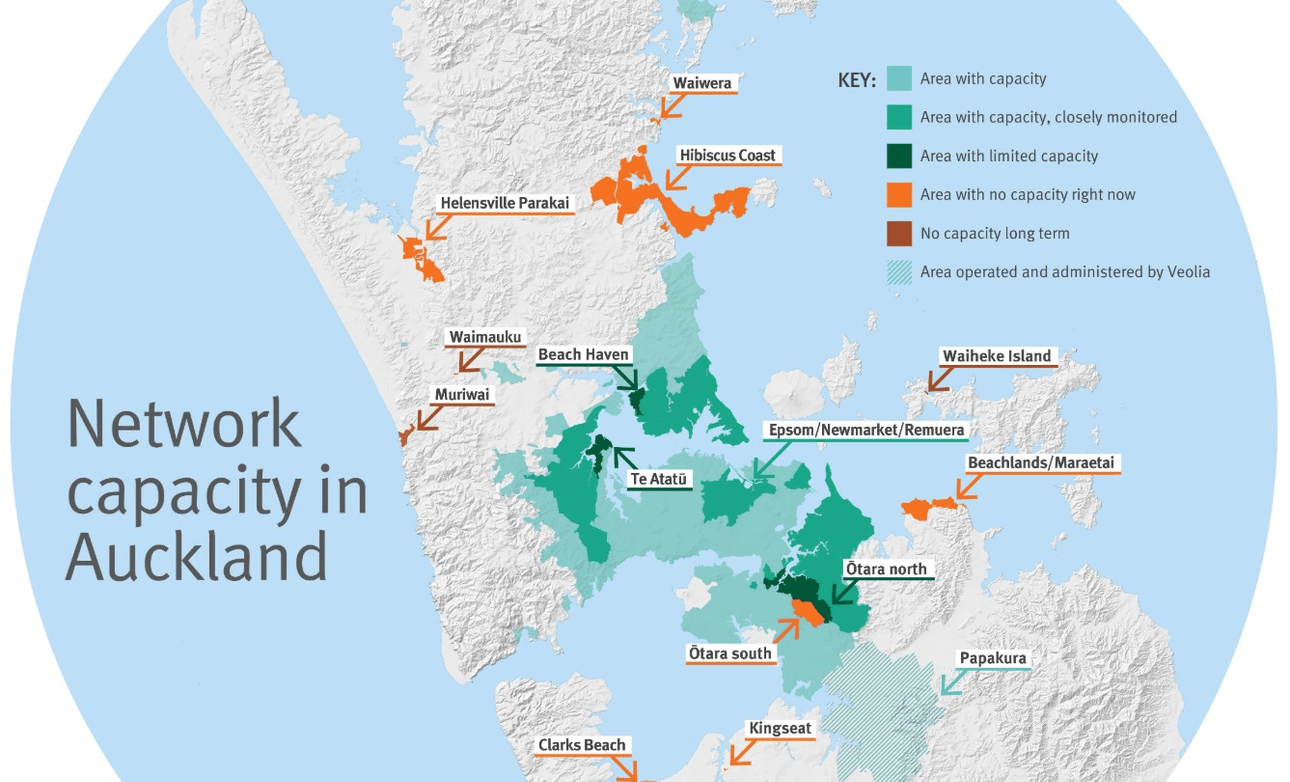
Yesterday the worriers got their wish. Thanks to a government backdown wrangled over chardonnays and summer barbecues, councillors are allowed to reduce the capacity in the new plan from two million to 1.6 million houses. Council’s policy and planning committee was meeting to decide where to make those cuts, and its chair Richard Hills started out explaining the staff recommendations to prioritise places 10km or more from the city centre. Asked why those areas should get first dibs on downzoning, council planner John Duguid was clear: it was because the land within 10km of the city centre had the best access to public transport, employment opportunities, regional amenities like parks and pools and three waters capacity, as measured by Watercare:

Map of Auckland showing water network capacity. Areas are shaded by capacity: green (with capacity), teal (closely monitored), blue-green (limited capacity), orange (no capacity now/long-term), and labeled locations.
Three waters capacity in the central areas is set to improve even more when the Central Interceptor comes online soon. (Image: Watercare)

It should have been a celebration. But what would you know, most of the people who were once so concerned about ensuring housing is near infrastructure weren’t happy. Instead they were stewing over the revelation that the places with the best infrastructure were in their well-to-do wards. North Shore councillor John Gillon had looked at the maps and found that a 10km radius from the city centre would include the entire area he represents. He moved an amendment, seconded by Fletcher, to delete the 10km clause, saying he was “concerned” about the figure.

Waitākere councillor Shane Henderson was having none of it. He pointed out that west and south Auckland had accepted the vast bulk of the new houses in Auckland since the Unitary Plan passed in 2016. As for strain on infrastructure, those areas have limited pipe capacity and less access to public transport, and we see the effects of that outside-in planning in rush-hour congestion, parking shortages and sewage overflows, he said. Henderson argued Fletcher and Gillon were engaged in “a poorly dressed up move to take away intensification from the best-equipped parts of the city”. “The intention is simple: to downzone wealthy suburbs. There is no sensible reason for excluding central isthmus communities – again –  from doing their part.”

The mayor was, if anything, more blunt. He said Gillon’s motion was aimed at putting housing in Pukekohe rather than areas close to “all the infrastructure”. “I don’t want to see endless sprawl just so nimbys in Parnell and politicians can get re-elected,” he said, in what appeared to be a shot at his political nemesis, Act leader David Seymour. “That’s disgraceful, I can’t vote for it.” ...

As Brown saw it, his colleagues’ first purpose was elitism. But if they had a second priority, it was delay. Gillon and Fletcher also put forward an amendment proposing to ask the government for more time to enact Plan Change 120. ...

The demand was familiar. Fletcher has asked for more consultation in just about every planning meeting for years, and the mayor was incensed. “I want to get out of this without further delay and dithering,” he said. “God almighty, it would be great to do something this three-year period.” ...

“For fuck’s sake, get on with it,” he said, as Fletcher spoke for the final time. ...

Afterward, Brown expanded on his frustration with Fletcher, saying the meeting was “one long filibuster to stop poor people living in her area.” 

Read the whole thing here. It's an entertaining lunchtime read.

[Pics from Spinoff]

Wednesday, 28 January 2026

The Minister for Epsom speaks

...
...
 

 "Depressing to see ACT—once upon a time at least ostensibly a pro-market party—apparently opposed to freeing up land use, and enabling urban land prices to fall a lot."

    ~ Michael Reddell

Tuesday, 9 December 2025

RMA Announcement: Live blogging

1:23pm
It starts badly.

“A core failure of the RMA was the absence of clear direction from central government,”
Mr Bishop says.

No. The core failure of the RMA is the complete absence of private property rights. It's starting position instead being: "You need our permission!"

This "reform" promises property rights, but it looks like it simply delivers more planning documents. And little more, if any, permission.

We're promised "fewer, faster plans"; "30-year regional spatial plans"; "nationally set policy direction"; and "planned national standards." So anyone who's ever said "the problem with this country is not enough planners" will be happy.

And what about property rights? “When you put property rights at the core and remove excessive government rules from people’s lives," says Mr Court, "the benefits will quickly follow." 

I'm still looking for how exactly property rights have been put at the core. I'll let you know when I find where he's put them ...

1:25pm

“The new planning system strengthens property rights and restores the freedom for New Zealanders to use their land in ways that affect nobody else." You keep saying that. Show me the evidence.

"Councils will be required to provide relief to property owners when imposing significant restrictions like heritage protections or significant natural areas." So apparently planners imposing restrictions still have more freedom to "use" your land than you do. Righto.

Not going well so far...

1:32pm

"More than 100 existing plans will be reduced to 17 regional combined plans that bring together spatial, land use and natural environment planning in one place, making it easier for New Zealanders to know what they can do with their property." That's not freedom for New Zealanders to use their land in ways that affect nobody else, is it Mr Bishop. That's the "freedom" to act under permission. 

So let me look at the specifics. I don't see "property rights" as a heading in the major release. So let me begin studying topic 'The New Planning System: Simplifying residential development ...

1:37pm
Blah, blah, "clear national priorities" woof, woof "land will be zoned" whitter, whitter "councils will have to ensure there’s enough land and infrastructure" wank, wank "regional spatial plans will guide future development "... It makes you wonder how anything ever got built here at all before town planning arrived here in 1928. 

<searching for "property rights" gives no hits in the document> <searching for "planning" gives me 18 hits>

1:46pm

"Certainty" is promised through "clear long-term spatial plans" telling investors what council planners will allow, and "front-loading decisions," whatever the hell that means. "This means clear rules and fewer surprises," says the boiler plate. Oh, and there'll be "A digital platform [that] will make it easier for you to access information, apply for consents, and track progress." That's nice, isn't it.

A key feature? "Standardised zones and overlays will make planning rules simpler and more consistent across the country." As if it makes a real difference whether there's 17 or 117 different zones and overlays telling you what you can't do. It hardly gives freedom for New Zealanders to use their land in ways that affect nobody else, does it.

"A new Planning Tribunal will offer you a low-cost way to resolve disputes, with limited council appeal rights." Possibly good, but there are still no details on this.

"Councils will also need to respond more quickly to private plan change requests, making it easier to unlock new areas for growth." Given the many problems with making councils respond quickly, how will this work? Given the cost of applying for a private plan change, how will this work?

1:59pm

The document says there will be "less need for consents." Why? is that because there's freedom for New Zealanders to use their land in ways that affect nobody else

No, it's because "councils will only be able to consider effects that have a minor, or more than minor impact on others or the environment." This, by the way, is precisely what the present "permissive" RMA allows. In other words, it's just the same.

It's also because, says the document, "design details that only affect the site itself, such as building layout, balconies or private views, won’t be regulated..." Except of course for the "guidance" supplied by several councils that tell you what they expect to see in your application. Oh, and "except in areas [which planners have decided enjoy] outstanding natural landscapes and heritage features." So much rurally where you want to build will still be policed to stop you fully enjoying your land; and many of the areas of our cities that were built before town planning came here will still be policed to keep them as museums. Nice.

So far I've yet to see much difference between the replacement and the original.

Let me look at the heading 'Making it easier to build and renovate your home' ...

2:13pm

Here's the promise: "The new planning system will support the Kiwi dream of improving your home or building a new one without unnecessary cost or delay." What's the reality?

"Standardised zones" blah, blah, as above.

"The public will only be notified about your project if the effects of it (the impacts like noise and shading) are more than minor." So, no different to current law then.

"Only people who are directly affected by a project can have a say." It's a lot of work to make this one small improvement.

"A new Planning Tribunal will be set up to help sort out disputes quickly and cheaply." Nice idea. But still no detail.

"You may be able to get ‘relief’, which means a form of support or compensation, if some planning controls or rules have a big impact on how you can use your land." I have a better idea, which would actually be core to protecting property rights. And it's this: outlaw every single planning control or rule that would have a big impact on how you can use your land. What about that?

This is all worse than a disappointment. Rather than a plethora of sackings of the unproductive, Bishop & Court instead propose to keep town planners hard at work. (Well, as hard as they ever get.) ...

2:32pm

Maybe I should have started with their "Overview" document instead of plunging into the details....

"Property rights" are mentioned seven times here, but only in the promises. "The new system is designed to unlock growth, reduce the costs of much-needed infrastructure, protect the environment and improve resilience – all while freeing up property rights so landowners have certainty and control over their land." That's a promise. Not a delivery.

The "expected outcomes" include "enhanced property rights through regulations that focus on only controlling impacts on the environment and other people." I'm surprised this is an "outcome" and not a guarantee. (And see above.)

"There will also be greater availability of relief," we are told, "if property rights are infringed." But here's the thing: the core is to make law that ensures property rights are not infringed.

"The proposed new system will make the enjoyment of property rights a guiding principle of reform," says the document, "so people can do more with their property." How? There are seven points under this heading including narrowing effects, simpler national rules, new national standards, binding environmental limits, better digital systems, and one Plan per region.

Not one of these seven, not one, gives any guarantee at all of protecting the enjoyment of property rights. I don't want one District Plan per region, I want none. I don't want simpler national rules, standards or limits set by planners, I want none at all, and I want the planners who write them unemployed. This idea of making the enjoyment of property rights a guiding principle of reform is less a guiding principle here than an incantation that, repeated often enough, will allow those sufficiently deluded to be convinced.

But it's not real.

The Bills promise "a fairer system for allocating resources," without defining whose those resources are, why a planner is entitled to allocate them, then admits that it will simply retain the RMA's approach to "allocation" anyway.

This is almost farcical.

The two new replacement Bills do promise "greater clarity and certainty," "clearer direction to decision-makers," and "mak[ing] the system more consistent and predictable." That's two of the four good things that objective law should do. (Protecting rights being the major one, of course, without which....) Big question still is: How?

"The Planning Bill and Natural Environment Bill will each have a clear purpose statement that describes what the Bill does." Without seeing the Bill yet, that's just another promise not a delivery.

3:03pm

Am I being too pessimistic? Well, politicians have promised to "fix" this fucking thing for thirty years, and haven't. More than a generation.  They've pledged to "fix," "fudge," "reform," repair," "enhance," and at most they've made changes to make it easier for governments to build. So every promise to date has been bullshit, and this change will likely be the last chance in my lifetime for any genuine change.  To actually have property rights protected in law. And it doesn't look promising.

Tell me I'm wrong. Please.

xxx:00pm

Not much comment in the Twittersphere, which is perhaps a measure of how little interest there is? A few quips that might have legs. Worth pondering ...


It's possible that this last is the only real nod towards property rights—unfortunate really, since 'compensation for takings' is not by any means the same thing as protecting property rights, despite what some people still think.

9:31am:

Twenty hours after the announcement, ACT's Simon Court (said to be ACT's Under-Secretary for Resource Management Reform and praised by his leader as having "driven the change at a detailed level and his contribution is enormous") is barely anywhere to be seen. No press releases on the ACT website cheering about it. No tweets posting about it.  Just two patsy questions to the Minister, two five-minute speeches to the House about infrastructure and transitions, and a three-minute stand-up with his leader.

Is he embarrassed?

One step forwards, three steps back.

"Oops." Luxon-led policy-making takes a tumble

It's a rule in politics. The devils is not always in the details. It's often that the details reveal the real devilry.

If the large print ever giveth, then the small print will surely taketh away.

Let's look at a few examples in an area I know something about: Building.

*** Building Minister Chris Penk seems a jovial character but unfortunately he knows little about his subject area. His first move was to promise faster building consents. Exciting. Encouraging. Mighty work.

Here's hist first step: "requiring councils to submit data for building consent and code compliance certificates every quarter." There are no other steps.

He adds "hope" to the idea of anything being faster. Council inspectors "must" issue building consents in a timely fashion, he insisted.  And yet every council inspector ever employed knows how to legally delay a consent application. In fact, if you fine a council for being legally overtime, they'll just legally delay applications for even longer to give themselves some head room. Which is what they've done.

Score One for the Grey Ones.

*** Another move by Building Minister Penk was "remove barriers to overseas building products." At least, that's what it said in the headline. His idea, sensible enogh on its face, is that if enough similar jurisdictions to ours have passed a product (places like Canada, US, UK, Europe, Australia etc.) then that product would be deemed to pass here too.

Yay? No, not so fast.

First move by the Ministry who oversees these things was to rent several new floors in Wellington.  Because their idea of this (and it is they who are running it) is to set up a committee who will consider, one at a time, every morsel of regulation passed anywhere at any time to decide of we might be so lucky to have it here

So far, in the three months since introduction, they'e okayed some taps from Sydney. Next year, they might look at concrete codes in the US. Done properly, with due consideration, this will take most committee members through to retirement.

Score One More for the Grey Ones. 

** And then the Minister for Regulatory Reform (sic) stepped up to announce a new measure to "liberate" builders and designers. For years, some of us have suggested that instead of applying to councils for permission to build (which asks for more knowledge than council employees really have, and puts ratepayers on the hook for the risk should they fail) we instead use insurance companies to take the risk.

You know, like if you build a hot rod or street racer instead of a bog standard car, then you ask the insurance company to take the risk, and they use their acumen to discern the risk, and charge you accordingly.  

This allows for good design, with risk properly underwritten. 

But you see that word above: instead.

Rather than placing the risk and the onus on designers and builders and insurers instead of on councils and ratepayers, the Minister for Regulatory Reform is doing this as well as. So it's no more "liberation day" than were Trump's tariffs: we end up getting the worst of both worlds: councils assessing risk, and insurers granted a monopoly charging like wounded bulls. And the ratepayers? Still on the hook.

So it's Several More there for the Grey Ones.

** It's like education, where a "regulatory review" by the same Minister for Regulatory Reform intends to "clarify" and "simplify" Childhood Education's overwhelmed sector. One imagines a quick fix might be going back to say, 1996, when things were working tolerably well, and just before regulations began piling on and classrooms and centres became over-regulated, under-performing, and wholly unaffordable for parents.

Instead, the "reform" begins by (and I quote) "establishing a new statutory role, the Director of Regulation, with responsibilities for performing key regulatory functions in the Early Childhood Education system." Which means another red carpet rolled out in yet another floor of a new office building in Wellington.

Back of the Net with another great effort by the Grey Ones.

*** It's a bit like the "cap" on rate rises. 

Let's stop rate rises!! Yay!! Well, not so fast. 

We know that the "cap" will be supplemented for weepy boomers with top-ups for water use, for mayors who plead public transport debts, and councillors who claim infrastructure shortfalls. We also know that the minister "responsible" ( I use the world loosely) is happy with "soaring" council debt, just as long as the effects and the headlines are only felt after he's gone.

Not to mention that the "cap" includes a minimum rate rise as well!

Yes, a minimum. By law, councils must increase rates by at least 2% every year.

It a sop, not a cap.

Grey Ones score again.

** And not to mention that the new-fangled means by which councils can "fix" their bloody awful traffic problems—traffic jams being a clash of capitalism (in the form of car production) confronting socialism (in the form of too few roads). The "new" solution is a tax. A new tax to be called "congestion charging," which will of course not replace any other tax but just be added to all those under which we are already burdened.

And if history is any guide, may help finish off Auckland's CBD altogether.

I'm pretty sure that's a total victory for Grey.
 With this government, as with every other in recent times, it's always one step forwards, and three steps back. Too many ministers with too little nous giving too much help to the unproductive to whom too many of us must seek permission before we can do anything.

I look forward to this afternoon with trepidation.

Monday, 20 October 2025

"The Broadcasting Standards Authority is a creature from the past which should not exist in a free and democratic society."


"In 1966 there was a watershed event. A National government, under Prime Minister Keith Holyoake, tried to stifle nascent private radio [by barring broadcasting by then pirate-radio Radio Hauraki]. It failed: the government monopoly was broken.

"The present National government can atone for its 1966 sin against freedom by joining its coalition partners to overcome the attempt by the Broadcasting Standards Authority to impose censorship on [Sean Plunket's] The Platform, an online media outlet. ...

"Today, a new type of freedom, the freedom to exchange information online without government censorship, is under challenge from a government agency. ... [T]his could be another watershed moment. National should join with ACT and New Zealand First, to abolish the Broadcasting Standards Authority. It is a creature from the past which should not exist in a free and democratic society.

"The Broadcasting Standards Authority’s actions have called public attention to the insidious role of the administrative state, the significant power of government agencies to write, interpret, and enforce their own regulations. Creative interpretation is little different to writing the regulations.

"Perhaps the Broadcasting Standards Authority has performed a service by demonstrating not only that it should be abolished, but also why other government agencies with similar powers should either be abolished or have their powers severely curtailed to restore democratic accountability."

Thursday, 21 August 2025

Helen Clark's women

Helen Clark: "Women should stick together. But not those women!"

"According to the NZ Herald this morning: 
'Former Prime Minister Helen Clark has described the departure of former Prime Minister Jacinda Ardern from politics as “devastating for women around the world”.'
"Not this one. ...

"Clark's comments relate to the abuse that women politicians have to endure and how they must stick together and build networks to protect themselves.

"When I had a brief fling with political advocacy, and later campaigning for ACT in 2005 and 2008, not many women wanted to stick together with me."
~ Lindsay Mitchell, from her post 'Why I disagree with Helen Clark'

Monday, 11 August 2025

15 YEARS AGO: Here's how Key helped fuel the gravy-train

One advantage of having blogged so long is having written about so many things.

One disadvantage of having blogged so long is watching things you've warned about being ignored.  Here's from 2010, with Eric Crampton's warning in particular now looking especially prescient....

AS YOU MAY HAVE NOTICED, the Government you voted for has signed you up to the UN Declaration on the Rights of Indigenous Peoples—something Helen Clark herself was opposed to, citing fears it would create “two classes of citizenship and … give indigenous people veto rights over laws made by Parliament.” 

But we already have two legal classes of  citizen, don’t we—something confirmed by Doug Graham when, as Minister in Charge of Treaty Capitulations, he told taxpayers, “The sooner we realise there are laws for one and laws for another, the better." 

So one law for all is officially dead. Pita Sharples grand-standing announcement merely throws another shovelful of dirt on that particular colour-blind aspiration. 

Instead, we now have another aspiration. One endorsed by your government without any conditions whatsoever, despite John Key’s insistence that the Declaration itself is “aspirational and non-binding.” 

Now naturally, Hone Harawira and co have a different view.  Hone has already been on radio insisting the Declaration will be used to support a gravy train of claims for other people’s property, and for truckloads of taxpayers’ money—and one suspects he speaks for many others when he says that, including those who will sit in judgement on such claims. 

And Mai Chen, eager to get in on the gravy, insists the declaration will “have an impact.”

   "‘Declarations … are international obligations and they do form part of the backdrop, the context within which courts do interpret, but it's not just courts its the Waitangi Tribunal and its also direct negotiations… [T]he entire country would appear to fall within the scope of the article, and [the text of the Declaration] generally takes no account of the fact that the land might be occupied or owned legitimately by others.’ 
    “Ms Chen said the Declaration would 'shape Maori expectations in negotiations.”

And the Declaration itself begins by affirming its “good faith in the fulfilment of the obligations assumed by States in accordance with the Charter.” 

So one suspects that this government signing up to the Declaration is going to involve more than just a little “aspirational” window-dressing. 

SO WHAT DOES IT CONTAIN,THIS DECLARATION? It should be no surprise to find that a UN Declaration with “rights” in the title contains a welter of manufactured “rights” that trample over genuine rights And if it were simply an enumeration of genuine rights—rights to life, liberty, free speech, the pursuit of property and happiness—it would hardly need the modifier “rights of indigenous people” added to it, as if by virtue of their indigeneity some individuals are more endowed with rights than others. 

As if to confirm that, The Declaration’s preamble talks about being “the basis for a strengthened partnership between indigenous peoples and States”—affirming as clearly as one could that “there are laws for one & laws for another.” 

It speaks of affirming to “peoples their right to self-determination”—ignoring that such a right pertains only to individualsnot to a collective

And the Declaration itself outlines specific “rights” which it says shall be upheld by “the States” which have affirmed it: 

  • “the right [of indigenous people] to freely determine their political status”

Which “right” is a recipe for separatism.

  • “the right to autonomy or self-government in matters relating to their internal and local affairs”

Which “right” is a guarantee that separatism will be upheld by “the State.”

  • “the right not to be subjected to forced assimilation or destruction of their culture… States shall provide effective mechanisms for prevention of, and redress for [this]”

Which “right” requires the State to subsidise for ever whatever parts of indigenous culture claimants will assert are being destroyed.

  • “the right to belong to an indigenous community or nation, in accordance with the traditions and customs of the community or nation concerned”

The “right” to subsidised separatism, in whatever form of tribalism that will manifest itself.

  • “the right to revitalize, use, develop and transmit to future generations their histories, languages, oral traditions, philosophies, writing systems and literatures, and to designate and retain their own names for communities, places and persons.”

A “right” to the subsidised education of tribalism and mysticism, and to the re-naming of New Zealand.

  • “States shall … take effective measures, in order for indigenous individuals, particularly children… to an education in their own culture and provided in their own language.”

The “right” to kohanga reo for ever.

  • “the right to establish their own media in their own languages”

The “right” to Maori TV for ever.

  • “the right to participate in decision-making in matters which would affect their rights, through representatives chosen by themselves in accordance with their own procedures, as well as to maintain and develop their own indigenous decision-making institutions.”
  • “States shall consult and cooperate in good faith with the indigenous peoples concerned through their own representative institutions in order to obtain their free, prior and informed consent before adopting and implementing legislative or administrative measures that may affect them.”

The explicit creation of two classes of citizenship, and the “right” to veto that Helen Clark was so concerned about.

  • “the right … to the improvement of their economic and social conditions, including, inter alia, in the areas of education, employment, vocational training and retraining, housing, sanitation, health and social security. 
    States shall take effective measures and, where appropriate, special measures to ensure continuing improvement of their economic and social conditions…”

The “right” to special racist welfare. 

  • “the right to maintain and strengthen their distinctive spiritual relationship with their traditionally owned or otherwise occupied and used lands, territories, waters and coastal seas and other resources”

The “right” to dream up a new basis of land claim for any part of New Zealand whatsoever.

  • the right "to own use, develop or control lands and territories they have traditionally owned, occupied or used"

As New Zealand's former permanent representative to the UN, diplomat Rosemary Banks, says “the entire country was potentially caught within the scope of that article. ‘The article appears to require recognition of rights to lands now lawfully owned by other citizens, both indigenous and non-indigenous ... Furthermore, this article implies indigenous peoples have rights that others do not.’"

  • “the right to redress, by means that can include restitution or, when this is not possible, just, fair and equitable compensation, for the lands, territories and resources which they have traditionally owned or otherwise occupied or used, and which have been confiscated, taken, occupied, used or damaged without their free, prior and informed consent.”

Providing the basis for a whole new cycle of claimants to ride a new gravy train. 

I COULD GO ON, BUT I suspect you already get the point. 

This is simply a whole litany of bogus “rights” with which the Hone Harawiras and Tame Itis of this country will have a field day.  For them and their lawyers, this is like Christmas in April. 

The affirmation of these bogus rights is John Key writing a blank cheque on taxpayers to buy the Maori Party for a generation. And just in case you think this isn’t the sound of someone putting their hand in your pocket, take a look at Article 39

    “Indigenous peoples have the right to have access to financial and technical assistance from States and through international cooperation, for the enjoyment of the rights contained in this Declaration.”

The Declaration is nothing less than a manifesto for subsidised separatism. 

As Ayn Rand said of a similar list of entitlements “rights”: 

    “A single question added to each of the above eight clauses would make the issue clear: At whose expense?     “[These so-called rights] do not grow in nature. These are man-made values—goods and services produced by men. Who is to provide them?     “If some men are entitled by right to the products of the work of others, it means that those others are deprived of rights and condemned to slave labor.     “Any alleged "right" of one man, which necessitates the violation of the rights of another, is not and cannot be a right.”

Take note here that “The State” itself has no money of its own—every dollar must first be taken from others. The bogus “rights” affirmed here, to which New Zealand is now a signatory, require of taxpayers that they provide a cradle-to-grave ATM machine for whatever tribalists want, including the property of taxpayers, creating “two classes of citizenship and … giving indigenous people veto rights over laws made by Parliament,” just as Helen Clark feared it would. 

One law for all is officially dead. 

And parliament’s One-Law-For-All party?  The party propping up a government giving tribalists more even than Helen Clark was prepared to? What about them? Fear not, punters, for fearless leader Rodney Hide says the Declaration and the secrecy with which it was announced “is not a deal-breaker." 

Given what ACT supporters have already swallowed, one wonders if anything ever would be.

NBEric Crampton sees informative parallels “between New Zealand signing on to the UN Declaration on the Rights of Indigenous People and Canada's constitutional wranglings over Quebec as a'"Distinct Society'." 

Friday, 6 June 2025

Yes, this is pathetic.

The reason for the punishment. Threats not immediately obvious.
Yes, it's accurate to call Te Pāti Māori a racist party — both its constituencies and policies are race-based. Like Wee Willy Jackson, who spoke yesterday against them being banned for 21 days, they view everything through a lens focussed on race.

"The world is watching'" said Jackson, "and this type of punitive punishment will enshrine and entrench in world political commentators, and certainly the Māori Party, that this place is indeed racist and that there's no hope for this place. That's how bad that decision is."* TPM MPs and other were happy to pile on and magnify his point. "Everyone can see the racism," said Takuta Ferris. " It is hardly being hidden." "Racism-whistling," said Marama Davidson. "Racism," said Ms Hapi-Clarke. Racism, racism, racism.

Baloney.

It's just a Parliament trying to maintain the illusion that its members deserve any sort of respect. 

As Chloe Swarbrick pointed out, it's a place full of of humbug: Winston stood up and preached about "contempt" — TPM's "utter contempt for the whole institution." Yet "the last time ... that the Privileges Committee did not make a consensus-based decision," cited Swarbrick in her speech, "in fact it was—and here I am reading explicitly from the Privileges Committee report back then—'for the Member, the Rt Hon Winston Peters, who knowingly provided false or misleading information on a pecuniary interest.'" MPs of course caring nothing for how much they lie to you, but who get upset (or pretend to) when they're seen to lie to each other.

But as for those wanting to punish these MPs by removing them from the House for an unprecedented period?

Don't be so bloody precious.

The Parliament needs some formality in order to function, to allow violently-opposed views to be heard and debated. But it also needs some theatre — and no-one could argue that Han-Rawhiti Maipi-Clarke's defiant rip-up-and-haka conclusion to the Treaty Principles Bill wasn't great theatre.

And let's not get all uptight about the alleged "threats" against the ACT Party front bench. If threats alone were enough to ban an MP for three weeks then Julie Anne Genter might be permanently on leave.

It was National Party MPs who escalated all this by arguing for a 21-day ban. And let's not forget it was ACT Party MP Parmjeet Parmar who investigated imprisonment as a possible punishment. Imprisonment!

Was that racism? No, it was simply irresponsible. (And in Parmar's case, authoritarian.)

Yesterday the Māori Party co-leader was still berating the "coloniser government" for punishing them. Maybe they should take a leaf out of Sin Fein's book, who also refused to concede the legitimacy of their Parliament. But in the Westminster Parliament Sinn Fein take their stand seriously: their seven MPs refuse to front at all.

* * * * 

* To be fair, Jackson was a bit more subtle than that. "These people on the other side," he said, "they're not all Ku Klux Klan members .... Some of them are quite good."