Showing posts with label Mies Van Der Rohe. Show all posts

Thursday, 11 February 2010

'Brick Country House' - Mies van der Rohe, 1923


mies-van-der-rohe
This  wonderfully free-flowing 1923 'pinwheel' plan for a country house project by Ludwig Mies van der Rohe combines elements of Frank Lloyd Wright, De Stijl Art (see below left for example from 1918), Berlage and Malevich.

The plan itself is almost pure abstraction.  Rather than cutting up space into little boxes, walls thrust out into the landscape--almost as Frank Lloyd Wright first had them do a generation earlier--only here in this house they are simpler and the whole composition less 'centred'; they 'hold' space rather than 'grasp' it, and being less ordered their reach is less centrifugal, and the thrust correspondingly less.

The elevations themselves are less successful -- Mies was still working out how to roof such a plan (something he worked out with his 'floating roof' of the Barcelona Pavilion) -- but it's fair to say that with this floor plan a new thing was brought into the world.

It was a plan that fully justified a 'Eureka!'

Wednesday, 11 June 2008

Modernist 'marvels'

Modernist architecture was capable of delivering great excitement, and great squalor.  This 'world-wide tour in ten slides' of some of the modern era's 'marvels' gives you a bit of both.

On which side would you place the Farnsworth House, by Mies van der Rohe, which is included as one of the ten? 

                    Farnsworth

You might be surprised to learn that it wasn't built in Omaha last year, but in Plano Illinois in 1945-51.

Wednesday, 30 January 2008

Tugendhat house - Mies van der Rohe

exterior1_v tugendhat-CRTugen1930deSandalo

045_0002One of European modern architecture's early classics, it was designed by Mies for for textile factory owner Fritz Tugendhat in Brno Czechoslovakia, 1928. 

If it looks familiar, it's because so may of today's 'classics' are simplhy stylistic recycling of Mies' early work.

The villa was seized from its Jewish owners Fritz and Greta Tugendhat by invading Germans in 1939, and was never returned to the family.

vila_tugendhat_project_doc_2

Friday, 10 August 2007

"Less is more."

"Less is more." Do you think when architect Mies van der Rohe came up with that now much-used expression he was thinking of the Teeny Tiny Bikini competition? I like to think so.

And don't go complaining about those little scraps of cloth the contestants are almost wearing: they make the link Safe For Work. Enjoy.

Monday, 26 June 2006

How not to skewer modernism

Here's an example of bad writing: a rant on modernist architecture by a chap too dim to see that he hasn't a point to make. To celebrate British architecture week, his "contribution to this joyous occasion [is] a brief meditation on the links between modernist architecture and totalitarianism."
The great authoritarian regimes of the 20th century were all suckers for the cool, clean lines of modernist architecture... At first sight, [he says] this might seem grotesquely unfair.
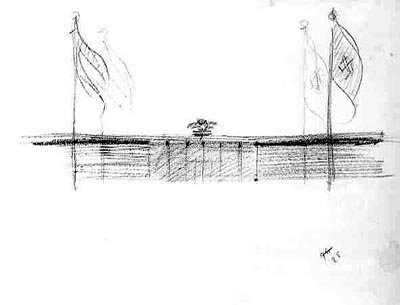
In fact, even after finishing his piece -- in The Guardian no less -- it seems more than unfair. In fact, it's just it's wrong. The Nazis liked bad classicism. The Soviets liked bad classicism.

In fact, not only were the great authoritarian regimes of the 20th century NOT suckers for the "cool, clean lines of modernist architecture," they were almost completely opposed to it.

There were certainly modernist architects sympathetic to both regimes -- and much work that should have been right down their strasse, such as the Nazi Pavilion by Mies van der Rohe (above) -- but neither regime really gave a rats for what the modernists were offering architecturally.

Many of those rejected modernists ended up in America (for better or worse), spreading modernist architecture to willing capitalists rather than to uniformed dictators -- and irony Tom Wolfe makes much of in his hilarious From Bauhaus to Our House. ("Row after Mies van der Rohe of worker housing pitched up fifty stories high" in the downtown commercial capitals of America's greatest cities.)

So as a serious piece, this one fails at the very first hurdle. His point then? It seems he just wants attention. And he does manage to gratuitously smear Ayn Rand in there somehow, which no doubt earns him some points in the Guardian's lunch room,but it's not really awfully clear what his point is there either, except perhaps to link Leni Riefenstahl, Hitler and Ayn Rand together in the same article. What a moron.

If his point really is that some modernists' work was totalitarian, that has been done better elsewhere -- including by Ayn Rand herself, and also here, by me.

If his point is that some modernists such as Philip Johnson were fascists, then that point has also been better made elsewhere -- including here, by me.

If his point is that he's an ignorant blowhard who courts controversy without the evidence to back it up, then that's a point that he's made all too well.
LINKS: Why fascism is a glass house - Peter Franklin, The Grauniad
From Bauhaus to Our House -
Tom Wolfe's site
Modernism: How Bad Was It? - Not PC (Peter Cresswell)
Architect Philip Johnson dies at 98
- Not PC (Peter Cresswell

TAGS: Architecture, Politics, Politics-UK

Wednesday, 15 March 2006

The Tall Building (continued): Glass Skyscrapers - Mies van der Rohe

Friedrichstrasse Skyscraper Project, Berlin, 1921 (left), and Study for a Glass Skyscraper, 1926 (right) - Mies van der Rohe.

Bold for their time, and known chiefly in teh form of these iconic stark charcoal, ink and pencil drawings (they were never built), these striking buildings would became the 'cutting edge' of US tall-building design some thirty years later, when as Tom Wolfe described it, "row upon Mies van der Rohe of glass skyscrapers" were built along the Chicago lakefront," all over Manhattan, and out across the cities of America.

Mies's intention in cladding the buildings completely in glass was to "preserve them in their most beautiful state." You may draw your own conclusions from the fact that neither this "beautiful state" nor these beautiful drawings includes people.

LINKS: Mies in Berlin - Museum of Modern Art
Plans and comments - La Defense

TAGS: Architecture

Wednesday, 8 March 2006

'Country House' - Mies van der Rohe, 1923


A wonderfully free-flowing 'pinwheel' plan for this country house project by Ludwig Mies van der Rohe from 1923. A plan that combines elements of Frank Lloyd Wright, De Stijl (see below left for example from 1918), Berlage and Malevich.

Walls thrust out into the environment, almost as Frank Lloyd Wright had them do a generation earlier -- only here they are simpler and less 'centred'; they 'hold' rather than 'grasp,' and their reach is less centrifugal and perhaps less ordered.

The elevations themselves are less successful -- Mies was still working out how to roof such a plan (something he worked out with his 'floating roof' of the Barcelona Pavilion) -- but it's fair to say that with this floor plan a new thing was brought into the world. It was a plan that justified a 'Eureka!'

TAGS: Architecture