This is an amusing account below of an important public meeting. Important in the context of making Auckland an affordable city.
Here's some quick context: Auckland's town planners have strangled the city in red tape for years. In recent times however, many planners and councillors (and mayor Wayne Brown) have come around to the realisation that the fewer houses built, the higher the prices for those houses: that, just maybe, people might be allowed to do a bit more on their land, to maybe build a little more densely.
Opposing this, of course, are the councillors and politicians of the leafier suburbs like Christine Fletcher -- and of course David Seymour, who's dropped his party's alleged principles about property rights to wring his hands instead about there being 'no density without infrastructure.'
There's no greater hand wringer than Christopher Luxon however, who decided over summer that Auckland Council must 'downzone' their proposed plan change that would allow greater density.
So this meeting Wednesday night was to confirm where the push for greater density would be maintained in the upcoming Plan (where would be upzoned), and where that push would be relaxed a little (where would be downzoned).
When the government’s efforts to intensify Auckland were debated at council back in August last year, critics took turns wringing their hands about the strain it would place on infrastructure. Plan Change 120 [which will allow greater density] could end up putting apartments in places that weren’t set up to handle them, they fretted. “Ultimately you can’t do all this upzoning without making the commitment to provide the infrastructure that will support it,” warned Albert-Eden-Puketāpapa ward councillor Christine Fletcher ...
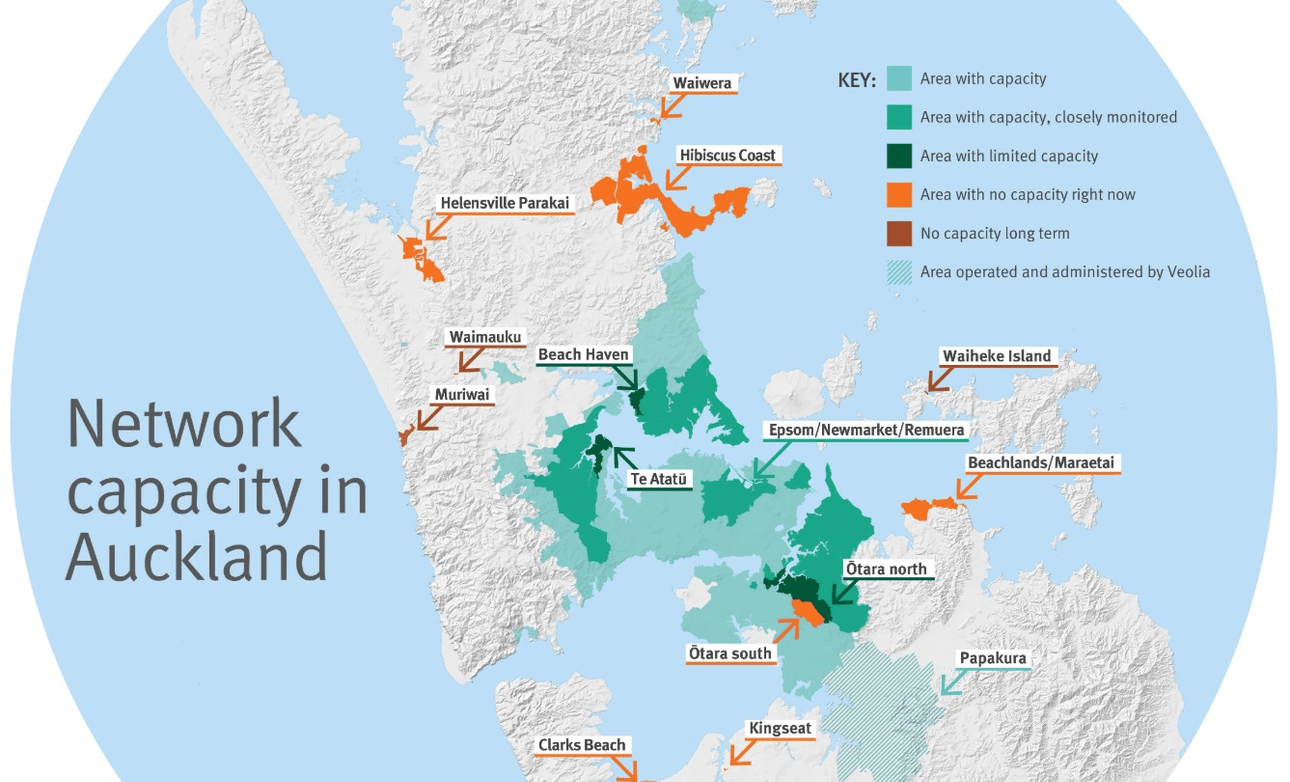
Yesterday the worriers got their wish. Thanks to a government backdown wrangled over chardonnays and summer barbecues, councillors are allowed to reduce the capacity in the new plan from two million to 1.6 million houses. Council’s policy and planning committee was meeting to decide where to make those cuts, and its chair Richard Hills started out explaining the staff recommendations to prioritise places 10km or more from the city centre. Asked why those areas should get first dibs on downzoning, council planner John Duguid was clear: it was because the land within 10km of the city centre had the best access to public transport, employment opportunities, regional amenities like parks and pools and three waters capacity, as measured by Watercare:
Three waters capacity in the central areas is set to improve even more when the Central Interceptor comes online soon. (Image: Watercare)
It should have been a celebration. But what would you know, most of the people who were once so concerned about ensuring housing is near infrastructure weren’t happy. Instead they were stewing over the revelation that the places with the best infrastructure were in their well-to-do wards. North Shore councillor John Gillon had looked at the maps and found that a 10km radius from the city centre would include the entire area he represents. He moved an amendment, seconded by Fletcher, to delete the 10km clause, saying he was “concerned” about the figure.
Waitākere councillor Shane Henderson was having none of it. He pointed out that west and south Auckland had accepted the vast bulk of the new houses in Auckland since the Unitary Plan passed in 2016. As for strain on infrastructure, those areas have limited pipe capacity and less access to public transport, and we see the effects of that outside-in planning in rush-hour congestion, parking shortages and sewage overflows, he said. Henderson argued Fletcher and Gillon were engaged in “a poorly dressed up move to take away intensification from the best-equipped parts of the city”. “The intention is simple: to downzone wealthy suburbs. There is no sensible reason for excluding central isthmus communities – again – from doing their part.”
The mayor was, if anything, more blunt. He said Gillon’s motion was aimed at putting housing in Pukekohe rather than areas close to “all the infrastructure”. “I don’t want to see endless sprawl just so nimbys in Parnell and politicians can get re-elected,” he said, in what appeared to be a shot at his political nemesis, Act leader David Seymour. “That’s disgraceful, I can’t vote for it.” ...
As Brown saw it, his colleagues’ first purpose was elitism. But if they had a second priority, it was delay. Gillon and Fletcher also put forward an amendment proposing to ask the government for more time to enact Plan Change 120. ...
The demand was familiar. Fletcher has asked for more consultation in just about every planning meeting for years, and the mayor was incensed. “I want to get out of this without further delay and dithering,” he said. “God almighty, it would be great to do something this three-year period.” ...
“For fuck’s sake, get on with it,” he said, as Fletcher spoke for the final time. ...
Afterward, Brown expanded on his frustration with Fletcher, saying the meeting was “one long filibuster to stop poor people living in her area.”
Read the whole thing here. It's an entertaining lunchtime read.
The great news is, National MPs are still leaving in droves!
Minister of Signage Maurice Williamson is the latest to fall on his sword For The Sake Of The Party– resigning as minister, if not (yet) as MP.1 The loss to the country from the resignation is incalculable – mostly because there is not a single lasting achievement from a lifetime in politics to add up.
So this makes, by some counts 15 National MPs about to leave the building for good.
Grounds for celebration, almost.
The bad news, however, and one reason not to celebrate yet, is that there are still people2 keen to replace them. Far, far too many.3
Sad but true.
UPDATE: No, turns out he has nothing else in his life besides his parliamentary pension. NewstalkZB just reports he plans to contest this next election.
1. But why the hell would he hang around now, after what is his (from memory) third demotion for being a bumbling fool. Time to choose a brighter future, Maurice. 2. I say “people,” though the jury remains out on whether entities wishing to be National candidates so conform. 3. A small but significant number challenging the given sartorial code by sporting Hawaiian shirts instead of suits.
It’s astonishing how quickly Maurice Wimpianson’s star has risen. From a bumbling politician sacked by his leader and unsure which way is up to a man everyone wants to talk up. It seems one big gay rainbow and the charming inability to pronounce the word “celibacy” was enough to give him delusions of adequacy, catapulting him to international fame and, now, a tilt at the Auckland mayoralty.
The only good thing about that is that i she he won he would leave parliament. That’s the only good thing.
Why do I say that? Well, as I see it the biggest problem facing Auckland is not making it liveable—it’s already that—it’s making it affordable. And as Building Minister for the last five years, Maurice’s every act—from licensing builders to his “guarantee regime” to banning D.I.Y. to over-complicating the ever-growing Gordian knot of building regulations—has driven housing costs and building costs higher. Deliberately. He took the leaky home issue and as minister proceeded to make it worse by using it as an excuse to corral builders, designers, Tom Cobley and all into what amounts to compulsory state unions. (Not to mention how, as Transport Minister, he imposed on us his lifetime licence and waffled airily before the 2008 election about imposing $50-a-week tolls on drivers.)
Maurice is a one-speech wonder. If he’s your answer, then Len Brown must be a hell of a question.
FOUR YEARS AFTER THEIR election pledge to address housing unaffordability, and ten years after the housing bubble began to seriously inflate, the National Government is finally making noises about the problem.
Unfortunately, I’m not sure they’re the right noises.
Short on specifics as yet—apparently there is a paper being submitted to Cabinet today outlining “a multi-pronged work programme” issued in response to the Productivity Commission's report on this issue,* after which we might perhaps learn more—and not a peep has been heard out of housing minister Phil Heatley—so all we have to go on presently are the noises about this made over the last week and weekend by Finance Minister Bill English. And those noises are not altogether encouraging.
English identifies housing affordability as a problem, yet his characterisation that the "housing market is not working properly” is neither accurate nor helpful. The housing market is working as well as it can within the shackles and costs placed on it by government and councils. What is not working however are the planning, regulatory and rates burdens that constitute those shackles and add to the costs—such that between 1992 and 2012 the national average house price increased more than four times more than prices in general, which should ring warning bells.
IT IS ENCOURAGING THAT English is framing the debate around Hugh Pavletich’s annual Demographia International Housing Affordability Surveys,** which now show the median cost of a house in New Zealand is 5.2 times the median income in New Zealand, and in Auckland 6.4 times median income.
Any ratio above five is considered unaffordable [says English in last week’s Herald]. Despite demand for low cost houses, relatively few are being built - in part because of the very high cost of land, particularly in Auckland.
Yesterday on Q+A he expanded on that, recognising “there are a number of problems.”
One is the cost of building. That does appear to be pretty high, particularly compared to Australia. There's a lot of work being done on why that might be the case. More scale, building regulation - all of that can be improved, and that process is underway.
While it is accurate however to say “that process is underway,” it is totally inaccurate to characterise Maurice Williamson’s amendments to the Building Act as anything but a sop. Nothing proposed therein will help reduce the increasing time, costs, delays and uncertainties involved in getting a building consent and in enduring the inspection process on site—instead he will be imposing new costs and further muddying the already opaque waters around risk and responsibility. Not to mention the licensing of building practitioners, which will further reduce the already low number of builders in the country while doing nothing to ensure their quality. All of which will further reduce the number of houses being built.
And while the cost of building materials sky-rocket, nothing proposed therein is going to make it easier to break what is essentially a “regulatory wall” of box-ticking making it almost impossible for NZers to use inexpensive foreign materials, or to enjoy the cost-savings of innovative building systems and techniques and systems. Systems like these Structural Insulated Panels, which are used in Canada, Europe, the US and Australia to great effect—low cost, low risk, low energy, huge insulation value, robust--but which are virtually impossible to build with here at home under our command-and-control building regulations that dictate virtually every detail of every new build.
It’s astonishing how much spin and how little real improvement one ridiculously incompetent and ill-informed Building Minister can make.
Yesterday’s press release from the Pakuranga Clown Maurice Wimpianson led with talk of “reducing red tape,” “red tape being snipped out of the $5.7 billion house building sector,” “cutting the red tape associated with building a house,” and other promising noises.
Unfortunately, all these “noises” about cutting red tape are bullshit, yet since they’ve been embraced by the industry’s noisiest cheerleaders and lapped up like mana by the ignorati in the press, I’ll need to explain why.
It’s all about the small print.
“Reducing red tape?” The only red tape that’s been reduced is “allowing” you, yourself, in your capacity as home-owner and D.I.Yer, to erect a small porch, a fence or a small retaining wall on your own land, or add a heat pump or shade sail to your house. Isn’t that nice of nanny? (Make sure you tug your forelock appropriately as you nail home that last fence paling.)
But when all’s said and done this is something you can do already, and have quite properly been allowed to do since Adam was a lad. (Whose bloody land is it anyway, for Galt’s sake?!) All that’s changed today is that the government’s thrice-announced plans to take that right away have been changed. Slightly. For the moment.
Oh, and if you do want to “do it yourself,” even to the small extent allowed by Nanny, you might just need your D.I.Y signed off by a builder. Ahem, by a “licensed building practitioner.” To whom you will need to tug your forelock, because (whether you like it or not) the law will require them to take responsibility for what you have just done.
So much for making the chain of responsibility clearer. That’s as much a lie as Labour’s new brochure claiming that all 15% of the Government Slavery Tax is due to National. (Q: Does the new announcement take councils out of the chain of responsibility? A: No. Q: So that still leaves ratepayers responsible for the failures of building inspectors required by law to take responsibility for things in which they have no ability? A: Yes. Q: So if you’re relying on insurers to protect home-owners for some parts of the building process, why not remove ratepayers’ risk altogether and allow insurers to cover it all? A: ? )
And so much for “reducing” red tape. Because not only is this not a real relaxation, what was also “announced” yesterday was a new requirement adding a whole new truckload of paperwork to “every job over $20,000” (which, these days, means every job) requiring that every home-owner and home-builder use Nanny’s contracts to have their homes built or renovated. Because Nanny knows best.
And with it too was announced yet again, just to remind us all, the same announcement that’s already been made several dozen times before over the last five years: that everyone from plumbers to builders to house designers will have to become a “licensed building practitioner” by 2012 or be forced out of the industry—a “license” being a proxy for quality and reliability that has and will fail abjectly to achieve either. (If you doubt this, just look how many leaky homes were designed by registered architects and built by master builders.)
A “license” has no more ability to guarantee quality than a stop sign has to stop a speeding car (or a ban on drugs has to keep drugs out of prisons). Nonetheless, every current practitioner will soon be forced to bend their current practices and methods to fit those of the people who were, by and large, most responsible for designing and building those leaky homes—to either change their ways, conform, or get out.
“Reducing red tape?” Sounds more like anti-competitive regulation to me, so it’s no surprise that everyone from the Master Builders Association to the Certified Builders Association came out of their woodwork to throw up their hands in celebration. Can you think why that was? If you answered: “For the same reason that large taxi companies were celebrating the compulsory requirement for security cameras in cabs,” then give yourself a large tick. It’s because these rent-seekers understand that this anti-competitive move will help to exclude their smaller more nimble competitors from the market, and probably send many more of them offshore. Simply put, by enforcing the flaccid practices of behemoth organisations on everybody, registration of builders and designers is a great way of preventing competition from new rivals.
So much for either “raising standards” or “reducing red tape.”
It’s a pity that none of the media commentators realise that. But they don’t. Instead, they’re busy selling this already oft-announced announcement as both a “new” announcement and a reduction of red tape, which tells you once again just how little these commentators bother to do anything other than repeat the self-serving press releases that get sent to them.
As I listened to all the nonsense and all the “practices” of all the dinosaurs that we will all soon be required to follow (either follow or leave the industry), I couldn’t help thinking of this observation by Frank Lloyd Wright (who was never “licensed” anywhere, nor even “qualified,” and under this current regime wouldn’t be allowed near a hammer, let alone a drawing board):
The building codes of the democracies embody, of course, only what the previous generation knew, or thought they knew, about building...
The codification in law of fluid and ever-changing practices is the first step in their calcification, and to the inevitable exclusion of innovation and new competition. Not that anything of that would bother either the people collecting their members’ dues at the Master Builders Association and the Certified Builders Association, or this Minister of Building--whose only relationship to the industry is being milked quite happily by the current team rebuilding his home at his great expense in Farm Cove, Pakuranga.
But as I listened to all the nonsense, and to all the new restrictions being announced as a removal of red tape, I thought back to a simpler time when regulations were simpler, home-owners actually had rights, and men who would one day become Prime Ministers would happily and without any hindrance from Nanny erect their own houses right from right down to making their own concrete blocks. I thought, in other words, of the house that Big Norm built could no longer build, and of the National Party Minister who only four years ago opposed, in the name of Big Norm, what has just been announced by his colleague:
Has the Minister visited the Kaiapoi home of former Labour Prime Minister Norm Kirk—in the Minister’s electorate—that he built with his own sweat and toil, including making his own blocks, a feat now outlawed by the Minister’s complex licensed building practitioner regime, which would have required Norm to have a licence for concrete work, a licence for blocklaying, a licence for roofing, a licence for carpentry, and a licence for external plastering; why does the Minister want to destroy with his politically correct red tape the proud New Zealand tradition of Kiwi battlers being able to build their own homes, when there is no evidence that the leaky homes problem was caused by DIY builders?
That’s the measure of how much real “red tape is relaxed” today. Answer: None.
By the way, it won’t surprise you to know that the surname of the National Party Minister with the forked tongue is Smith, and his first name is Nick. The dick.
Libertarianz leader Dr Richard McGrath ransacks the newspapers for stories and headlines on issues affecting our freedom.
This week: Key cutting
Our Prime Minister created ripples this week that extended well beyond the borders of the Shaky Isles when he shared the fact that he has been vasectomised.
In fact he thought getting a vasectomy was such a good idea that he now wants to make the process compulsory, starting with his Cabinet Ministers. [Some of us would advocate a much deeper cut – Ed.] Given that last month was NZ Music Month, ministers were asked to nominate a song they would prefer as background music while their work is done.
Deputy Prime Minister Bill English nominated Rod Stewart’s ballad ‘The First Cut Is The Deepest.’
Maurice Williamson could only think of the Joy Division dirge ‘Love Will Tear Us Apart.’
Gerry Brownlee betrayed possible hillbilly ancestry when he suggested Lynard Skynard’s ‘Gimme Back My Bullets.’
Murray McCully came over all misty-eyed as he recalled the Neil Diamond/Barbra Streisand classic ‘You Don’t Bring Me Condoms Any More.’
Judith ‘Crusher’ Collins had to be restrained from launching into a rendition of ex-Kiss member Ace Frehley’s number ‘Rip It Out.’
Wayne Mapp, a golden oldies fan, suggested ‘Great Balls of Fire’ by Jerry Lee Lewis.
Chris Finlayson may have an S&M streak as he recalled 80s band Culture Club and their song ‘Do You Really Want To Hurt Me’, along with John Mellencamp’s ‘Hurt So Good.’
Nathan Guy thought ahead to possible future children post-vasectomy with his suggestion, Jim Croce’s 1973 hit ‘If I Could Save Sperm In A Bottle.’
Tim Groser winced as he hummed the tune to REM’s ‘Losing My Religion.’
Georgina Te Heu Heu cackled as she remembered a song by Queens of The Stone Age: ‘Suture Up Your Future.’
Tony Ryall contemplated elective surgery of a sterilising nature to Nirvana’s tune ‘Half The Man I Used To Be.’
Paula Bennett’s ideal background music as she supervises Phil Goff’s family planning with a rusty tin lid would be Gloria Estafan’s ‘Cuts Both Ways.’
Jonathan Coleman, a medical doctor, said he would prefer to do his own vasectomy with the benefit of local anaesthesia to a medley by Nine Inch Nails – ‘The Beauty of Being Numb’, ‘Somewhat Damaged’ and ‘Mr Self Destruct.’
Toward the end of his media conference yesterday, the Prime Minister said real men bike home after their vasectomies. He was then asked how things are in the nutsack region these days.
‘Love Hurts,’ he replied.
[Note: The Libertarianz Party’s policy on vasectomies is that they should be done by mutual consent in the private sector, by whatever practitioner a person wants to employ. The medical monopoly and crumbling public hospital system should be opened up to competition, thus putting downward pressure on the cost of this surgical procedure.]
When the people fear the government, there is tyranny - when the government fear the people, there is liberty. - Thomas Jefferson
For most people, that would lead to the obvious quip that it's good to see National Party ministers recognising that the National Government that caused the problem was akin to a natural disaster.
But that would be too easy, and not quite accurate, because most people inclined to make that quip still labour under the assumption that the primary cause of the problem was the Nats' “deregulation” of the building industry in the early nineties.
As you know, I don't buy that argument. Sure, the government played a part in the problem, but it wasn’t the Nats’ deregulation that caused the problem (because, dear reader, there was none). Their role consisted in putting into place a regulatory regime that, in obscuring who was bearing the real risk in new buildings, ended up as the worst of both worlds.
Basically, local-government bureaucrats are simply not competent to do the job that the legislation of successive governments have required of them, i.e., to act as some sort of 'gatekeeper' of building quality.
And the central-government bureaucrats at BRANZ and the Building Industry Authority, who between them were required by law to vet all materials and building processes, were not competent to act as any sort of ‘gatekeeper’ of materials’ quality.
The involvement in the building process of both government and council might have suggested to buyers that somehow the rules of risk and reality had been suspended, and that that the rule of caveat emptor didn’t apply. But they do, and it still does.
Who drives a car off the lot without first getting it checked out? But putting central and local government bureaucrats into positions of authority that they just weren’t competent to carry out encouraged buyers to “drive away” a new house with only some un-backed pieces of paper to protect them.
Buyers may not have realised that a council-issued Code of Compliance for their new house and a BRANZ appraisal for the materials it was built with were between them about as credible as a Goldman Sachs mortgage-backed security. But they didn’t. And they weren’t.
Sadly, the intrusion of councils and government departments into a process in which they're just not competent to play a part raised costs for builders and home-buyers in the first place, and puts ratepayers and taxpayers on the hook now for something they themselves haven’t done.
But that leaves us all confronting a tough question: while we can all sympathise with those caught up in this plight, why should ratepayers and taxpayers who didn't choose to invest in these lemons have to bail out those who did?
That’s still the hard question that talk of a “natural disaster” just doesn’t so easily brush away—because this was not a natural disaster, it was entirely man-made, and those who were mainly to blame have largely managed to escape responsibility for it. And by saying "those who are mainly to blame," for the most part I don't mean designers and builders.
“The guarantee or warranty would have a surety holder behind it [you say], so if something goes wrong a claim can be made against the relevant party [i.e., the insurer].
So you’re proposing an insurance regime, Maurice, said to cost each potential home-builder another $5000 on top of all the thousands of dollars they’re already charged before they can get started, while still maintaining the failed council inspectorate that levies all those charges.
Does that make any sense?
At a time when everyone is trying to get the cost of new homes down, why on earth would you add a new cost to home-builders for what is (at least in theory) just a duplication of what is already being done?
And if the insurance regime isn’t just a duplication of what councils are already doing, does that mean the existing council inspection regime is inadequate—as the evidence would strongly suggest? An insurance regime that is all but an admission that the current building regime doesn’t work.
But why on earth would any case would insurers want to get involved in the system as you propose, unless they can charge like a wounded bull for all the unknown liabilities the duplication of effort is likely to load onto them?
Doesn’t this duplication just make the chain of responsibility even more muddy than it is now? Who will know who is responsible for what – council or insurers? Who will know who pays when stuff goes wrong – ratepayers or insurers? Who will know who exactly has final responsibility – council or insurers? Wouldn’t it make more sense to make the chain of responsibility completely transparent by removing one of these two from your regime altogether?
And since ratepayers are already potentially liable for those $11.5 billion or more (by virtue of the Building Act that your government brought in, Maurice), wouldn’t it make more sense to remove the one that’s already demonstrably failed?
In fact, why leave ratepayers in the gun at all? If you’re going to talk “warranty,” then wouldn’t it make sense to remove the risk from ratepayers altogether by simply sheeting home responsibility to insurers completely?
Wouldn’t this be manifestly simpler all round?
In other words, why keep insisting that councils do a job it’s now abundantly clear they’re not suited for, when if you let the grey ones get out of the way insurance companies can do what they do best: setting and maintaining standards; insuring against risk; and spreading the risk around properly, at no risk at all to ratepayers.
Take your head out of your hands, Maurice, and have a think about it. Because if you do, you’ll realise it would remove a lot of your other headaches too.
Did you notice Building Minister Maurice Wimpianson talking over the weekend about how his head hurts when he wonders how his government is going to “fix” New Zealanders’ leaky homes – a problem said to have a bill upwards of $11.5 billion? How “a Government who's running deficits - and has a forecast track of deficits for many years out - has to just sit there with its head in its hands, saying, 'Well, I just don't how to do this'.”?
“If we can ensure that a homeowner has guaranteed access to funds, and a guaranteed ability to repay [he told a Guyon Espiner too dim to realise what he was saying]. . . we can allow inflation and we can allow rising house prices to let people fix their home and actually move on and move out of the situation.”
“Key’s plan to wipe out the billions of dollars of leaky home liability (and by implication the tens of billions of dollars his government is spending that it hasn’t got) is not to address the real problems, it’s going to be to print money – the age-old remedy of quacks, charlatans and short-sighted so-called statesmen.”
No wonder it looks so appealing to this lot.
Quite apart from all the damage inflation does to an economy, inflating the way out of the problem is simply a way of making savers transfer their resources to afflicted home-owners without the process being noticed. It’s a coward’s way to fix things.
Few details have been released so far, but Maurice Wimpianson’s proposal to “shift the responsibility for building work” away from councils and onto “licensed” builders looks like the worst of both worlds. “The liability for building now lands on local councils and that needs to change,” says Williamson, and so it does. Trouble is, I’m not so sure that what I’ve heard of his changes – what will be the third major change to the industry in little over a decade – are the silver bullet the industry needs.
It’s true that councils should never have been landed with a responsibility they can properly administer nor a risk their ratepayers can afford. (The cost of making councils responsible for building risk has been made worse both by leaking houses, and the green-plated building regulations supposed to “fix” that problem, which heavily inflates the cost of repairs.) Assessing building quality is not something councils do well, and with the increasing sophistication of buildings these days the attempt to have them shoulder the responsibility for it has been a disaster all around.
Long discussions about sophisticated building systems with people who have only just learnt to read and write, but who nonetheless are required to take responsibility for issuing your consent, is not a process calculated to make a person fall in love with the present system.
Long delays in processing consents and issuing Code Compliance Certificates only add to already exorbitant costs for home-builders and home-buyers – costs that reflect the attempts by council to do something they can’t do well, and to stump up for a responsibility they should never have had.
But you’re not going to fix this mare’s nest of unclear responsibility and the extra cost that reflects that loose chain by allowing “licensed” builders to “self-certify.” That just sounds absurd. And it cuts out completely D.I.Y.ers and honest builders who don’t wish to pay fat sums to ignorant fat cats to assess them.
Don’t be confused by the rhetoric of the Building Minister. It’s not a free market or a deregulation that Wimpianson is proposing. It’s a hampered market with costs inflated by state meddling, the supply of builders restricted by state controls, and the cost of risk (which is inflated by green-plated building regulations inflating the cost of repairs) landed squarely on builders’ shoulders – those few builders who will choose to remain.
Government-licensing of builders is no more a guarantee of building quality than it was to have government-licensing of building systems. We’re still paying for the false sense of security that gave everyone. Using qualifications as a proxy for quality is the only way a bureaucrat in a state-controlled system can “measure” quality, but it certainly doesn’t guarantee it -- as a perusal of the “quality” of registered teachers would tell you.
The idea that registering architects and licensing builders is some silver bullet that guarantees quality can be exploded simply by looking at the number of leaky houses designed by registered architects and built by master builders, i.e., a significant number. I’m repairing one now that was built by master builders, and designed and signed off by the president of the Institute of Architects – didn’t stop the building leaking, or needing expensive repairs
It’s essential that councils be taken out of the building chain. They should never have been there in the first place. But licensing builders is not the answer to fall back on: and the enthusiastic reception by Master Builders to the idea is not evidence that it is the answer, but evidence instead that Master Builders see the opportunity here for rent-seeking. And they will be.
To see what the answer to all this might be, let’s look at what might happen if the government got the hell out of the way altogether (aside, that is, from its proper job of registering titles and contracts). Now, when you buy a second-hand car you’ll usually get it inspected. When you buy a house, which is the most expensive thing most of you are ever going to buy, you’d expect that you’d have that inspected too. And just as sellers of second-hand cars are increasingly touting the quality of the inspections and inspectors to help sell their cars – Come With Full AA Inspection! Signature Class Car! – so too would recognised building inspectors acquire increased importance among buyers.
Wouldn’t be very long before they’d be looking only for houses backed by reputable inspectors – inspectors who, unlike councils, would have their own reputation on the line with every house they assess.
And acquiring importance too would be insurance companies. I see Maurice floating the idea of a warranty bought by the builder, but without details it’s hard to know precisely what’s intends for Maurice’s Market. But what’s likely to happen in a free market is that standards are increasingly set by insurance companies themselves – standards that in many cases will be higher than they are now, but are based on what’s economically workable for their customers. If you want to sell a house, then you’ll want to convince house-buyers it was well-built – and the best way to convince them of that would be first to convince the best insurance company you can afford.
The company that insures your house has the biggest incentive to assess its build-quality without taking your wallet off at the arm. And in a free building market, each insurance company would be free to set its own building standards – with premiums and reputations to suit. Build the housing equivalent of a Toyota Corolla, and most insurers would charge very little for the very little risk involved. Build the housing equivalent of a hot rod however, something more radical, and you’d find fewer insurers willing to back you, and those who did would want to charge you more for the privilege. But you’d still be able to build it, which you can’t do today.
The outcome of an actual free market would be that you could choose your risk based on the level of building risk and building excitement you wanted – just as you do with a car – and building standards would eventually be set by market mechanisms that left the risk where it should be: on buyers and sellers and insurers. Not on ratepayers.
Standards would likely be higher, as insurers (like the AA do with their car inspections) fight to increase their reputations. And over time you’d have building standards that encouraged innovation, rather than strangled it, protected home-owners rather than leaving them in limbo, and didn’t cost an arm and a leg and numerous long delays to assess.
Frank Lloyd Wright used to say that the building regulations of today reflect what the building inspectors of yesterday knew, or thought they knew.
He’s still right. And it’s getting so that’s all we’re allowed to erect.
UPDATE: A question from a commenter made me wonder if I hadn’t been too clear.
Basically, I am suggesting is inspections not just when you buy an existing house (which is what most people do now), but also during the construction of your new house – and not from your local council, but by your chosen insurer.
What I'm essentially suggesting is that if govt and local govt withdrew, then what would be likely to replace them is an insurance-driven model, with the insurance companies themselves acting as your "consenting agency." Unlike now, that would make the chain of responsibility for failure very clear, and the motivation for doing good very stark.
Your motivation as a home-builder for using one would be to ensure both its resale value and its insurability. Both would be easier if you can choose and afford a reputable insurer who sets objective standards by which your new building can be measured. (And these could even refer to existing standards like NZS, AS and so on.)
And the motivation of the insurer would be the same as it is now in every other field: to offer a competitive rate and service while maintaining its reputation for square dealing.
So as a home-builder you'd be dealing with a rational organisation who wanted to help you -- and also wanted to ensure things were done right.
And as a home-owner you'd have both the choice of insurer, and the choice of the level of risk you wanted to take.
Basically, if you wanted to build something conventional, you could get a good inexpensive service that protected you and future home-buyers. And if you wanted something more like the Bavinger House (below and right), you'd have to pay a little more . . . but unlike the situation now, you'd actually be allowed to build it!
UPDATE 2: Opening my latest copy of ‘Scope’ magazine, I read with interest the story of this new house (right and below) on Fiji’s Denarau Island for a newly retired couple, designed by Auckland-based Glasgow Architects. The house, one of many in this still popular resort area, has been specced for abundant rainfall, Fiji’s heat and high tropical wind forces. Says principal Garry Glasgow of the insurance-based model used in resort-town Fiji,
“Building in Fiji presents some interesting issues as there is no ‘building code’ as we are accustomed to in New Zealand. ‘In fact,” Garry says, ‘the control on quality is dependent on the insurance companies who insist on engineering reports and architectural qualifications to comply with their building criteria. For this reason more detailed construction supervision was required than is the case in New Zealand.”
UPDATE 3: Meanwhile back in New Zealand, the South Pacific’s home of extensive, expensive building bureaucracy, we hear more stories like this one:
“We're getting a simple shed built, to use as a workshop. The contractor tells us that the council charges for a building permit have gone up by around 40% in less than two years. And even though the number of applications has dropped drastically over the past twelve months the waiting time for approval hasn't varied.....Oddly enough, the four councils in this area have all put up their charges by exactly the same amount. “In addition, any windows in a habitable building must be double-glazed--never mind the cost, never mind that it's none of the council's damn business. “These bastards are nothing more than parasites, leeching off other people's work and getting in the way of the productive sector of society. A pox on them all.”
Good old Maurice Williamson. Spurned by his leader, unwanted in the Key Cabinet, sacked from the transport portfolio for "telling it like it is," Wimpianson has been left to till the unfertile fields of the Building portfolio, where he's clearly been putting his "imagination" and "free market credentials" to work in striking out for a brighter future for the building industry.
This, by the way, is irony. When Williamson and Nick Smith were appointed to the portfolios of Building and the RMA respectively, I pointed out that neither of these two either understands or is even interested in the real and serious problems with the two Acts over which they now preside, and consequently far from expecting to see any genuine building reform, all that could be expected from these two was disappointment.
I hate it when I’m right.
Wimpianson says today he wants to "shake up" the Building Act. He's promising a "review" of the Act that would be "a multi-pronged piece of work" – a piece of work that that would “examine possible legislative changes” that include “licensing of builders” – most of whom are already out of work -- and “the accreditation of specific building materials.”
"We don't know the answers," says Wimpianson in unwittingly re-releasing the Clark Government’s building policy. Admitting he doesn’t know the the answers is in fact the only thing here he's got right.
Consider: the vast majority of leaking homes, particularly the large scale examples, were build by Master Builders and drawn up by Registered Architects. Did that save the home owners?
Consider: the largest proportion of building materials that have been implicated in leaking homes were accredited by the government's two building bureaucracies, BRANZ and the BIA, and installed in most cases by builders who followed the details mandated by the manufacturers and by those two august bodies (the latter of which has now disappeared like the fly-by-night outfit Wimpianson suggests builders must be). But have those building materials manufacturers felt any legal heat? Have those two government bodies fronted up? Did accreditation of these materials by BRANZ and the BIA save home owners?
Which means that Wimpianson's "multi-pronged approach" shows all the imagination of a concrete block, and the same grasp of his portfolio that Sitiveni Sivivatu showed with the ball on Saturday night.
Wimpianson complains about an industry where all one needs is "a ute, a dog and a cellphone" to become a builder. Fine words from a man who can’t even make it in a “profession” where all it takes is a cheap suit, a shit-eating smile and an ability to hold up a sign the right way up.
Oops.
And people say I shouldn't use words like "moron" to describe the members of this National-led government ...
Fair play to TVNZ's 'Close Up' programme, which in successive nights has highlighted the iniquities and bureaucracy of the Resource Management Act, the Building Act and the NZ Building Code.
On Monday night we saw the would-be supermarket on the North Shore whose doors have been kept closed for years by the Resource Management Act [see 'Supermarket'], and last night we heard stories of two small projects whose Building Consent applications cost up to a third of the cost of the buildings themselves [see 'Permits'].
One could almost begin to think there was some collusion between the 'Close Up' programme and a reforming government, eager to soften us up for sweeping reforms to these two handbrakes to growth, and significant contributors to housing cost inflation.
If only.
Instead of talking to either of the new ministers responsible for the Building or Resource Management Acts, Rodney Hide was wheeled out as the new Minister of Local Government. Yes, he talked about what he'd like to do about regulations generally -- if he can; if John Key lets him; if he had responsibility for these acts -- but neither he nor his interviewer seemed aware that his ministerial warrant for Local Government doesn't extend to doing anything to either the Resource Management Act or the Building Act.
For that you need to look to the ministers who actually are responsible for these two acts. Which means (for the Building Act) Maurice Wimpianson, the minister for signs, the man responsible as a former Minister of Transport for imposing the new lifetime driving licenses on us; and (for the Resource Management Act) Nick the Dick Smith, the man who calls the RMA "far-sighted environmental legislation," and who in the nineties administered the Act for three years without change.
So far from expecting any real change, I suggest all we can expect is disappointment. Neither of these two either understands or is even interested in the real and serious problems with these two Acts.
In fact, only last month Nick the Dick was telling audiences around the country that instead of expunging the poison at the heart of the act "National supports the underlying principles of the Resource Management Act..."
Just so you know what that means, the underlying principles of the RMA are stated in those sections of the Act Smith has promised not to change. These stated principles uphold the toxic collectivism of kaitiakitanga - or "stewardship" - while completely ignoring ownership, which means property rights (in fact, in all its 455 pages the RMA fails to even mention property rights, even once, while harbouring a savage penalties regime if you do things on your own property of fines up to $200,000, and up to two years in jail!); the principles uphold the nonsense of 'intrinsic values' while destroying distinctively human values; they tout 'effects-based planning' while prescriptively regulating and prohibiting human activities; they have empowered an enormous army of consultants to interpret and manage the Act, and of bureaucrats to administer the consents required by the Act; they protect trees, rocks and mud puddles while providing no protection for human life and human property; they "protect" "future generations" while doing over and impoverishing this generation.
These are the underlying principles that the National Party supports. More power for planners, politicians and consultants ... and none at all for you.
So don't expect much from either of these National Party ministers.
It's a petard made entirely of timidity -- of a policy of being too scared to ever say what they mean, or to mean what they say. It's a policy that means that National politicians are required to be saying less and less, which means their every bland utterance will be examined for more and more of what they might signify. It's a policy that means every time a National politician stick their neck out it's immediately and embarrassingly withdrawn amidst headlines of wimpishness and wowserism.
It's a policy born of desperation for power, and a the typical Tory tendency to appeasement, but it's a policy that presents a seasoned politician like a Clark or a Cullen everything they need to make a meal from -- as they already have -- and that requires every position the Tories might eventually wish to adopt remains essentially undedefended.
That's not a recipe for real substantive change, is it.
If there's anyone to blame for the accusations of National's 'secret agenda' being flung around it's the National Party themselves -- not because they have one, but because their public timidity and instant backtracking when challenged suggests they've got something to hide. And frankly, they have: their spinelessness.