Showing posts with label Local Government. Show all posts

Monday, 25 May 2026

More mismanagement, please, ministers demand

"More mismanagement please," insists Minister

In 2002 Sandra Lee's Local Government Act took the shackles off local government, and gave them written permission to build monuments and to blow out budgets. Her Act reversed the legal principle that governments may only do what they are legally empowered to do, and instead said they could do what the hell they like unless there was a law to stop them. And so budgets were blown out, monuments were built, and everyone forgot what councils had been originally constituted to do: i.e, that boring stuff like looking after pipes in the ground.

Then in 2010 Rodney Hide super-sized Auckland's Council, and debt ballooned from around $1 billion in total for the 8 councils smashed together (mainly from Manukau and Auckland) to a figure of nearly $15 billion now. And the mandarins heading the new super-sized council immediately added a whole new layer of super-sized egos to run it, or try to, literally hundreds of new six-figure staff there to attend bigger meetings and build bigger monuments. 

So what lesson do you think the Ministers for Resource Management Reform and Local Government, Chris Bishop and Simon Watts, draw from this? 

Are they to insist, in their last few months of government, that Sandra Lee's Local Government Act be reversed, and councils required to go back to their knitting? Back to a better focus, to those pipes in the ground and on the rubbish on the streets?

Not a bit of it. Instead these idiots are insisting that all councils take lessons from Auckland's monumental disaster. In what appears to be a last-minute lurch to a headline, they have given councils three months (just this side of the election) to come up with proposals to merge themselves out of existence, and those that do not will have mergers chosen for them by Messrs Watt and Bishop.

And all this while Bishop is making a bollocks of his RMA replacement.

We are led by donkeys. In politics, anyway.

UPDATE: And to reinforce the issue, here's the most recent headline on Auckland's local governance: 
'Nerves on edge as Auckland Council finalises record rate rise in cost of living crisis.' 

What sane person would look at that and say: "Let's have more of that around the country?"

It takes a minister ...

Friday, 13 March 2026

"One long filibuster to keep poor people out of her area"

This is an amusing account below of an important public meeting. Important in the context of making Auckland an affordable city.

Here's some quick context: Auckland's town planners have strangled the city in red tape for years. In recent times however, many planners and councillors (and mayor Wayne Brown) have come around to the realisation that the fewer houses built, the higher the prices for those houses: that, just maybe, people might be allowed to do a bit more on their land, to maybe build a little more densely. 

Opposing this, of course, are the councillors and politicians of the leafier suburbs like Christine Fletcher -- and of course David Seymour, who's dropped his party's alleged principles about property rights to wring his hands instead about there being 'no density without infrastructure.' 

There's no greater hand wringer than Christopher Luxon however, who decided over summer that Auckland Council must 'downzone' their proposed plan change that would allow greater density.

So this meeting Wednesday night was to confirm where the push for greater density would be maintained in the upcoming Plan (where would be upzoned), and where that push would be relaxed a little (where would be downzoned). 

And with that introduction, here's Hayden Donnell ...

When the government’s efforts to intensify Auckland were debated at council back in August last year, critics took turns wringing their hands about the strain it would place on infrastructure. Plan Change 120 [which will allow greater density] could end up putting apartments in places that weren’t set up to handle them, they fretted. “Ultimately you can’t do all this upzoning without making the commitment to provide the infrastructure that will support it,” warned Albert-Eden-Puketāpapa ward councillor Christine Fletcher ...

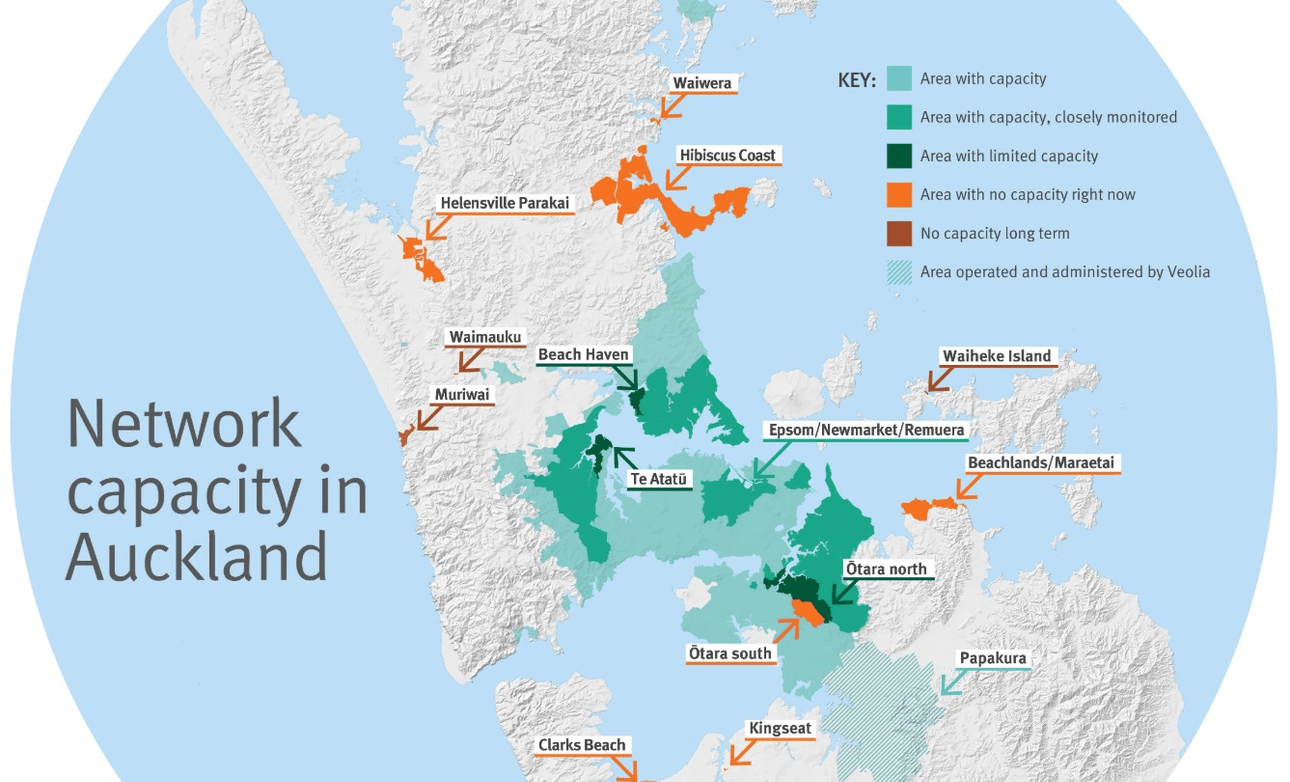
Yesterday the worriers got their wish. Thanks to a government backdown wrangled over chardonnays and summer barbecues, councillors are allowed to reduce the capacity in the new plan from two million to 1.6 million houses. Council’s policy and planning committee was meeting to decide where to make those cuts, and its chair Richard Hills started out explaining the staff recommendations to prioritise places 10km or more from the city centre. Asked why those areas should get first dibs on downzoning, council planner John Duguid was clear: it was because the land within 10km of the city centre had the best access to public transport, employment opportunities, regional amenities like parks and pools and three waters capacity, as measured by Watercare:

Map of Auckland showing water network capacity. Areas are shaded by capacity: green (with capacity), teal (closely monitored), blue-green (limited capacity), orange (no capacity now/long-term), and labeled locations.
Three waters capacity in the central areas is set to improve even more when the Central Interceptor comes online soon. (Image: Watercare)

It should have been a celebration. But what would you know, most of the people who were once so concerned about ensuring housing is near infrastructure weren’t happy. Instead they were stewing over the revelation that the places with the best infrastructure were in their well-to-do wards. North Shore councillor John Gillon had looked at the maps and found that a 10km radius from the city centre would include the entire area he represents. He moved an amendment, seconded by Fletcher, to delete the 10km clause, saying he was “concerned” about the figure.

Waitākere councillor Shane Henderson was having none of it. He pointed out that west and south Auckland had accepted the vast bulk of the new houses in Auckland since the Unitary Plan passed in 2016. As for strain on infrastructure, those areas have limited pipe capacity and less access to public transport, and we see the effects of that outside-in planning in rush-hour congestion, parking shortages and sewage overflows, he said. Henderson argued Fletcher and Gillon were engaged in “a poorly dressed up move to take away intensification from the best-equipped parts of the city”. “The intention is simple: to downzone wealthy suburbs. There is no sensible reason for excluding central isthmus communities – again –  from doing their part.”

The mayor was, if anything, more blunt. He said Gillon’s motion was aimed at putting housing in Pukekohe rather than areas close to “all the infrastructure”. “I don’t want to see endless sprawl just so nimbys in Parnell and politicians can get re-elected,” he said, in what appeared to be a shot at his political nemesis, Act leader David Seymour. “That’s disgraceful, I can’t vote for it.” ...

As Brown saw it, his colleagues’ first purpose was elitism. But if they had a second priority, it was delay. Gillon and Fletcher also put forward an amendment proposing to ask the government for more time to enact Plan Change 120. ...

The demand was familiar. Fletcher has asked for more consultation in just about every planning meeting for years, and the mayor was incensed. “I want to get out of this without further delay and dithering,” he said. “God almighty, it would be great to do something this three-year period.” ...

“For fuck’s sake, get on with it,” he said, as Fletcher spoke for the final time. ...

Afterward, Brown expanded on his frustration with Fletcher, saying the meeting was “one long filibuster to stop poor people living in her area.” 

Read the whole thing here. It's an entertaining lunchtime read.

[Pics from Spinoff]

Monday, 9 February 2026

Catastrophic sewage failure starts with pisspoor decision-making

"[T]he cause of the calamity are ... sitting, neatly itemised, in Wellington City Council’s own records. ...

"On 27 May 2021, Wellington City Council’s Long-Term Plan Committee faced a clear fork in the road."Officers presented councillors with water investment options, including one — Water Option 3 — that contained a $391 million wastewater renewals programme... to reduce sewage pollution, starting with the central city and south-coast catchments now making headlines.

"At the same meeting, officers recommended Cycleways Option 3, with capital expenditure of $120 million over ten years. ... An amendment was moved by then-councillor [and now Green MP] Tamatha Paul ... to adopt Cycleways Option 4, expanding the programme to $226 million — nearly doubling it.

"That amendment passed.

"Accelerated wastewater renewal did not.

"The vote is on video. The numbers are in the Long-Term Plan. The consequences are now floating in Cook Strait."

~ Peter Bassett from his post 'Wellington’s Sewage Crisis Wasn’t an Accident. It Was a Vote — and Everyone’s Pretending Not to Remember'

Monday, 2 February 2026

"The point is not to get 2 million homes."

"Right now, Auckland Council’s zoning allows people to build about a million shops selling tasty pies. ... Can you imagine it? Auckland with a million pie shops – and hardly anything else.

"Of course it is ridiculous. ... The number of pie shops finds its own level, adjusting as demand changes. There is no 'right' number that can be determined on its own. The right number is found as entrepreneurs take punts and consumers make choices. ...

"When central government asked Auckland to zone to allow up to 2 million additional dwellings, it wasn’t a demand that Auckland build that many homes. Or even an expectation that anyone would ever try to build nearly that many.

"The point is not to get 2 million homes.

"When lots of places can turn into houses, townhouses and apartments when housing needs change, then new housing can just turn up when and where it is needed. Developers watch where people most want to live, look at the cost of developing in different places, and try their luck. ...

"[Councils however] have been reluctant to allow enough new housing to keep up with demand ... [so] as a way of resetting planning culture, central government has mandated that [councils] allow more housing, using numerical targets. ...

"For now, just remember that Auckland allows about a million pie shops. Look around. Do you see a million pie shops?

"Things being allowed does not cause them to exist. But allowing competition changes, and improves, what can exist."

~ Eric Crampton from his op-ed 'The misguided fuss over ‘2 million more’ houses for Auckland

Friday, 30 January 2026

Your 'employees' have given themselves another big pay rise

....

"While ratepayers across the country faced double-digit rate hikes, mayors and councillors up and down New Zealand once again saw their salaries increase this year.

"On average, councillors had their pay packets increased by 9.81 percent between 2025 and 2026, while mayors saw an 8.53 percent boost to their pay."

Tuesday, 9 December 2025

One step forwards, three steps back.

"Oops." Luxon-led policy-making takes a tumble

It's a rule in politics. The devils is not always in the details. It's often that the details reveal the real devilry.

If the large print ever giveth, then the small print will surely taketh away.

Let's look at a few examples in an area I know something about: Building.

*** Building Minister Chris Penk seems a jovial character but unfortunately he knows little about his subject area. His first move was to promise faster building consents. Exciting. Encouraging. Mighty work.

Here's hist first step: "requiring councils to submit data for building consent and code compliance certificates every quarter." There are no other steps.

He adds "hope" to the idea of anything being faster. Council inspectors "must" issue building consents in a timely fashion, he insisted.  And yet every council inspector ever employed knows how to legally delay a consent application. In fact, if you fine a council for being legally overtime, they'll just legally delay applications for even longer to give themselves some head room. Which is what they've done.

Score One for the Grey Ones.

*** Another move by Building Minister Penk was "remove barriers to overseas building products." At least, that's what it said in the headline. His idea, sensible enogh on its face, is that if enough similar jurisdictions to ours have passed a product (places like Canada, US, UK, Europe, Australia etc.) then that product would be deemed to pass here too.

Yay? No, not so fast.

First move by the Ministry who oversees these things was to rent several new floors in Wellington.  Because their idea of this (and it is they who are running it) is to set up a committee who will consider, one at a time, every morsel of regulation passed anywhere at any time to decide of we might be so lucky to have it here

So far, in the three months since introduction, they'e okayed some taps from Sydney. Next year, they might look at concrete codes in the US. Done properly, with due consideration, this will take most committee members through to retirement.

Score One More for the Grey Ones. 

** And then the Minister for Regulatory Reform (sic) stepped up to announce a new measure to "liberate" builders and designers. For years, some of us have suggested that instead of applying to councils for permission to build (which asks for more knowledge than council employees really have, and puts ratepayers on the hook for the risk should they fail) we instead use insurance companies to take the risk.

You know, like if you build a hot rod or street racer instead of a bog standard car, then you ask the insurance company to take the risk, and they use their acumen to discern the risk, and charge you accordingly.  

This allows for good design, with risk properly underwritten. 

But you see that word above: instead.

Rather than placing the risk and the onus on designers and builders and insurers instead of on councils and ratepayers, the Minister for Regulatory Reform is doing this as well as. So it's no more "liberation day" than were Trump's tariffs: we end up getting the worst of both worlds: councils assessing risk, and insurers granted a monopoly charging like wounded bulls. And the ratepayers? Still on the hook.

So it's Several More there for the Grey Ones.

** It's like education, where a "regulatory review" by the same Minister for Regulatory Reform intends to "clarify" and "simplify" Childhood Education's overwhelmed sector. One imagines a quick fix might be going back to say, 1996, when things were working tolerably well, and just before regulations began piling on and classrooms and centres became over-regulated, under-performing, and wholly unaffordable for parents.

Instead, the "reform" begins by (and I quote) "establishing a new statutory role, the Director of Regulation, with responsibilities for performing key regulatory functions in the Early Childhood Education system." Which means another red carpet rolled out in yet another floor of a new office building in Wellington.

Back of the Net with another great effort by the Grey Ones.

*** It's a bit like the "cap" on rate rises. 

Let's stop rate rises!! Yay!! Well, not so fast. 

We know that the "cap" will be supplemented for weepy boomers with top-ups for water use, for mayors who plead public transport debts, and councillors who claim infrastructure shortfalls. We also know that the minister "responsible" ( I use the world loosely) is happy with "soaring" council debt, just as long as the effects and the headlines are only felt after he's gone.

Not to mention that the "cap" includes a minimum rate rise as well!

Yes, a minimum. By law, councils must increase rates by at least 2% every year.

It a sop, not a cap.

Grey Ones score again.

** And not to mention that the new-fangled means by which councils can "fix" their bloody awful traffic problems—traffic jams being a clash of capitalism (in the form of car production) confronting socialism (in the form of too few roads). The "new" solution is a tax. A new tax to be called "congestion charging," which will of course not replace any other tax but just be added to all those under which we are already burdened.

And if history is any guide, may help finish off Auckland's CBD altogether.

I'm pretty sure that's a total victory for Grey.
 With this government, as with every other in recent times, it's always one step forwards, and three steps back. Too many ministers with too little nous giving too much help to the unproductive to whom too many of us must seek permission before we can do anything.

I look forward to this afternoon with trepidation.

Monday, 1 December 2025

Regional shambles

"Let’s be clear: regional councils deserve to be sent off with a pat on the back and a firm shove. They’ve become expensive holding pens for consultants, issuing bylaws no one asked for, and running consultations no one understands. Water quality down, rates up, and when something goes wrong, they blame climate change and hand out a glossy brochure.

"But what we’re being sold as the solution (this idea of a 'mayoral body' running the show) is not a solution. It’s a camel designed by a committee of camels. It takes the worst aspects of regional councils and fuses them with a structural contradiction that will blow up the first time anything controversial hits the table. ...

"In the name of reform, we’re being handed a muddle. No ultimate authority. No single accountable figure. Just a table full of mayors all claiming to be regional leaders while keeping one eye on the local Facebook page and the other on next year’s campaign posters.

"It’s not just bad governance. It’s impossible governance."

~ Zoran Rakovic from his post 'From Council to Circus: Mayors in a Regional Tent'

Thursday, 14 August 2025

"If there’s one thing in scandalously short supply in local government—shorter even than pothole repair crews—it’s thinking."

"Let’s imagine, for a moment, that the Selwyn District Council—or any local council, really—sits down for its annual budget meeting. Around the table: spreadsheets, solemn faces, and that quietly menacing phrase, “We have no money.” Ordinarily, this is the cue for the whole exercise to shift gears into a grim little theatre where the actors, trained over decades in the art of bureaucratic despair, start explaining why the only answer is to raise rates yet again. But Ernest Rutherford, New Zealand’s own Nobel Prize–winning atom-splitter, had a rather different view. 'We have no money,' he once said, 'therefore we have to think.' ...
    "Rutherford’s logic flips the frame. No money? Good. Now you’re forced to think. And if there’s one thing in scandalously short supply in local government—shorter even than pothole repair crews—it’s thinking."

~ Zoran Rakovic from his post 'Councils' addiction to addition. Or "we have no money, therefore we will have to think"'

Monday, 14 July 2025

Rocketing rates rises rightly reviled

"Look at me, I'm on a bus!" Second-prize winner in the "my council spends too much awards,"
Greater Wellington's spender-in-chief Daran Ponter unfortunately ignores the exits.

BY HOW MUCH HAVE YOUR rates gone up by this year?

If you're "lucky," they've only risen by under 3 percent — that's if you're under the regime of either the Whanganui or Waitomo District Councils, or the Bay of Plenty Regional Council. You, dear people, are the "lucky" ones. Only a 3-percent rates rise

Not so lucky however if you live under the arm of the Clutha District Council, Upper Hutt City Council, Waipa District Council, Hamilton City Council, or Hastings District Council. If you're unlucky enough to have those folk on the letterhead of your. rates bill, then you're forced to pay more than 15 percent more this year than last year.

And pity those poor folk in Hastings.  Over the last three years, under Mayor/Chair Sandra Hazlehurst, their rates demands have gone up by just under 50 percent. Fifty percent in three years! And there are four councils demanding even more over these last three years — West Coast Regional Council demanding 66 percent more than they did in 2022, and Greater Wellington 55 percent more.

Well, I guess Wellington does need to fix its pipes, right?

But here's the problem. Those rocketing rates rises haven't been going to fix the pipes, have they. Like every other council ni the country, the Greater Wellington Regional Council has found what its politicians and planners think are far more important things on which to spend your money.

Monuments. Landscaping.

Bread. Circuses. Consultants.


All paid for from your rates, which also pay (almost) for their hefty borrowing. 

You can find all these frightening figures at the Taxpayer Union's Rates Dashboard 2025, released today.


THE FIGURES ARE FRIGHTENING. BUT they still don't reveal the whole truth.  'Cos even with rates rocketing, these profligate bastards still can't pay their way. They're not just over-spending, they're over-borrowing.
At least 11 councils have net debt-to-revenue ratios of more than 200 percent.

Hamilton is on 281 percent, just four points away from the limit on councils’ debt covenants. Queenstown Lakes is on 265 percent. Tauranga is on 248 percent now, but forecasting to blow the 285 percent lid from 2030 onwards.

“Some are reaching their debt ceilings, which will have the auditors in a twist,” says [Greater Wellington's Spender-in-Chief Daran] Ponter. “That’s a real issue. If you look to the UK, Birmingham has effectively gone into liquidation in the last few weeks. There’s a city of two to three million people that basically can’t pay its way anymore.”

Hamilton’s mayor Paula Southgate 
[42% rates rises over three years]and Local Government NZ vice president Campbell Barry, who is the Hutt City mayor [45% over three years], today published research showing the wide gap between council revenues and capital spending obligations, over the 10 years of the new longterm plans.
The research, by Infometrics, shows councils had already committed to $23.3 billion capital investment from 2021 to 2024. Infometrics principal economist Brad Olsen says once construction inflation is added in, that’s nearly $3 billion more.
It's all very well for Nicola Willis to say she wants councils to "stick to the basics" and "not waste ratepayers money" — "focusing on the things people expect them to do, which is the rubbish, the roads, the pipes, the basics - and not all the fanciful projects" — but she is doing damn all about it.

It's just more politico-blather.

Sandra Lee, 2002: Let's get councils
spending more, and doing less core
Nicola Willis is Finance Minister. She should have a good talk to her hopeless Local Government Minister Simon Watts about repealing the one Act that gave explicit permission for councils to begin focussing on all the fanciful projects, and to ignore the things people expect them to do, such as the rubbish, the roads, the pipes, the basics ...

That Act was the Local Government Act, which receives far less opprobrium than it should.

JUST OVER TWO DECADES AGO, in 2002, the then-Local Government Minister was the hard-left Alliance Party's Sandra Lee. And it was then that local government debt began to rise dramatically — not because councils around the country were over-investing in infrastructure; not because they were going hard on their core business; not at all because they were building, maintaining and upgrading roads, bye-roads, drains, pipes and parks as they were damned well supposed to. For the most part, instead, with some significant exceptions, they weren't. What they began building instead was a lot of expensive fucking monuments

Monuments mostly to themselves.

The culprit here was Sandra Lee's Local Government Amendment Act 2002, which granted to city councils, district councils and regional councils a "power of general competence" (I know, right?) which would enable them to enter into any activity they wished, with the only limit being their imagination and the pockets of their ratepayers.

Prior to Sandra Lee's Local Government Act, councils could only do what they were legally permitted to to, i.e., to carry out their core business. After Sandra Lee's Local Government Act, however, the leash was off. And council credit cards started straight away racking up debt for vanity projects everywhere. 

I'd like to say I told you so. I'd like to, so I will. Because I was as outraged then as I am now:

Libertarianz Leader Peter Cresswell is outraged at today's announcement by Helen Clark and Minister of Local Government Sandra Lee to grant local authorities "a power of general competence" in order to "enhance the well-being of their communities." "The well being of everyone in a community is more likely to be enhanced by retaining a tight leash on councils," says Cresswell, "since most councils have already well demonstrated they struggle for competence."
    "Local government throughout New Zealand's history has demonstrated its utter incompetence in handling the loot they confiscate from ratepayers by wasting it on such idiocies as the New Plymouth Wind Wand, the Auckland Britomart edifice, and the Palmerston North empty civic building." he said. ...
    "More substantially," says Cresswell, "there is a crucial constitutional principle at stake -the constitutional principle that citizens may do whatever they wish, apart from what is specifically outlawed, whereas governments and councils may only do what is specifically legislated for. The main purpose of this constitutional principle is to keep a leash on government, both central and local. It is this leash that is beginning to gnaw at local governments, and it is this leash that Clark and Lee propose to untie."
    "It is a dangerous step to take," warns Cresswell, who points out that councils are being given more 'freedom' at he same time as the Resource Management Amendments Bill threatens to take away even more freedom from New Zealand property owners. "The constitutional principle is being reversed," he says. "Even as they propose giving local government wider powers to act, they are taking away the power of individuals to act for themselves," says Cresswell. "Every property owner should rise up in protest," he says.
    "Libertarianz will be making a strong submission on the consultation document," says Cresswell. 

Which we did. For all the bloody use that it did: The Clark Government passed it, a succession of Local Government ministers since since has kept it, and every bloody local councillor ever since Sandra's "permissive" Act has spent like a drunken sailor on shore leave with a start-up founder's credit card.

The New Zealand Local Government Funding Agency (LGFA) supplies around two-thirds of that council debt, and last time I looked their tab was just over $18 billion. That's about $20,000 for every ratepayer. Add to that an existing $5 billion of Auckland and Christchurch council debt. And those numbers are every year by around a billion a year as ballooning rates rises fail to keep up with even-more ballooning council spending.

And as you can now see, it's not like they've been spending much of it underground.

In Christchurch they've been turning the city into "an innovative and modern community with major facilities from Akaroa Wharf to Te Kaha Canterbury Multi-Use Arena." In Wellington they've been watching the city's infrastructure crumble while they vote to spend hundreds of millions on earthquake-prone inner-city monuments of questionable value. And here in Auckland, council have allocated yet another billion dollars (plus fuck-ups) to pour down the ever-expanding black hole of the train set with the ever-disappearing-opening date, plus several hundreds of millions more to continue transforming the place into "one of the world's most liveable cities."

A shame there are still very few plans to make it an affordable one.

What on earth is to be done?

You know, here's an idea.

Instead of keeping Sandra Lee's Local Government Act and binning Three Waters, which is where this new Coalition Government went, how's about — and hear me out, now that you've all heard the story —how's about we bin Sandra Lee's act and tell fucking councils to stop over-spending, to close down their PR departments, and to get back to their core fucking business.

Maybe you could suggest something like that to Simon Watts, who's the current Local Government minister. 

But you'll have to explain to him first who Sandra Lee is, and what she did back then to stuff things up. Because the gormless twit does appear a bit simple.

UPDATE: It's been pointed out to me that Simon Watts is trying to overturn some of Sandra Lee's Act, and argued that I've been unnecessarily harsh about him in my conclusion.

Nearly two years into his job, he is introducing an Act he says will "refocus" councils to their core jobs.

. . . .
 . . . .
. . . .
Unfortunately, however, while this is good as far as it goes, it's the Act from way back in 2002 that still needs a bullet.

Wednesday, 30 April 2025

ACT leader whimpers about ACT leader

ACT LEADER DAVID SEYMOUR IS outraged that Auckland Council plans to set up a co-governed committee to manage the Waitākere Ranges. "Auckland Council’s plan to set up a co-governed committee to manage the Waitākere Ranges shows why Kiwis need councillors who believe in democracy," says ACT Leader David Seymour.

Democracy.

“The Waitākere Ranges belong to all Aucklanders [says the ACT leader] and should be managed democratically. But Auckland Council’s plan would see unelected decision-makers closing tracks and dictating land use in the surrounding rural areas."

Dictating.

“The ranges are governed under the Waitākere Ranges Heritage Area Act," notes the ACT leader. And the Waitākere Ranges Heritage Area Act calls for a "Deed of Acknowledgement" recognising and giving power to tangata whenua. If the ACT leader has a problem with the Deed of Acknowledgement and the giving of power then — since it's the Waitākere Ranges Heritage Area Act that requires the acknowledgement and gives such power — then it's the Waitākere Ranges Heritage Area Act that he has a problem with.

One can only imagine that the ACT leader then was just as outraged.
Minister for Local Government, 2008-11

Except ... it should be further noted that the Waitākere Ranges Heritage Area Act was introduced by the Minister for Local Government in 2008, and brought into law in April 2008. And that ACT leader was himself Minister of Local Government for three years from 2008 to 2011, in which he had ample opportunity to amend the Act.

He didn't.

Ample opportunity to restrict the powers of  local government to those in which it enjoyed a "general competence."

He didn't.

What did he do instead?

Oh, that's right. He spent his time, ego, and rapidly dwindling political capital on super-sizing Auckland's already tumescent council, all but ensuring citizens' rates bills would be equally super-swollen.

Dictating to Aucklanders how their "democracy" would work.

Local government in New Zealand exists because central government created it, and grants it powers. Instead of drastically shrinking the power of local government, as an ACT leader should have done, that ACT leader instead awarded this super-sized council many more. Including the power — nay, the necessity — to set up a co-governed committee to manage the Waitākere Ranges. 

It's a bit late now to watch this ACT leader whimpering about it.

Monday, 15 April 2024

"The RMA’s starting position is that you need permission. It is going to be dumped." But ...


"Did you know it costs 50% more to build a house here than it does in Australia? ...
    "We [sic] have successfully regulated our housing market so tightly that only the children of existing homeowners can obtain the financing to purchase property. We [sic] have created a landed gentry. ...
    "There are two reasons for this; land use restrictions and building regulations.
    "Let’s start with land use. The Resource Management Act, or RMA, began life in 1991 as a blueprint for preventing Kiwis doing anything with their land unless it complied with a national environmental plan and had the consent of the local council. ...
     Again. ...
    "Simon Court, the Act MP and Undersecretary with the responsibility for drafting the replacement, has a different outlook. You can do whatever you want with your land, so long as it does not interfere with someone else’s property or rights.
[Not true. See below.* - Ed.]
    "[But] this reform is 18 months away and will be in place for less than a year before the next election. ... National and Act have had six years to draft their RMA replacement. [And they haven't. - Ed.]
    "There are plenty of interested parties who would have contributed to this effort and a bill should have been ready to present to a select committee in the first hundred days. [Yes, it damn well should have been. - Ed.]
    "The longer any RMA replacement has to gain acceptance the more durability it will enjoy upon a return to a Labour-led government, and Labour have their RMA bill already drafted and ready to go; that being the one Court and his mates deleted on Christmas Eve. [Not to mention the not-insignificant regime uncertainty in the market until the replacement Act filters down to council's 'planners.' - Ed.]
~ Damien Grant, from his over-optimistic column 'Housing market so tightly regulated we’ve created landed gentry'
* Court's most-developed explanation of his proposed 'Urban Development Act' begins this way:
"Under ACT’s Urban Development Act, limits for urban development would continue to be based on locally-decided [council] plans."
So rather than a plethora of sackings of the unproductive, Court — a 'planner' himself by profession — proposes instead to keep his colleagues planners hard at work.
"These plans [his 'reform' plan continues] have democratic mandates [sic] and protect the legitimate expectations of property owners, while allowing councils to plan for infrastructure delivery."
Translation: Our party's two leading MPs represent home-owners in the country's leafiest suburbs, pledged to protect the unreasonable expectations of those suburbs' home-owners about what can be built next door.
"Councils [says Court] will not be permitted to restrict housing density more than the Auckland Mixed Housing Suburban zone."
Auckland's MHS "zone," by the way, essentially mandates for more of the same tightly restricted suburbia. And this confirms that zoning will still be with us, as well as planners. (How this reflects, as Grant says, 'doing what you want on your land as long as it doesn't affect someone else's property right,' Court alone knows. I suggest they both read Bernard Siegan.) 
"These zoning rules [Court says] have already been validated [sic] through extensive litigation in the Environmental Court ..."
One would have expected to see the back of that meddling court damned soon. Sadly, it seems however, we have a Court who refuses to meddle enough in his 'reforms,' and is doing it so damn slowly we will have years of uncertainty in what folk can plan to build on their own land.


Thursday, 1 February 2024

"It may sound stark, but Wellington city no longer adds up."


The Aro Street Geyser. [Pic from Stuff]

"The Coalition Agreement between National and ACT states as a 'principle' that decisions now will be 'based on sound public policy principles, including problem definition, rigorous cost benefit analysis and economic efficiency.'
    "So what is cost-benefit analysis? It is not simply calculating the ratio of the benefits to costs of a decision and choosing to spend money when the benefits exceed costs. No, it involves calculating those ratios for all prospective projects and ranking them from highest to lowest. 
    "Given a limited budget, one must select projects with the highest ratios until the budget is spent. On such a basis, Wellington should be left to fail. Why? Because its vast infrastructure needs, ranging from Mount Victoria Tunnel to port facilities to shambolic water leakage problems involve relatively limited benefits & massive costs that make no sense when compared to the urgent needs of Auckland....
    "It may sound stark, but Wellington city no longer adds up. It is built on subsidies and the backs of others. The costs of running it are no longer justified. An unshakeable implication of the Coalition Agreement is that Wellington should be left to fail and many of its Ministries moved elsewhere.'

RELATED:


Thursday, 25 January 2024

Whatever happened to the idea that building and maintaining infrastructure is council's core business?


YESTERDAY MORNING, THE RESIDENTS OF Waipukurau were awoken to loudspeakers in the street "spreading the message of immediate and vital water restrictions" after a "major leak."

South Wairarapa residents endured water restrictions two weeks ago due to leaks in their water infrastructure.

All summer, water and sewage has continued to pour downs Wellington streets, while water restrictions are imposed in Wellingtonian's homes and the council starts planning for a state of emergency. (An announcement this morning says Wellingtonians should prepare for "Level 3" restrictions, and the declaration of a "drinking water emergency.")

And on Boxing Day in Auckland, thirty-six of Auckland's beaches were off limits because they were contaminated with poo.

It's all a bit shit at the moment, isn't it. All too literally.

Billions of dollars are supposed to be needed to fix New Zealand's threadbare infrastructure after what's said to be decades of underground under-investment.  Local Government New Zealand (a lobby group for the very people who under-invested) reckons we are "heading toward a tragedy if more is not invested in council infrastructure, and that people need to get used to double-digit rates increases." Infrastructure New Zealand (a lobby group who chases government dollars for its members) reckons the number of billions needed is somewhere near 200 billion.

The solution from both lobby groups is supposed to be lots of central government cash.

Meanwhile (to pick one council just at random, since it's where I live) Auckland council's rate this year are going up another 7.5 percent this year. And that's with a mayor supposedly reluctant to raise them. And to pick another (let's use Wellington since it presently has the highest-profile mayor) they've just voted to "invest" $330 millions dollars in a tumble-down town hall —on the back of a 12.3 percent rate rise which still doesn't cover what could be a billion-dollar hole in their accounts.

Um.

May I ask a polite question?

Just what the fuck is the primary purpose of local fucking goivernment? 

Whatever happened to the idea that building and maintaining infrastructure is council's core fucking business?

If I refer to my handy copy of G.W.A Bush's history of Auckland Council (if you just give me a moment to find it) we find that the clamour for setting up the damned thing back in the 1840s was because sewage was flowing in the streets. Specifically Queen Street. "Auckland," wrote the 1847 editor of The New Zealander, while it is "erected in the healthiest country in the world, has enough filthy lanes and dirty drains to keep up a virtual plague, had it been situated in a less airy country." Set up finally in 1851, its core business (reflected in its six committees) was Bye-Laws, Roads, Public Works, Public Health, and Charitable Trusts. This reflected Lord John Russell's instructions to Governor Hobson back in December 1840 that "district governments" should be set up "for the conduct of all local affairs such as drainage, bye-roads, police, the erecting and repair of local prisons, court-houses, and the like."

Much responsibility has been taken away from councils since (bye-roads, police, the erecting and repair of local prisons, court-houses, and the like) so from the Lord's list we're left, as core business, just drainage.

Fucking drainage.

You know, the stuff that's supposed to contain that stuff that's running down our streets.

This is what Labour's Three Five Six Waters was supposed to solve, taking away this the core business of council. National has binned that, but continues to dangle to councils a somewhat similar carrot. Because some councils were, and still are, keen to off-load the job of drainage to someone else. 

But if I may again ask another polite question: Why the fuck aren't councils doing the fucking job they were specifically set up to do?

Huh?!

It's not like they've been keeping rates down while they've under-fucking-invested.

New water infrastructure is desperately needed around the country because, for the most part, for at least two decades, council's haven't been doing their core work.

Why do I say two decades?

Guess why: just over two decades ago, in 2002, the then-Local Government Minister was the hard-left Alliance Party's Sandra Lee. And it was then that local government debt began to rise dramatically — not because councils around the country were over-investing in infrastructure; not because they were going hard on their core business; not at all because they were building, maintaining and upgrading roads, bye-roads, drains, pipes and parks as they were damned well supposed to. For the most part, instead, with some significant exceptions, they weren't. What they began building instead was a lot of expensive fucking monuments

Monuments mostly to themselves.

The culprit here was Sandra Lee's Local Government Amendment Act 2002, which granted to city councils, district councils and regional councils a "power of general competence" (I know, right?) which would enable them to enter into any activity they wished, with the only limit being their imagination and the pockets of their ratepayers.

Prior to Sandra Lee's Local Government Act, councils could only do what they were legally permitted to to, i.e., to carry out their core business. After Sandra Lee's Local Government Act, however, the leash was off. And council credit cards started straight away racking up debt for vanity projects everywhere. 

I'd like to say I told you so. I'd like to, so I will. Because I was as outraged then as I am now:

Libertarianz Leader Peter Cresswell is outraged at today's announcement by Helen Clark and Minister of Local Government Sandra Lee to grant local authorities "a power of general competence" in order to "enhance the well-being of their communities." "The well being of everyone in a community is more likely to be enhanced by retaining a tight leash on councils," says Cresswell, "since most councils have already well demonstrated they struggle for competence."
    "Local government throughout New Zealand's history has demonstrated its utter incompetence in handling the loot they confiscate from ratepayers by wasting it on such idiocies as the New Plymouth Wind Wand, the Auckland Britomart edifice, and the Palmerston North empty civic building." he said. ...
    "More substantially," says Cresswell, "there is a crucial constitutional principle at stake -the constitutional principle that citizens may do whatever they wish, apart from what is specifically outlawed, whereas governments and councils may only do what is specifically legislated for. The main purpose of this constitutional principle is to keep a leash on government, both central and local. It is this leash that is beginning to gnaw at local governments, and it is this leash that Clark and Lee propose to untie."
    "It is a dangerous step to take," warns Cresswell, who points out that councils are being given more 'freedom' at he same time as the Resource Management Amendments Bill threatens to take away even more freedom from New Zealand property owners. "The constitutional principle is being reversed," he says. "Even as they propose giving local government wider powers to act, they are taking away the power of individuals to act for themselves," says Cresswell. "Every property owner should rise up in protest," he says.
    "Libertarianz will be making a strong submission on the consultation document," says Cresswell. 

Which we did. For all the bloody use that it did: The Clark Government passed it, a succession of Local Government ministers since since has kept it, and every bloody local councillor ever since Sandra's "permissive" Act has spent like a drunken sailor on shore leave with a start-up founder's credit card.

The New Zealand Local Government Funding Agency (LGFA) supplies around two-thirds of that council debt, and last time I looked their tab was just over $18 billion. That's about $20,000 for every ratepayer. Add to that an existing $5 billion of Auckland and Christchurch council debt. And those numbers are every year by around a billion a year as ballooning rates rises fail to keep up with even-more ballooning council spending.

And as you can now see, it's not like they've been spending much of it underground.

In Christchurch they've been turning the city into "an innovative and modern community with major facilities from Akaroa Wharf to Te Kaha Canterbury Multi-Use Arena." In Wellington they've been watching the city's infrastructure crumble while they vote to spend hundreds of millions on earthquake-prone inner-city monuments of questionable value. And here in Auckland, council have allocated yet another billion dollars (plus fuck-ups) to pour down the ever-expanding black hole of Len Brown's train set, plus several hundreds of millions more to continue transforming the place into "one of the world's most liveable cities."

A shame there are very few plans to make it an affordable one.

What on earth is to be done?

You know, here's an idea.

Instead of keeping Sandra Lee's Local Government Act and binning Three Waters, which is where this new Coalition Government is at the moment, how's about — and hear me out, now that you've all heard the story —how's about we bin Sandra Lee's act and tell fucking councils to stop over-spending, to close down their PR departments, and to get back to their core fucking business.

Maybe you could suggest something like that to Simeon Brown, who's the current Local Government minister. 

But you'll have to explain to him first who Sandra Lee is, and what she did back then to stuff things up. Because I don't think he was born then.
Tuesday, 26 September 2023

"Cleaning up the mess of excessive Council activities ... should be a central government priority."


 "Cleaning up the mess of excessive Council activities, which they’re ill-equipped to tackle, should be a central government priority. Obviously that’s beyond the comprehension of the don’t-rock-the-boat National dullards but very much in the realm of the reformist ACT Party. So much of New Zealand future prospects depend on ACT being a major influential player in the next government, failing which the exodus out of New Zealand by our best and brightest will become massive."
~ Bob Jones from his post 'Stuff + Nonsense'

Monday, 25 September 2023

How not to get more houses built (the Bishop/Seymour edition)


National's Chris Bishop and ACT's David Seymour have both helped cancel the one thing in recent years that (however imperfect) allowed us to build more houses. 

They argue instead that what people build is their business (not that of the property-owners who want to build) and that where people build should be restricted to where council decides (in its desultory way) to build infrastructure. To increase council's motivation to build, to move them from desultory to dilatory, Bishop and Seymour both declare a policy to give councils some of the GST from the house building that (eventually) results.

This will, say these budding urban planners, go towards building more infrastructure, and so, therefore, many more houses will be built! (You can almost hear the victory laps being run.)

Not so fast, says the phenomenon christened the Flypaper Effect.

The Flypaper Effect results when a dollar of taxpayers' money is sent to local government to spend. Turns out that "when municipalities receive additional funding, they don’t tend to spend it on improving public services, they tend to spend this money on special interest groups." And monuments. And if it's money from "above," as per the Seymour/Bishop model, they spend even more in more wasteful ways than if that dollar were raised directly from ratepayers (about which they're hardly parsimonious).

It's called The Flypaper Effect because essentially money sticks where it hits, i.e., "it sticks to that city and they use it [more] for interest groups and log-rolling and all of the rest of it," explains the economic paper outlining the phenomenon, and not so much for building infrastructure.

In simple words then: more monuments, not so much infrastructure => not so much infrastructure, not so much housing.

So it all rather makes a mockery of the Seymour/Bishop model for getting more houses built.

Idiots.


Thursday, 6 July 2023

"In any battle for excitement and attraction it would be most unwise to put your money on bureaucracy."


"WHICH DID MORE FOR DUNEDIN – the City Council’s public relations department, or the creators of the 'Dunedin Sound'? In any battle for excitement and attraction it would be most unwise to put your money on bureaucracy. Something all governments, and all Ministers for the Arts, would be wise to remember."
~ Chris Trotter, from his post 'Art for Our Sake'

Tuesday, 23 May 2023

Taxpayers Union: "Fatuous as a fart"


Cartoon by Nick Kim, from The Free Radical

The so-called Taxpayers Union/Free Speech Union folk should be doing good work. They oppose the theft of taxpayers (they say) and support free speech (they claim). But they repeatedly demonstrate that they ain't got an f'ing clue about the very thing(s) which they are allegedly set up to oppose or support.

Take for example their latest campaign: "[to] highlight the concerns of ratepayers and councils threatened by the Government’s proposed replacement to the Resource Management Act."
New Zealanders are rightly frustrated with the cumbersome Resource Management Act [they say], which restricts how we use our land and has fuelled a serious infrastructure and housing shortage [and so it has], but this proposed replacement will make the situation much worse [and so it will].
Sounds good, right? Because -- hard as it it to believe it -- the government's proposed replacement to the RMA really is even worse than the original! And that ain't easy to do.

So, good on them for their organised opposition.

But -- and here's the problem -- they have absolutely no idea what's wrong with the proposed replacement.

Are they against the replacement because it makes property law even more amorphous and misunderstandable than it is now? Not a bit of it.

Are they opposed because it puts racism right at the centre of environmental and property law? No, no mention of that.

Are they raising their banners against it because if further immiserates property rights -- stripping away from you even more control over your own land, and giving that power to clipboard-wielding planners? No, not at all. 

Instead, it appears they're just outraged that those planners will no longer be employed by your local council, but instead by regional councils. And that's the extent of their stated opposition. See what I mean:
Not content with seizing water assets from local communities [they say], the Government is now proposing to grab planning powers from local councils and transfer them to fifteen unaccountable, undemocratic, so-called Regional Planning Committees. At this rate there won’t be much left for your council to do.
As if that would be a bad thing.

The Taxpayers Union/Free Speech Union folk need a lesson in the things they claim to be about. Because at the moment, their opposition is about as confused and as fatuous as a fart.

Tuesday, 14 March 2023

Taking your eye off your knitting


"Could [government, central or local] have mitigated [the damage caused by Cyclone] Gabrielle? Lurking behind that question is the abolition of Catchment Boards when they were merged into Regional Councils [by Michael Bloody Bassett] in 1989. We were told at the time that their task to restrain the rivers from flooding was largely over. I wonder if the residents of Esk Valley think that today. Dropping a responsibility down in the bureaucratic hierarchy often results in reducing its ability to do its job....
    "I wonder whether central government has yet learned that its propensity for centralisation does not always work. Many Cantabrians loathed the way they were pushed around or ignored by Wellington [after the Christchurch earthquakes]. Centralisation is a powerful force in New Zealand politics. While there may be a little difference between Labour and National on this dimension, it was National which was in charge dealing with the aftermath of the Canterbury earthquakes....
    "[T]here is a tendency in central government to see itself as much more competent that local government, underestimating local competence and overestimating its own. Additionally, Wellington bureaucrats have a tin ear to local aspirations. We will see whether Labour gets the balance better in 2023 than National did after 2011."

~ Brian Easton getting some things right in his otherwise lacklustre post 'Gabrielle’s Trumpet challenges fiscal stability' [hat tip Point of Order]

Wednesday, 1 March 2023

#ThreeWaters: "The fear of privatisation is pathetic, weak and disappointing." #Luxon


"If it were up to me I would take water off of local government, I'd vest it in companies, owned directly by ratepayers, required to make a profit and transition income away from rates, towards user fees (even if it is a flat fee). The bogeyman of privatisation, so carefully cultivated in the 1990s, and spread through the education system and much of the media is so stultifying that even ACT is quiet on it, but I think water should be privatised by handing it to property owners....
    " BUT... National is terrified of the 'p' word. 'The public ownership of water is not up for debate [says National]. Councils will not be able to propose water service models that involve privatisation [says National].'... Even Rob Muldoon once considered selling minority shareholdings in Air New Zealand. This is a pathetic surrender to left-wing scaremongering....
     "The fear of privatisation is pathetic, weak and disappointing, when there should be no reason to not argue for the right of local authorities to choose privatisation if they wish."

~ Liberty Scott, from his post 'Is National's proposed water reform enough?'


Tuesday, 31 January 2023

Trust the government, they said


"How much confidence should the public have in authorities managing natural disasters? Not much, judging by the farcical way in which the civil defence emergence in Auckland has played out.
    "The way authorities dealt with Auckland’s extreme weather on Friday illustrated how hit-and-miss our civil defence emergency system is. In particular, the communications failures made the crisis much worse than it needed to be.... All central and government agencies did a very bad job of communicating with Aucklanders on Friday evening.
    "Auckland’s Emergency Management proved particularly unhelpful to the public during the chaos of Friday.... As for New Zealand’s civil defence mobile phone message warning system, this failed to kick in. It only issued warnings to Aucklanders’ phones on Sunday night – over 48 hours too late.
    "Increasingly, the bureaucracy is being blamed for the poor management of Auckland’s weather disaster.... [T]oo often the system can become bureaupathic, with rules and procedures becoming more important than producing the right outcomes. Officials themselves can become more driven by self-interest than by serving the public interest....
    "We saw on Friday night that one of the worst examples of this was when Waka Kotahi – the government agency tasked with roads – logged off early in the disaster, tweeting that they were finishing for the night about 7:30pm, and leaving road users to their own devices.
    "Of course, the blame can’t be all shifted to the bureaucracy – the Mayor himself has proven to be the worst communicator of all.... Today’s 'Herald' editorial points out that Brown will be remembered for his 'tone-deaf' defence on Friday night that 'my role isn’t to rush out with buckets.'
    "Although the mayor [and] emergency systems and authorities obviously didn’t create the disaster, they had a responsibility to mitigate its worse effects, which they did not do...."