Showing posts with label Auckland. Show all posts

Monday, 25 May 2026

More mismanagement, please, ministers demand

"More mismanagement please," insists Minister

In 2002 Sandra Lee's Local Government Act took the shackles off local government, and gave them written permission to build monuments and to blow out budgets. Her Act reversed the legal principle that governments may only do what they are legally empowered to do, and instead said they could do what the hell they like unless there was a law to stop them. And so budgets were blown out, monuments were built, and everyone forgot what councils had been originally constituted to do: i.e, that boring stuff like looking after pipes in the ground.

Then in 2010 Rodney Hide super-sized Auckland's Council, and debt ballooned from around $1 billion in total for the 8 councils smashed together (mainly from Manukau and Auckland) to a figure of nearly $15 billion now. And the mandarins heading the new super-sized council immediately added a whole new layer of super-sized egos to run it, or try to, literally hundreds of new six-figure staff there to attend bigger meetings and build bigger monuments. 

So what lesson do you think the Ministers for Resource Management Reform and Local Government, Chris Bishop and Simon Watts, draw from this? 

Are they to insist, in their last few months of government, that Sandra Lee's Local Government Act be reversed, and councils required to go back to their knitting? Back to a better focus, to those pipes in the ground and on the rubbish on the streets?

Not a bit of it. Instead these idiots are insisting that all councils take lessons from Auckland's monumental disaster. In what appears to be a last-minute lurch to a headline, they have given councils three months (just this side of the election) to come up with proposals to merge themselves out of existence, and those that do not will have mergers chosen for them by Messrs Watt and Bishop.

And all this while Bishop is making a bollocks of his RMA replacement.

We are led by donkeys. In politics, anyway.

UPDATE: And to reinforce the issue, here's the most recent headline on Auckland's local governance: 
'Nerves on edge as Auckland Council finalises record rate rise in cost of living crisis.' 

What sane person would look at that and say: "Let's have more of that around the country?"

It takes a minister ...

Friday, 13 March 2026

"One long filibuster to keep poor people out of her area"

This is an amusing account below of an important public meeting. Important in the context of making Auckland an affordable city.

Here's some quick context: Auckland's town planners have strangled the city in red tape for years. In recent times however, many planners and councillors (and mayor Wayne Brown) have come around to the realisation that the fewer houses built, the higher the prices for those houses: that, just maybe, people might be allowed to do a bit more on their land, to maybe build a little more densely. 

Opposing this, of course, are the councillors and politicians of the leafier suburbs like Christine Fletcher -- and of course David Seymour, who's dropped his party's alleged principles about property rights to wring his hands instead about there being 'no density without infrastructure.' 

There's no greater hand wringer than Christopher Luxon however, who decided over summer that Auckland Council must 'downzone' their proposed plan change that would allow greater density.

So this meeting Wednesday night was to confirm where the push for greater density would be maintained in the upcoming Plan (where would be upzoned), and where that push would be relaxed a little (where would be downzoned). 

And with that introduction, here's Hayden Donnell ...

When the government’s efforts to intensify Auckland were debated at council back in August last year, critics took turns wringing their hands about the strain it would place on infrastructure. Plan Change 120 [which will allow greater density] could end up putting apartments in places that weren’t set up to handle them, they fretted. “Ultimately you can’t do all this upzoning without making the commitment to provide the infrastructure that will support it,” warned Albert-Eden-Puketāpapa ward councillor Christine Fletcher ...

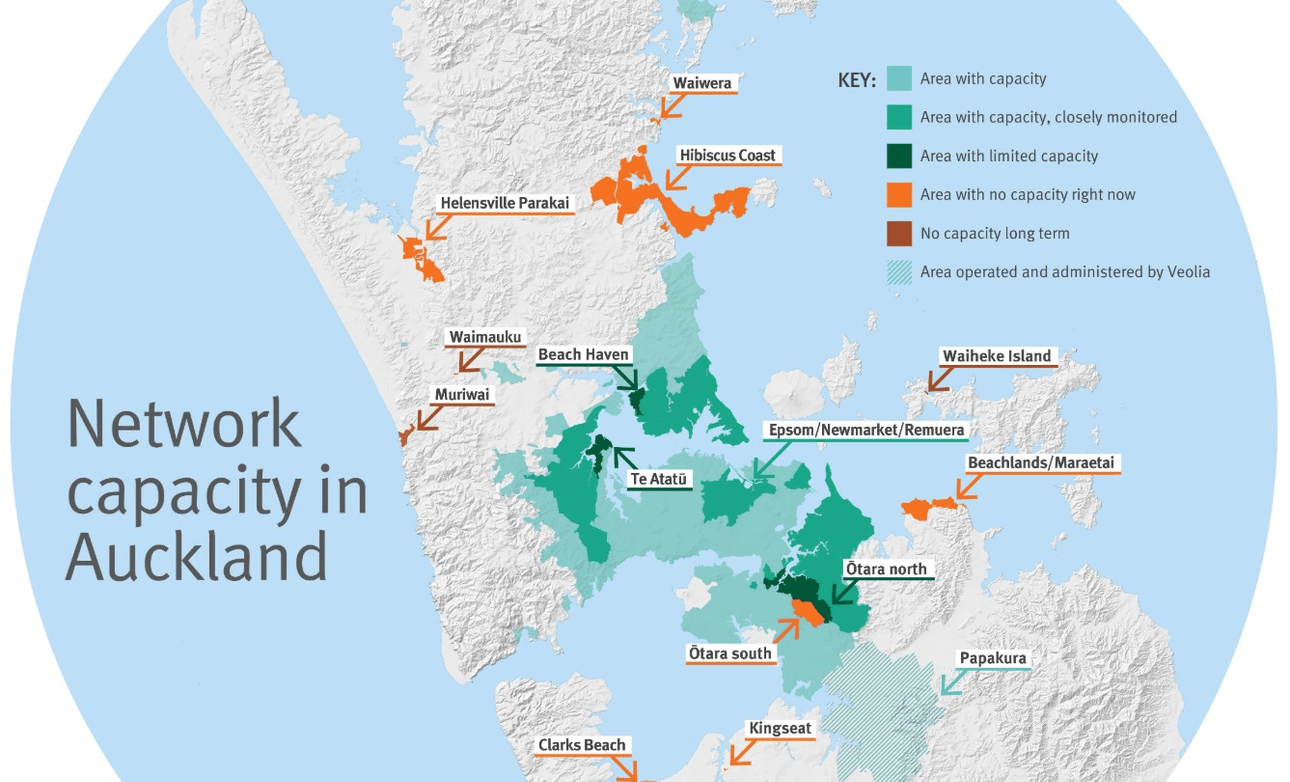
Yesterday the worriers got their wish. Thanks to a government backdown wrangled over chardonnays and summer barbecues, councillors are allowed to reduce the capacity in the new plan from two million to 1.6 million houses. Council’s policy and planning committee was meeting to decide where to make those cuts, and its chair Richard Hills started out explaining the staff recommendations to prioritise places 10km or more from the city centre. Asked why those areas should get first dibs on downzoning, council planner John Duguid was clear: it was because the land within 10km of the city centre had the best access to public transport, employment opportunities, regional amenities like parks and pools and three waters capacity, as measured by Watercare:

Map of Auckland showing water network capacity. Areas are shaded by capacity: green (with capacity), teal (closely monitored), blue-green (limited capacity), orange (no capacity now/long-term), and labeled locations.
Three waters capacity in the central areas is set to improve even more when the Central Interceptor comes online soon. (Image: Watercare)

It should have been a celebration. But what would you know, most of the people who were once so concerned about ensuring housing is near infrastructure weren’t happy. Instead they were stewing over the revelation that the places with the best infrastructure were in their well-to-do wards. North Shore councillor John Gillon had looked at the maps and found that a 10km radius from the city centre would include the entire area he represents. He moved an amendment, seconded by Fletcher, to delete the 10km clause, saying he was “concerned” about the figure.

Waitākere councillor Shane Henderson was having none of it. He pointed out that west and south Auckland had accepted the vast bulk of the new houses in Auckland since the Unitary Plan passed in 2016. As for strain on infrastructure, those areas have limited pipe capacity and less access to public transport, and we see the effects of that outside-in planning in rush-hour congestion, parking shortages and sewage overflows, he said. Henderson argued Fletcher and Gillon were engaged in “a poorly dressed up move to take away intensification from the best-equipped parts of the city”. “The intention is simple: to downzone wealthy suburbs. There is no sensible reason for excluding central isthmus communities – again –  from doing their part.”

The mayor was, if anything, more blunt. He said Gillon’s motion was aimed at putting housing in Pukekohe rather than areas close to “all the infrastructure”. “I don’t want to see endless sprawl just so nimbys in Parnell and politicians can get re-elected,” he said, in what appeared to be a shot at his political nemesis, Act leader David Seymour. “That’s disgraceful, I can’t vote for it.” ...

As Brown saw it, his colleagues’ first purpose was elitism. But if they had a second priority, it was delay. Gillon and Fletcher also put forward an amendment proposing to ask the government for more time to enact Plan Change 120. ...

The demand was familiar. Fletcher has asked for more consultation in just about every planning meeting for years, and the mayor was incensed. “I want to get out of this without further delay and dithering,” he said. “God almighty, it would be great to do something this three-year period.” ...

“For fuck’s sake, get on with it,” he said, as Fletcher spoke for the final time. ...

Afterward, Brown expanded on his frustration with Fletcher, saying the meeting was “one long filibuster to stop poor people living in her area.” 

Read the whole thing here. It's an entertaining lunchtime read.

[Pics from Spinoff]

Wednesday, 25 February 2026

Norris House - Claude Megson

Architect Claude Megson talked about the "great-souled house." A house not just to park oneself in, but a universe we construct for ourselves.

Perhaps his best example -- his own second-favourite (after his own house) -- is the Norris House in Remuera

And it's for sale ...


Thursday, 5 February 2026

Auckland can't afford a second crossing ... or can it?

OVER SUMMER ONE ALWAYS gets a few ideas. Some good, some questionable. Some that just seem obvious once they've occurred to you. 

Here's one of those.

Let's start with three propositions: 

1. Auckland can't afford new infrastructure.

2. But Auckland would like to move its port. (But Auckland can't afford new infrastructure.)

3. Auckland will soon need a second harbour crossing. (But Auckland can't afford new infrastructure.)

Auckland can't afford that new infrastructure. Can't it? Perhaps it can.

Let's see what happens if we put those three problems together. As architects like to say, the solution is often contained within the problem ....

LET'S START WITH A CONTROVERSY from a few years ago when then-mayor Phil Goff complained about the Ports of Auckland steadily encroaching on the harbour with its ongoing reclamation work at the Ferguson container wharf. We joked that if they kept going, the Port would eventually end up in Devonport ...

A good joke.

But what if the wharf—or some part supported by the wharf—somehow did end up there?

Might that be a good thing?

Let's think: at the moment (see below) 

  • the gap between Devonport and Port is just 800 metres -- that's compared to the 1000 metre length of the existing Harbour Bridge
  • the rail line to Britomart passes right beside the container wharf
  • the Grafton gully motorway points in a straight line down to the container wharf
  • RNZ Navy land takes up some of the best land in the country to house the world's most ineffective navy
  • existing tidal wetlands and greenspace on Belmont/Devonport (Charles Reserve, Hauraki Primary, Philomel Reserve, Bayswater Park, Plymouth Reserve, Hill Park, Ngataringa Park) offers scope to avoid simply dumping traffic on Lake Rd, and instead to link up with existing Northern Motorway at Takapuna.

Could we all win?

I think we could.

So the project could feature

  • elegant new 'gateway' bridge for road, rail and foot
  • new spur rail line from existing Quay Street rail line to Devonport
  • new Devonport railway station, with platform under bridge (with a later link to Takapuna as well?)
  • new road connection to existing motorway at Takapuna and at Grafton
  • new apartments and marinas on and around existing container wharf (southside) and on former naval base (northside)
The latter (i.e., apartments) would pay for the former (i..e, everything else) --- and for the port and the naval base to move. They would have to.

The port is important, make no mistake. But viable plans for the port to move have already been drawn up. And there's no reason for New Zealand's Navy, who would be second in a fight with Switzerland's, to be there at all—squatting on some of the country's most expensive real estate rather than hanging out somewhere much less expensive. If you must keep them in Auckland (why?) then dredge the Manukau. Removing them will help to some small extent in removing pressure from Devonport's housing market -- as will new apartments built around what will be a new transport hub there.

IN ITS FAVOUR:

  • very little distance to build the crossing (just 800m at present, compared to 1000m for the existing bridge, which could still be further reduced)
  • done well, the bridge and apartments together become a gateway to the city's inner harbour, framing it and re-defining it
    • curved bridge which, like San Diego's renowned curved Coronado Bridge, would be high enough for ships to pass under, 
    • and/or, like Santiago Calatrava's magnificent structures, delicate enough to enliven the harbour, which would be both structurally elegant and appropriate as a harbour-side gateway to the city
    • even a 'utilitarian' suspension bridge or cable-stayed would suit (we have plenty of great bridge designers here)
  • removes some proportion of traffic from existing Harbour Bridge 
  • easier Devonport road connection, removing congestion from Lake Rd
  • immediate foot, cycle, and rail access to/from Devonport
  • high-density apartment living on former container wharves, enjoying spectacular harbour views, a new marina, and easy walkable access to city wand waterfront
  • high-density apartment living on former naval base waterfront living enjoying spectacular city views, with a marina, an easy commute to city and beyond (and public transport direct to city via new spur rail line!), and easy walkable access to both the waterfront and to Devonport...
What's not to like? Even Wayne Brown should like it, because he'd get to bully the Navy, the Port authorities, AT and ministers of transport and defence.

San Diego's renowned Coronado Bridge

Sharq Crossing, Doha, by Santiago Calatrava
PROBLEMS?
  • Nimbys, of course, in Parnell, in Devonport and in Belmont
    • some property in Belmont and in Devonport will need to be bought, voluntarily -- or perhaps the air rights bought
    • Parnell owners already regularly whinge about the existing container wharf anyway
  • work on coastal wetlands
    • that said, this would be an ideal opportunity to fix (properly this time) some of the drainage issues around these areas
  • new location needed for the container port, and imported cars...
    • not an insignificant cost, but relocation also paid for from apartment sales...
  • bridge needs to allow large cruise ships underneath
    • so it needs to have some height!
  • cost
Cost is always the biggest problem. And too much taxpayer money has been wasted already. But that's the benefit here: these apartments on both sides, sit on over 100 Hectares some of the most valuable real estate in the country -- currently occupied only by cars, containers and a Navy that needs to bugger off. At even just 50-100 dwellings per Hectare that's still between 5-10,000 apartments to be sold. Multiply that number by a few million dollars or so, and you're in the ballpark for your project budget.

The revenue from the new development (apartments, marinas, hospitality etc.) should more than pay for the project -- and have the added benefit further helping intensify the central city (a god thing), and bringing down house prices all over the(a great thing!). 

The only major problems I foresee, apart from the bureaucratic haggling about which branch of government owns what, is that government (central or local) would set themselves up as the developer. Which never ends well. And that, inevitably therefore, given the glacial rate of progress of recent projects around the city, it will be the next half-century before anything is ever completed.

Monday, 2 February 2026

"The point is not to get 2 million homes."

"Right now, Auckland Council’s zoning allows people to build about a million shops selling tasty pies. ... Can you imagine it? Auckland with a million pie shops – and hardly anything else.

"Of course it is ridiculous. ... The number of pie shops finds its own level, adjusting as demand changes. There is no 'right' number that can be determined on its own. The right number is found as entrepreneurs take punts and consumers make choices. ...

"When central government asked Auckland to zone to allow up to 2 million additional dwellings, it wasn’t a demand that Auckland build that many homes. Or even an expectation that anyone would ever try to build nearly that many.

"The point is not to get 2 million homes.

"When lots of places can turn into houses, townhouses and apartments when housing needs change, then new housing can just turn up when and where it is needed. Developers watch where people most want to live, look at the cost of developing in different places, and try their luck. ...

"[Councils however] have been reluctant to allow enough new housing to keep up with demand ... [so] as a way of resetting planning culture, central government has mandated that [councils] allow more housing, using numerical targets. ...

"For now, just remember that Auckland allows about a million pie shops. Look around. Do you see a million pie shops?

"Things being allowed does not cause them to exist. But allowing competition changes, and improves, what can exist."

~ Eric Crampton from his op-ed 'The misguided fuss over ‘2 million more’ houses for Auckland

Wednesday, 21 January 2026

Another frickin' housing backflip!

Christopher bloody Luxon has now announced his fourth major housing policy backflip as National party leader.

I say "announced," but since the pissweak pipsqueak is too pusillanimous to even consider openly putting his head above that particular parapet, he's instead allowed news of his latest flip-flop to leak out from the likes of the oleaginous Matthew Hooton.

Sadly, since most of those backflips have come when Luxon's party is in government, the big loser here is anyone who wants sufficient certainty to plan, build, lend on, borrow against or borrow to buy a house. Let alone several houses. Which means: Almost all of us.

Ever wondered why the Auckland residential construction industry is in a hole? One big reason is the hole in Luxon's head that swings from NIMBY to YIMBY like a weather vane in a storm —making him first abandon bipartisan agreement on housing intensification, then talk about "going for growth," then abandon that again, then talk up Auckland's planned intensification, and now, apparently, abandon it once again. If it's certainty you're after to plan and build, then this Prime Minister and his weather-vane brain is not doing much for you.

Asked for details this morning of his latest backflip, suggesting a reduction in the requirement for Auckland Council to zone for a minimum two-million sites, the pissant Prime Minister spoke to Radio NZ for eight minutes while saying effectively nothing beyond we'll all just have to wait and see. So there.

Asked if it would make a difference if the two-million housing figure was pulled back to 1.5 million, [Scott] Caldwell [from the Coalition for More Housing] said lowering the two-million figure would undermine the feasible capacity of new homes.
And so it will.
“Any pulling back would be compromising Auckland’s housing affordability,” he said.
Which it will.
Caldwell said constant back and forth over new planning rules for more housing since 2020 inevitably meant more delays, and it could be the 2030s before more houses were delivered.
Which is true.
“Waiting until 2035 to deliver real cost-of-living wins is a generation too late for those struggling to find affordable housing in our largest city,” he said.
Which it is.

Wednesday, 30 April 2025

ACT leader whimpers about ACT leader

ACT LEADER DAVID SEYMOUR IS outraged that Auckland Council plans to set up a co-governed committee to manage the Waitākere Ranges. "Auckland Council’s plan to set up a co-governed committee to manage the Waitākere Ranges shows why Kiwis need councillors who believe in democracy," says ACT Leader David Seymour.

Democracy.

“The Waitākere Ranges belong to all Aucklanders [says the ACT leader] and should be managed democratically. But Auckland Council’s plan would see unelected decision-makers closing tracks and dictating land use in the surrounding rural areas."

Dictating.

“The ranges are governed under the Waitākere Ranges Heritage Area Act," notes the ACT leader. And the Waitākere Ranges Heritage Area Act calls for a "Deed of Acknowledgement" recognising and giving power to tangata whenua. If the ACT leader has a problem with the Deed of Acknowledgement and the giving of power then — since it's the Waitākere Ranges Heritage Area Act that requires the acknowledgement and gives such power — then it's the Waitākere Ranges Heritage Area Act that he has a problem with.

One can only imagine that the ACT leader then was just as outraged.
Minister for Local Government, 2008-11

Except ... it should be further noted that the Waitākere Ranges Heritage Area Act was introduced by the Minister for Local Government in 2008, and brought into law in April 2008. And that ACT leader was himself Minister of Local Government for three years from 2008 to 2011, in which he had ample opportunity to amend the Act.

He didn't.

Ample opportunity to restrict the powers of  local government to those in which it enjoyed a "general competence."

He didn't.

What did he do instead?

Oh, that's right. He spent his time, ego, and rapidly dwindling political capital on super-sizing Auckland's already tumescent council, all but ensuring citizens' rates bills would be equally super-swollen.

Dictating to Aucklanders how their "democracy" would work.

Local government in New Zealand exists because central government created it, and grants it powers. Instead of drastically shrinking the power of local government, as an ACT leader should have done, that ACT leader instead awarded this super-sized council many more. Including the power — nay, the necessity — to set up a co-governed committee to manage the Waitākere Ranges. 

It's a bit late now to watch this ACT leader whimpering about it.

Thursday, 3 April 2025

Did you know you can see shit political economy from space? [update 2]

Auckland: Eden Terrace's workers' cottages on the right, Mt Eden's California Bungalows 
beginning over the railway line lower left. (Photo showing the area before the Dominion Rd flyover,
from the Sir George Grey Special Collections, Auckland Libraries, 580-9498']

Did you know you can see shit political economy from space? Here below is the Black Hole of North Korea at night, too poor to have enough lights to switch on.

And you can see shit political economy in Auckland too, in aerial photographs. To be accurate: you can see shit political economy in the form of the effect of tariffs. ...

Let me explain.

The first houses built here en masse were workers' cottages and then villas. When you fly over the city, you can see a ring of these villas around the inner parts of the city — especially so in Ponsonby and Grey Lynn — built right up until the First World War.

But after that war, something changed. It seemed to some that the United States had rescued Europe from its Great War, and had a lifestyle to which an increasingly prosperous population could aspire. It was the Jazz Age — the age of radio, electrification, automobiles, and the mass production (Fordism!) that made them affordable. In love with Americanism, in housing here it became the decade of the California Bungalow.

California Bungalow, Mt Eden

A villa is not a bungalow.  Like the California lifestyle it aped (and which the world would fully fall in love with after another war), the California Bungalow was freer than the more uptight Victorian villa, and reached out for sun and air. Their broad spreading gables form a second ring around the city in what we now call the "tram suburbs," a ring from Pt Chev through Mt Albert, Sandringham, Mt Eden, Greenlane, Ellerslie, and right around to the border of Meadowbank/Remuera.

Their popularity was immense. 

Their takeover seemed unstoppable. 

Until something happened.

That something involved a tariff. Brought in by US Senators Smoot and Hawley, their Smoot Hawley Tariff Act raised tariffs on imports by an average of twenty percent. Their intention (we're told) was to quarantine American manufacturers from the effects of the 1929 stock market crash. What it did do instead was to spread the misery and contagion around the globe, kicking off the Great Depression and all but shutting down international trade for nearly two decades.

John Bell Condliffe's "wagon wheel" showing the dramatic death spiral of world trade
following the disastrous implementation of the 1930 Smoot-Hawley Tariff Act

New Zealand economist J.B. Condliffe has a world-famous diagram describing the accelerating downward spiral of trade as every country and trading bloc in the world put up their own tariff walls in response. It was one of the most successful acts of intentional self-destruction in all modern history.*

Almost at a stroke, we fell out of love with the US.  In Britain, still the head of something called an Empire, an Imperial Preferences Act was swiftly passed making trade within the Empire roughly tariff-free — allowing many Commonwealth countries to escape the Depression first. (Not so the US of A, which had to wait until the death of a President and the end of a war to boom again.)

And trade amongst the Empire, rather than outside it, meant many more British goods replacing the previous love affair with American. Not least in housing. If the twenties was the decade of the California Bungalow, then the thirties was the decade of the English Cottage/English Revival. We can see these crabby, restrained offerings around the outer parts of the tram suburbs. (And you can see all these styles described in the Auckland Council's 'Style Guide,' pp 14-24)

In insulating itself from the world, America had not only shot itself in the foot economically, it also lost its influence with the rest of the world. 

Turned out it was a not-so-great way to Make America Go Away Again.

* * * *

* Until April 2, 2025, that is, with what Johan Norberg calls "the longest suicide note in economic history."


UPDATE 1: David Farrar notes that our average two-percent tariff rate (world's second-lowest after Singapore) becomes in the mind of the Toddler-in-Chief a twenty-percent tariff. (I use the word "mind" loosely.)

Johan Norberg has more on the effects of what he jokingly calls '"Liberation Day June 17 1930":


As he says, " I think the US was heading for trouble even before, but it certainly deepened the depression and spread it around the world, with devastating effects for European democracies. We would have had a depression anyway, but perhaps not a great one."

UPDATE 2
"Thomas Rustici identified the role of the Smoot-Hawley Tariff Act in exacerbating the Great Depression, particularly through its effects on trade, banking failures, and economic contraction. His seminal work, *Smoot-Hawley and the Great Depression: A General Equilibrium Analysis* (2005), presents a compelling argument that Smoot-Hawley initiated a trade war, triggered mass bankruptcies, destabilized the banking system, and led to deflation and depression. ... 
"Conclusion Rustici’s work provides one of the most comprehensive and rigorous explanations of how the Smoot-Hawley Tariff Act triggered a trade war, bankrupted farmers and businesses, destabilized the banking system, and created deflationary collapse. His analysis is central to understanding how protectionist policies can create economic catastrophe by disrupting credit, trade, and monetary liquidity. His insights remain critical in debates over trade policy and economic crises."

Monday, 3 March 2025

Another National tax grab

Leadership aspirant Chris Bishop headed to Auckland recently to tell us of the grand plans he will very kindly allow us to build. But before that, a new tax.

David Farrar kindly ssummarises. I unkindly fisk ...

Bishop says: "Congestion stifles economic growth in Auckland, with studies showing that it costs between $900 million to $1.3 billion per year. Congestion is essentially a tax on time, productivity, and growth. And like most taxes, I’m keen to reduce it."
Yes, congestion stifles economic growth. Yet little has been to arrest it. And over the last dozen or so years councils and transport ministries and bureaucracies have done everything to promote it, with transit lanes, bottlenecks, speed humps, speed restrictions, cycle lanes, bus lanes, no-right-turns, no-left-turns, pedestrianisation, beautification ... anything but combat traffic congestion.

Sit beside almost any major Auckland thoroughfare and you'll see that useable traffic lanes at rush-hours have nearly halved, while traffic has nearly doubled. A few nights back around 10pm a friend and I sat beside Hobson St — a near-motorway that once had six lanes or so allowing motorists to get out of the city on her motorways. Those lanes are now halved (with beautification works, don't you know, as part of John Key's bloody Convention Centre white elephant) and even at 10pm motorists were in a jam.

Will Bishop improve mobility?

Will he hell: he intends instead to make mobility more expensive.

Bishop says: "The government will be progressing legislation this year to allow the introduction of Time of Use pricing on our roads."

As commenter Bill says on Farrar's thread: "OK so another tax. Is there no problem the government thinks can’t be fixed without more taxes?

"We the motorists already pay for the roads with petrol tax and registration fees. How much of this money has been spent creating traffic bottlenecks, humps, removing free left turns etc? How is any of that helping with congestion? This latest tax proposal should be vehemently opposed. The money squandered on all the traffic obstruction should instead be spent on facilitating the uninterrupted flow of traffic. It sounds like they want to tax motorists to fix a problem that they themselves created. This is not incompetence, it is villainy."

Bill is right.

Bishop says: "Any money collected through time of use charging will be required to be invested back into transport infrastructure that benefits Kiwis and businesses living and working in the region where the money was raised."

Bishop is bullshitting.

Nicola Willis is so short of the readies already that she'll be overjoyed to grab as much of this windfall as she can. And if not her, then as soon as things are "bedded down," your next finance minister will have his or her hand in your pocket to root around in your small change. Don't doubt it.

Bishop says: "Modelling has shown that successful congestion charging could reduce congestion by up to 8 to 12 percent at peak times."

As every hired modeller knows, modelling will show whatever the modeller's hirer wants it to show; it all depends on the parameters chosen for said model. Sure, make something more expensive and (depending on one's marginal utility) then less of that thing will get utilised. But if the marginal utility of getting around is high enough (and it probably is) then Bishop's new tax will just make getting around more expensive. And we'll still be congested. And poorer.

Bishop says: "New Zealand can raise our productivity simply by allowing our towns and cities to grow up and out."

Well, duh.

Some of us have been arguing for years that up-and-out will make Auckland both more liveable and affordable. (Productive? That's an odd one to claim.) But with developers and builders having to sit on their hands while Bishop's bureaucrats rewrite the RMA to say what councils will allow developers and builders to do — to relieve the uncertainty since Bishop and his boss canned the MDRS — it seems like we're as far away as ever. And that uncertainty is hardly making developers and builders more productive ...
Bishop says: "My aspiration [for Auckland] is ..."

You know, frankly, it doesn't matter a shit what Bishop's aspirations for Auckland are! Because given the piss-poor popularity of his boss, and the pathetically slow promise to abolish and replace the RMA (to protect property rights, we're promised, and to finally give some certainty to those developers and builders) then  it will be too damn late this term for any changes at all to be made, and next term he'll have lost his chance.

And this time, three years from now, we'll all be sitting here in exactly the same position.

Only by then we'll (maybe) have a new train set.

And we will have bloody Bishop's new tax.

Wednesday, 5 June 2024

NZ housing still severely unaffordable


Demographia's annual study on housing affordability around the world has just been released for 2024.

The good news is that Auckland has become marginally more affordable. 

Yay!

The bad news is that still doesn't mean it's anywhere near affordable. And one major reason for that good news has been in abeyance since the last election campaign.

A city's Affordability Index is generally measured as the city's median house price divided by its median annual salary.  Increased densification allowed under the new Unitary Plan and then the Labour-National bipartisan agreement on house-building (essentially  relaxing rules to allow 3 story 3-unit developments "as of right"), allowed a brief period in which more building was allowed to be done, and was. The effect was to reduce Auckland's Index Number from the severely affordable  8.6 (i..e, median house price was 8.6 times median annual salary) to the still frightening 8.3 (the number should be much closer to 3.0).

That puts Auckland squarely in the top rank of the world's unaffordable cities, edging out more affordable cities such as Miami and Greater London (8.1), New York, NY-NJ-PA (7.0), and Brisbane and Perth (8.1, 6.8).


The graph showing building consents up to mid-2022 tells the increased-supply part of the good story. Research reinforces it: "Five years after zoning regulations were relaxed across more than three-quarters of Auckland, Dr Greenaway-McGrevy's research has found the changes have resulted in more than 20,000 additional homes across the city."

The even more bad news however is that building has almost slowed to a halt since National backtracked on that bipartisan agreement — "figures from Statistics NZ show building consents were issued for 2931 new dwellings throughout the country in March. That's down 26.2% compared to the 3971 consents issued in March last year." In Auckland, the number of consents issued dropped by 30.6%! Housing researcher Dr Greenaway-McGrevy now says "any future benefit from the up-zoning change now had a 'question mark over it'."

You can blame the big mouth of Christopher Luxon and his housing minister for much of that.


Wednesday, 15 May 2024

"...*if* Mr Bishop delivers on his promise."


"Far too many New Zealanders already suffer from serious financial stress because of the ridiculous price of houses. The problem is only going to get worse unless the Government delivers on the promise made by the Minister of Housing, Chris Bishop, who, in a major speech near the end of February, said the Government is aiming to get house prices back to where the median house price is between three and five times the median household income. To protect himself from the anger of thousands of property-owning voters, he did say that that was his ambition over the next 'ten to twenty years,' but if he is at all serious New Zealanders better get used to the idea that house prices will not be rising steadily year after year into the indefinite future.
    "Increasingly, as houses get older and in need of repair, and if the market is working as it should do, they will sell for less than they cost to buy.
    "But what about the land they sit on? Surely that won’t decline in value? Certainly there will always be land which has special appeal: that will quite likely rise in value faster than other prices and faster than incomes. But given New Zealand has a great abundance of land, section prices should be nowhere near where they are currently in most of our cities. That implies that section prices are likely to stagnate or decline from present levels if Mr Bishop delivers on his promise. [Yes, "if" - Ed.]
    "In an earlier article I quoted the case of a 455 square-metre bare section on sale in Drury – nearly 40 kilometres from downtown Auckland – for $842,000 including GST, or $1,850 per square metre. This is more than 10 times the average price per square-metre of sections in the US. This difference is caused primarily by the tight restrictions imposed by local governments on where houses are allowed to be built.
    "Those who demand that housing be confined within tightly prescribed urban boundaries – as is true in all our major cities – must be told again and again that they and they alone are primarily responsible for the appalling social costs arising from the outrageous price of housing in New Zealand’s major cities."

~ former Reserve Bank governor Don Brash from his post 'Perhaps house prices don’t always go up'


Tuesday, 14 May 2024

"You're free to build, but ..."


The National-led Coalition boasts that it will "fix housing" by bringing in rules requiring councils to zone enough land* on which land-owners are free to build sufficient housing to allow for the next thirty years of demand.**

Doesn't that sound great, you think. "Free to build," you say! 

The National-led coalition's housing honchos are either stupid, naive, or they think that we are.

As should have been obvious from Auckland council's passive-aggressive resistance to government diktats on the Medium-Density Residential Standards (MDRS), telling councils to "free up land" only works if councils are so inclined. If they are already so inclined, ministers wouldn't need to tell them. And if they aren't so inclined then, well, as Bryan Caplan points out in his new "graphic novel" Build, Baby, Build: The Science and Ethics of Housing Regulation, councils can hinder construction in dozens of other ways ... if it's so inclined. (And it is.)

For starters it could ...

Go tell Minister Bishop. (Or send him a copy of Bryan's book.)

* * * * 

* Zoning is a restriction on land telling owners that the planners know better than the owner (and would-be buyers) what should go there. How is it a restriction, you ask? If the planners' zone allows what the owner would do anyway, it's not needed. If it disallows it, it's not wanted.

** This presumes that the grey ones would even know, to any standard of meaningful proof, what demand would look like over the next thirty years. I mean, it's not like there's any thirty-year stretch in recent history they could point to and say "look, we got it right."

Thursday, 1 February 2024

"It may sound stark, but Wellington city no longer adds up."


The Aro Street Geyser. [Pic from Stuff]

"The Coalition Agreement between National and ACT states as a 'principle' that decisions now will be 'based on sound public policy principles, including problem definition, rigorous cost benefit analysis and economic efficiency.'
    "So what is cost-benefit analysis? It is not simply calculating the ratio of the benefits to costs of a decision and choosing to spend money when the benefits exceed costs. No, it involves calculating those ratios for all prospective projects and ranking them from highest to lowest. 
    "Given a limited budget, one must select projects with the highest ratios until the budget is spent. On such a basis, Wellington should be left to fail. Why? Because its vast infrastructure needs, ranging from Mount Victoria Tunnel to port facilities to shambolic water leakage problems involve relatively limited benefits & massive costs that make no sense when compared to the urgent needs of Auckland....
    "It may sound stark, but Wellington city no longer adds up. It is built on subsidies and the backs of others. The costs of running it are no longer justified. An unshakeable implication of the Coalition Agreement is that Wellington should be left to fail and many of its Ministries moved elsewhere.'

RELATED:


Thursday, 25 January 2024

Whatever happened to the idea that building and maintaining infrastructure is council's core business?


YESTERDAY MORNING, THE RESIDENTS OF Waipukurau were awoken to loudspeakers in the street "spreading the message of immediate and vital water restrictions" after a "major leak."

South Wairarapa residents endured water restrictions two weeks ago due to leaks in their water infrastructure.

All summer, water and sewage has continued to pour downs Wellington streets, while water restrictions are imposed in Wellingtonian's homes and the council starts planning for a state of emergency. (An announcement this morning says Wellingtonians should prepare for "Level 3" restrictions, and the declaration of a "drinking water emergency.")

And on Boxing Day in Auckland, thirty-six of Auckland's beaches were off limits because they were contaminated with poo.

It's all a bit shit at the moment, isn't it. All too literally.

Billions of dollars are supposed to be needed to fix New Zealand's threadbare infrastructure after what's said to be decades of underground under-investment.  Local Government New Zealand (a lobby group for the very people who under-invested) reckons we are "heading toward a tragedy if more is not invested in council infrastructure, and that people need to get used to double-digit rates increases." Infrastructure New Zealand (a lobby group who chases government dollars for its members) reckons the number of billions needed is somewhere near 200 billion.

The solution from both lobby groups is supposed to be lots of central government cash.

Meanwhile (to pick one council just at random, since it's where I live) Auckland council's rate this year are going up another 7.5 percent this year. And that's with a mayor supposedly reluctant to raise them. And to pick another (let's use Wellington since it presently has the highest-profile mayor) they've just voted to "invest" $330 millions dollars in a tumble-down town hall —on the back of a 12.3 percent rate rise which still doesn't cover what could be a billion-dollar hole in their accounts.

Um.

May I ask a polite question?

Just what the fuck is the primary purpose of local fucking goivernment? 

Whatever happened to the idea that building and maintaining infrastructure is council's core fucking business?

If I refer to my handy copy of G.W.A Bush's history of Auckland Council (if you just give me a moment to find it) we find that the clamour for setting up the damned thing back in the 1840s was because sewage was flowing in the streets. Specifically Queen Street. "Auckland," wrote the 1847 editor of The New Zealander, while it is "erected in the healthiest country in the world, has enough filthy lanes and dirty drains to keep up a virtual plague, had it been situated in a less airy country." Set up finally in 1851, its core business (reflected in its six committees) was Bye-Laws, Roads, Public Works, Public Health, and Charitable Trusts. This reflected Lord John Russell's instructions to Governor Hobson back in December 1840 that "district governments" should be set up "for the conduct of all local affairs such as drainage, bye-roads, police, the erecting and repair of local prisons, court-houses, and the like."

Much responsibility has been taken away from councils since (bye-roads, police, the erecting and repair of local prisons, court-houses, and the like) so from the Lord's list we're left, as core business, just drainage.

Fucking drainage.

You know, the stuff that's supposed to contain that stuff that's running down our streets.

This is what Labour's Three Five Six Waters was supposed to solve, taking away this the core business of council. National has binned that, but continues to dangle to councils a somewhat similar carrot. Because some councils were, and still are, keen to off-load the job of drainage to someone else. 

But if I may again ask another polite question: Why the fuck aren't councils doing the fucking job they were specifically set up to do?

Huh?!

It's not like they've been keeping rates down while they've under-fucking-invested.

New water infrastructure is desperately needed around the country because, for the most part, for at least two decades, council's haven't been doing their core work.

Why do I say two decades?

Guess why: just over two decades ago, in 2002, the then-Local Government Minister was the hard-left Alliance Party's Sandra Lee. And it was then that local government debt began to rise dramatically — not because councils around the country were over-investing in infrastructure; not because they were going hard on their core business; not at all because they were building, maintaining and upgrading roads, bye-roads, drains, pipes and parks as they were damned well supposed to. For the most part, instead, with some significant exceptions, they weren't. What they began building instead was a lot of expensive fucking monuments

Monuments mostly to themselves.

The culprit here was Sandra Lee's Local Government Amendment Act 2002, which granted to city councils, district councils and regional councils a "power of general competence" (I know, right?) which would enable them to enter into any activity they wished, with the only limit being their imagination and the pockets of their ratepayers.

Prior to Sandra Lee's Local Government Act, councils could only do what they were legally permitted to to, i.e., to carry out their core business. After Sandra Lee's Local Government Act, however, the leash was off. And council credit cards started straight away racking up debt for vanity projects everywhere. 

I'd like to say I told you so. I'd like to, so I will. Because I was as outraged then as I am now:

Libertarianz Leader Peter Cresswell is outraged at today's announcement by Helen Clark and Minister of Local Government Sandra Lee to grant local authorities "a power of general competence" in order to "enhance the well-being of their communities." "The well being of everyone in a community is more likely to be enhanced by retaining a tight leash on councils," says Cresswell, "since most councils have already well demonstrated they struggle for competence."
    "Local government throughout New Zealand's history has demonstrated its utter incompetence in handling the loot they confiscate from ratepayers by wasting it on such idiocies as the New Plymouth Wind Wand, the Auckland Britomart edifice, and the Palmerston North empty civic building." he said. ...
    "More substantially," says Cresswell, "there is a crucial constitutional principle at stake -the constitutional principle that citizens may do whatever they wish, apart from what is specifically outlawed, whereas governments and councils may only do what is specifically legislated for. The main purpose of this constitutional principle is to keep a leash on government, both central and local. It is this leash that is beginning to gnaw at local governments, and it is this leash that Clark and Lee propose to untie."
    "It is a dangerous step to take," warns Cresswell, who points out that councils are being given more 'freedom' at he same time as the Resource Management Amendments Bill threatens to take away even more freedom from New Zealand property owners. "The constitutional principle is being reversed," he says. "Even as they propose giving local government wider powers to act, they are taking away the power of individuals to act for themselves," says Cresswell. "Every property owner should rise up in protest," he says.
    "Libertarianz will be making a strong submission on the consultation document," says Cresswell. 

Which we did. For all the bloody use that it did: The Clark Government passed it, a succession of Local Government ministers since since has kept it, and every bloody local councillor ever since Sandra's "permissive" Act has spent like a drunken sailor on shore leave with a start-up founder's credit card.

The New Zealand Local Government Funding Agency (LGFA) supplies around two-thirds of that council debt, and last time I looked their tab was just over $18 billion. That's about $20,000 for every ratepayer. Add to that an existing $5 billion of Auckland and Christchurch council debt. And those numbers are every year by around a billion a year as ballooning rates rises fail to keep up with even-more ballooning council spending.

And as you can now see, it's not like they've been spending much of it underground.

In Christchurch they've been turning the city into "an innovative and modern community with major facilities from Akaroa Wharf to Te Kaha Canterbury Multi-Use Arena." In Wellington they've been watching the city's infrastructure crumble while they vote to spend hundreds of millions on earthquake-prone inner-city monuments of questionable value. And here in Auckland, council have allocated yet another billion dollars (plus fuck-ups) to pour down the ever-expanding black hole of Len Brown's train set, plus several hundreds of millions more to continue transforming the place into "one of the world's most liveable cities."

A shame there are very few plans to make it an affordable one.

What on earth is to be done?

You know, here's an idea.

Instead of keeping Sandra Lee's Local Government Act and binning Three Waters, which is where this new Coalition Government is at the moment, how's about — and hear me out, now that you've all heard the story —how's about we bin Sandra Lee's act and tell fucking councils to stop over-spending, to close down their PR departments, and to get back to their core fucking business.

Maybe you could suggest something like that to Simeon Brown, who's the current Local Government minister. 

But you'll have to explain to him first who Sandra Lee is, and what she did back then to stuff things up. Because I don't think he was born then.