This is an amusing account below of an important public meeting. Important in the context of making Auckland an affordable city.
Here's some quick context: Auckland's town planners have strangled the city in red tape for years. In recent times however, many planners and councillors (and mayor Wayne Brown) have come around to the realisation that the fewer houses built, the higher the prices for those houses: that, just maybe, people might be allowed to do a bit more on their land, to maybe build a little more densely.
Opposing this, of course, are the councillors and politicians of the leafier suburbs like Christine Fletcher -- and of course David Seymour, who's dropped his party's alleged principles about property rights to wring his hands instead about there being 'no density without infrastructure.'
There's no greater hand wringer than Christopher Luxon however, who decided over summer that Auckland Council must 'downzone' their proposed plan change that would allow greater density.
So this meeting Wednesday night was to confirm where the push for greater density would be maintained in the upcoming Plan (where would be upzoned), and where that push would be relaxed a little (where would be downzoned).
When the government’s efforts to intensify Auckland were debated at council back in August last year, critics took turns wringing their hands about the strain it would place on infrastructure. Plan Change 120 [which will allow greater density] could end up putting apartments in places that weren’t set up to handle them, they fretted. “Ultimately you can’t do all this upzoning without making the commitment to provide the infrastructure that will support it,” warned Albert-Eden-Puketāpapa ward councillor Christine Fletcher ...
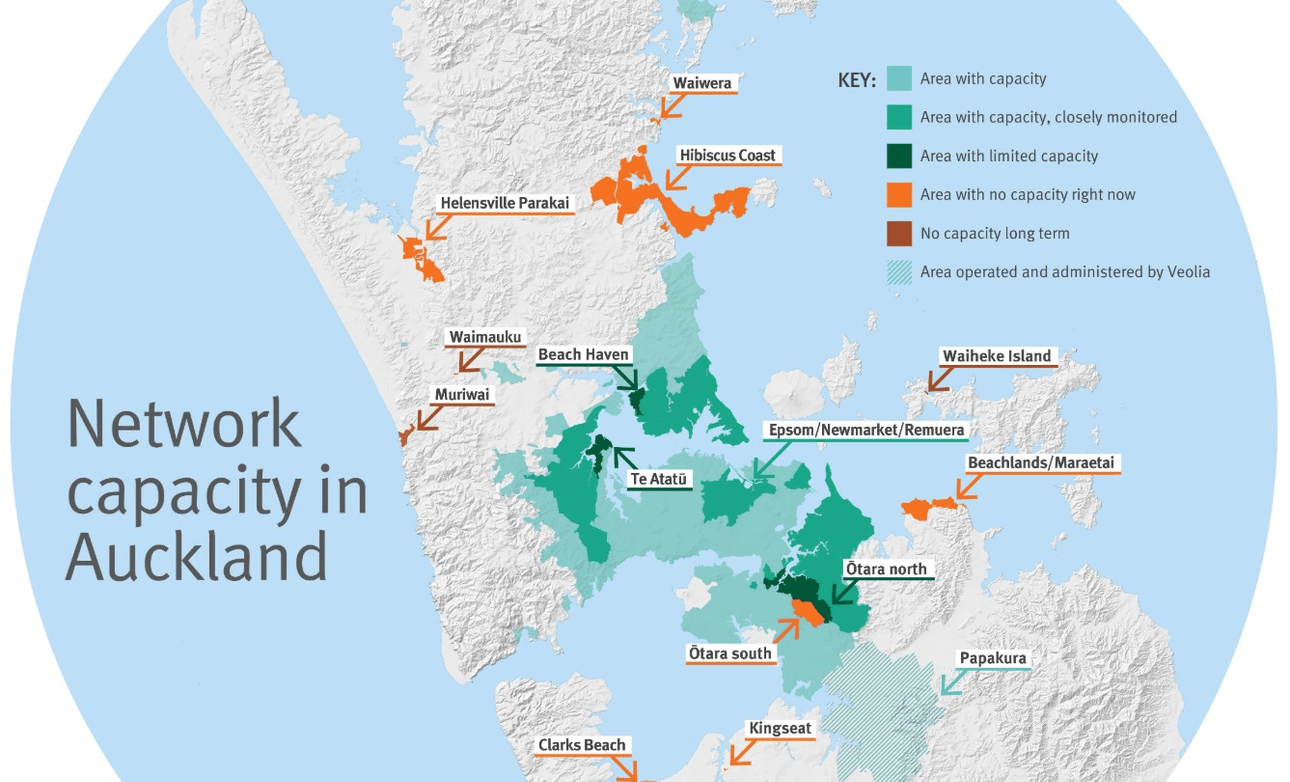
Yesterday the worriers got their wish. Thanks to a government backdown wrangled over chardonnays and summer barbecues, councillors are allowed to reduce the capacity in the new plan from two million to 1.6 million houses. Council’s policy and planning committee was meeting to decide where to make those cuts, and its chair Richard Hills started out explaining the staff recommendations to prioritise places 10km or more from the city centre. Asked why those areas should get first dibs on downzoning, council planner John Duguid was clear: it was because the land within 10km of the city centre had the best access to public transport, employment opportunities, regional amenities like parks and pools and three waters capacity, as measured by Watercare:
Three waters capacity in the central areas is set to improve even more when the Central Interceptor comes online soon. (Image: Watercare)
It should have been a celebration. But what would you know, most of the people who were once so concerned about ensuring housing is near infrastructure weren’t happy. Instead they were stewing over the revelation that the places with the best infrastructure were in their well-to-do wards. North Shore councillor John Gillon had looked at the maps and found that a 10km radius from the city centre would include the entire area he represents. He moved an amendment, seconded by Fletcher, to delete the 10km clause, saying he was “concerned” about the figure.
Waitākere councillor Shane Henderson was having none of it. He pointed out that west and south Auckland had accepted the vast bulk of the new houses in Auckland since the Unitary Plan passed in 2016. As for strain on infrastructure, those areas have limited pipe capacity and less access to public transport, and we see the effects of that outside-in planning in rush-hour congestion, parking shortages and sewage overflows, he said. Henderson argued Fletcher and Gillon were engaged in “a poorly dressed up move to take away intensification from the best-equipped parts of the city”. “The intention is simple: to downzone wealthy suburbs. There is no sensible reason for excluding central isthmus communities – again – from doing their part.”
The mayor was, if anything, more blunt. He said Gillon’s motion was aimed at putting housing in Pukekohe rather than areas close to “all the infrastructure”. “I don’t want to see endless sprawl just so nimbys in Parnell and politicians can get re-elected,” he said, in what appeared to be a shot at his political nemesis, Act leader David Seymour. “That’s disgraceful, I can’t vote for it.” ...
As Brown saw it, his colleagues’ first purpose was elitism. But if they had a second priority, it was delay. Gillon and Fletcher also put forward an amendment proposing to ask the government for more time to enact Plan Change 120. ...
The demand was familiar. Fletcher has asked for more consultation in just about every planning meeting for years, and the mayor was incensed. “I want to get out of this without further delay and dithering,” he said. “God almighty, it would be great to do something this three-year period.” ...
“For fuck’s sake, get on with it,” he said, as Fletcher spoke for the final time. ...
Afterward, Brown expanded on his frustration with Fletcher, saying the meeting was “one long filibuster to stop poor people living in her area.”
Read the whole thing here. It's an entertaining lunchtime read.
The fact New Zealand has an infrastructure crisis (roads, pipes, umpty-tum waters) is a testament to how short-term political thinking has encouraged short-term spending decisions. Labour's "plan" (if a glossy pamphlet without detail can even be called that) simply doubles down on that ongoing disaster. As Roger Partridge notes:
Rather than seek the best global returns, it would invest in New Zealand companies selected for political purposes. The fund’s goal is not profit maximisation but job creation through government-directed investment. This is corporate welfare dressed in the ... garb of sovereign wealth management.
YESTERDAY MORNING, THE RESIDENTS OF Waipukurau were awoken to loudspeakers in the street "spreading the message of immediate and vital water restrictions" after a "major leak."
South Wairarapa residents endured water restrictions two weeks ago due to leaks in their water infrastructure.
All summer, water and sewage has continued to pour downs Wellington streets, while water restrictions are imposed in Wellingtonian's homes and the council starts planning for a state of emergency. (An announcement this morning says Wellingtonians should prepare for "Level 3" restrictions, and the declaration of a "drinking water emergency.")
And on Boxing Day in Auckland, thirty-six of Auckland's beaches were off limits because they were contaminated with poo.
It's all a bit shit at the moment, isn't it. All too literally.
Billions of dollars are supposed to be needed to fix New Zealand's threadbare infrastructure after what's said to be decades of underground under-investment. Local Government New Zealand (a lobby group for the very people who under-invested) reckons we are "heading toward a tragedy if more is not invested in council infrastructure, and that people need to get used to double-digit rates increases."Infrastructure New Zealand (a lobby group who chases government dollars for its members) reckons the number of billions needed is somewhere near 200 billion.
The solution from both lobby groups is supposed to be lots of central government cash.
Meanwhile (to pick one council just at random, since it's where I live) Auckland council's rate this year are going up another 7.5 percent this year. And that's with a mayor supposedly reluctant to raise them. And to pick another (let's use Wellington since it presently has the highest-profile mayor) they've just voted to "invest" $330 millions dollars in a tumble-down town hall —on the back of a 12.3 percent rate rise which still doesn't cover what could be a billion-dollar hole in their accounts.
Um.
May I ask a polite question?
Just what the fuck is the primary purpose of local fucking goivernment?
Whatever happened to the idea that building and maintaining infrastructure is council's core fucking business?
If I refer to my handy copy of G.W.A Bush's history of Auckland Council (if you just give me a moment to find it) we find that the clamour for setting up the damned thing back in the 1840s was because sewage was flowing in the streets. Specifically Queen Street. "Auckland," wrote the 1847 editor of The New Zealander,while it is "erected in the healthiest country in the world, has enough filthy lanes and dirty drains to keep up a virtual plague, had it been situated in a less airy country." Set up finally in 1851, its core business (reflected in its six committees) was Bye-Laws, Roads, Public Works, Public Health, and Charitable Trusts. This reflected Lord John Russell's instructions to Governor Hobson back in December 1840 that "district governments" should be set up "for the conduct of all local affairs such as drainage, bye-roads, police, the erecting and repair of local prisons, court-houses, and the like."
Much responsibility has been taken away from councils since (bye-roads, police, the erecting and repair of local prisons, court-houses, and the like) so from the Lord's list we're left, as core business, just drainage.
Fucking drainage.
You know, the stuff that's supposed to contain that stuff that's running down our streets.
This is what Labour's ThreeFiveSix Waters was supposed to solve, taking away this the core business of council. National has binned that, but continues to dangle to councils a somewhat similar carrot. Because some councils were, and still are, keen to off-load the job of drainage to someone else.
But if I may again ask another polite question: Why the fuck aren't councils doing the fucking job they were specifically set up to do?
Huh?!
It's not like they've been keeping rates down while they've under-fucking-invested.
New water infrastructure is desperately needed around the country because, for the most part, for at least two decades, council's haven't been doing their core work.
Why do I say two decades?
Guess why: just over two decades ago, in 2002, the then-Local Government Minister was the hard-left Alliance Party's Sandra Lee. And it was then that local government debt began to rise dramatically — not because councils around the country were over-investing in infrastructure; not because they were going hard on their core business; not at all because they were building, maintaining and upgrading roads, bye-roads, drains, pipes and parks as they were damned well supposed to. For the most part, instead, with some significant exceptions, they weren't. What they began building instead was a lot of expensive fucking monuments.
Monuments mostly to themselves.
The culprit here was Sandra Lee's Local Government Amendment Act 2002, which granted to city councils, district councils and regional councils a "power of general competence" (I know, right?) which would enable them to enter into any activity they wished, with the only limit being their imagination and the pockets of their ratepayers.
Prior to Sandra Lee's Local Government Act, councils could only do what they were legally permitted to to, i.e., to carry out their core business. After Sandra Lee's Local Government Act, however, the leash was off. And council credit cards started straight away racking up debt for vanity projects everywhere.
I'd like to say I told you so. I'd like to, so I will. Because I was as outraged then as I am now:
Libertarianz Leader Peter Cresswell is outraged at today's announcement by Helen Clark and Minister of Local Government Sandra Lee to grant local authorities "a power of general competence" in order to "enhance the well-being of their communities." "The well being of everyone in a community is more likely to be enhanced by retaining a tight leash on councils," says Cresswell, "since most councils have already well demonstrated they struggle for competence." "Local government throughout New Zealand's history has demonstrated its utter incompetence in handling the loot they confiscate from ratepayers by wasting it on such idiocies as the New Plymouth Wind Wand, the Auckland Britomart edifice, and the Palmerston North empty civic building." he said. ... "More substantially," says Cresswell, "there is a crucial constitutional principle at stake -the constitutional principle that citizens may do whatever they wish, apart from what is specifically outlawed, whereas governments and councils may only do what is specifically legislated for. The main purpose of this constitutional principle is to keep a leash on government, both central and local. It is this leash that is beginning to gnaw at local governments, and it is this leash that Clark and Lee propose to untie." "It is a dangerous step to take," warns Cresswell, who points out that councils are being given more 'freedom' at he same time as the Resource Management Amendments Bill threatens to take away even more freedom from New Zealand property owners. "The constitutional principle is being reversed," he says. "Even as they propose giving local government wider powers to act, they are taking away the power of individuals to act for themselves," says Cresswell. "Every property owner should rise up in protest," he says. "Libertarianz will be making a strong submission on the consultation document," says Cresswell.
Which we did. For all the bloody use that it did: The Clark Government passed it, a succession of Local Government ministers since since has kept it, and every bloody local councillor ever since Sandra's "permissive" Act has spent like a drunken sailor on shore leave with a start-up founder's credit card.
The New Zealand Local Government Funding Agency (LGFA) supplies around two-thirds of that council debt, and last time I looked their tab was just over $18 billion. That's about $20,000 for every ratepayer. Add to that an existing $5 billion of Auckland and Christchurch council debt. And those numbers are every year by around a billion a year as ballooning rates rises fail to keep up with even-more ballooning council spending.
And as you can now see, it's not like they've been spending much of it underground.
In Christchurch they've been turning the city into "an innovative and modern community with major facilities from Akaroa Wharf to Te Kaha Canterbury Multi-Use Arena." In Wellington they've been watching the city's infrastructure crumble while they vote to spend hundreds of millions on earthquake-prone inner-city monuments of questionable value. And here in Auckland, council have allocated yet another billion dollars (plus fuck-ups) to pour down the ever-expanding black hole of Len Brown's train set, plus several hundreds of millions more to continue transforming the place into "one of the world's most liveable cities."
A shame there are very few plans to make it an affordable one.
What on earth is to be done?
You know, here's an idea.
Instead of keeping Sandra Lee's Local Government Act and binning Three Waters, which is where this new Coalition Government is at the moment, how's about — and hear me out, now that you've all heard the story —how's about we bin Sandra Lee's act and tell fucking councils to stop over-spending, to close down their PR departments, and to get back to their core fucking business.
Maybe you could suggest something like that to Simeon Brown, who's the current Local Government minister.
But you'll have to explain to him first who Sandra Lee is, and what she did back then to stuff things up. Because I don't think he was born then.
Since the subject of water, and who owns it -- or who claims to own it -- is increasingly topical (and becoming more-and-more fractious) I figured it might be a good time to repost this blog from way back in 2012 when John Key was blathering Prime Ministerially about who owns (or doesn't own) the stuff ...
“Hallelujah, the country is talking about property rights!” That’s been my reaction to the discussion that’s taken over the country in recent days. Sadly however there’s been much more heat than light—much of it emanating from the Prime Minister.
John Key announced: “No one owns water.” But what he really means is: “The government owns the water.” So he is being duplicitous.
He argued “this was established in Common Law quite some time ago.” Perhaps the leader of the National Party wants us to ignore the sad reality that, two decades ago, the Bolger Government’s Resource Management Act stripped away two virtually every common law property protection that exists.
But did common law even clearly establish what John Key claimed, that “no one owns water”? Well, once again the Prime Minister is being slippery. Common law and statute law both recognise direct ownership of water contained by the owner—try taking a bottle of water from the supermarket without paying for it and see how far you get. In today’s Britain nearly all water services are privately owned. And in early New Zealand, history records European and American sailors trading food for water with Maori —recognising by the trade the ownership of the water being traded.
What we are talking about with the case now before the Waitangi Tribunal is not water contained by the owner, however, but water flowing down a river. The common law recognised rights in river water, the relevant right in this case being the right to the flow—this right adhering in the main to the land-owners adjoining the river. Here’s a (poorly-spelled) summary:
See how slippery Key’s being? Common law recognised that, in general, no one owns the actual body of water in the river—i.e., no-one owned the actual molecules. What they do own in common law, or can lay claim to, are rights in or associated with the water. This might be as simple as recognising a mill-owner's right to use the river flow to mill flour (or generate power) or a hapu's pre-existing right to specific fishing spots -- or it could be as complicated as working out who owns the right to "harvest" ice in a frozen lake. (True story.)
So to rely on the bald claim that “no one owns water” is like resting your argument on the meaning of the word “is.”
And as common law developed and the Industrial Revolution challenged and expanded the rights recognised in river water, common law recognised that in most contexts taking water for canals, mill-ponds, power generation and the like is quite unexceptionable just as long as “it is unaccompanied by any permanent abstraction, and so causes no diminution of the stream as it flows past others’ land.”
So why is Key being so slippery rather than resting on the actual truth of the common law? Perhaps because the National Party’s Resource Management Act stripped away essentially all common law rights in water, replacing them with a system of government permits. A license to pollute, if you will.
And, as the Maori Council recognises, a government that doles out permits beyond right (as the RMA does) can in the right circumstances have its arm twisted to dole out ownership beyond right. The only constraint Key can turn to in these circumstances, he thinks, is to repair to the very system of law his party’s Resource Management Act has killed.
Tangled, huh?
The simple fact is common law can and did recognise rights in water. Increasingly worldwide, as water resources are being diminished by the tragedy of the commons, that ability to recognise pre-existing rights is being embraced rather than diminished. But not here. Here, instead, government dissembles while the issue refuses to disappear -- and the solution (recognising common law rights in water) is studiously ignored.
To help you untangle the nonsense and learn more about common law and water, here’s a brief ramble around (a swim through?) a few resources on the net:
A reasoned view at the Maori Law & Politics blog on what the issues are, particularly the difference between Tikanga Maori and British Common Law. Q&A: Māori Council Water Claim and Asset Sales – MAORI LAW & POLITICS
The answer to most water problems is clearer property rights, and greater common law protection of those rights. Dirty dairying and dodgy drafting – NOT PC
Riparian Rights Cases Summaries in the UK and Canada Riparian Rights Case Summaries – Excerpted from Elizabeth Brubaker’s book Property Rights in Defence of Nature
"Our Prime Minister describes what was, odds-on, a deliberate attempt to entrench policy while under urgency and in very severe violation of constitutional norms - and criticised as unconstitutional and undemocratic by the country's main constitutional law experts - as 'quirky'. Quirky. Right."
"Even the Government's own report acknowledges that it is PRIVATE water companies that perform well."
"What virtually NO-one in the media has asked ... is: why the fear of privatising water? ... "It is thanks to muddled-headed Marxists like [Pennie Bright and] Eugenie Sage that water remained the most unreformed infrastructure sector [in the 1990s], leaving it in the idealised world of 'local democracy' ... largely staying away from people paying for what they use, but rather taxing everyone so the biggest users of water (typically businesses) get subsidised by the smallest users (typically people living on their own). That's socialism for you. "Yet what does privatisation of water look like? DIA's own report ... has a handy chart [comparing] the relative performance of ten [privately-owned] English water companies, with government-owned water companies in Northern Ireland and Scotland, and New Zealand council-owned water providers. "All of the private water companies outperform the others.... In other words, not only are private water companies in England performing better than the New Zealand council owned examples, but they have been outperforming Scottish Water - which has been the pin-up case study for the Ardern Government.... "So what's actually wrong with private companies providing water infrastructure and services? "Why wont any Opposition MPs say there are benefits ... ?"
It began as ‘Three Waters’, the government‘s plan to centralise the processing of the ‘three waters’ of stormwater, drinking water and sewerage.
And then it became Five Waters, with the late and stealthy/shambolic addition to the legislation of coastal and geothermal waters.
And now, late last week, long after submissions and discussion on the legislation was all but over, and the Bill was being rushed through Parliament, another addition was made — a plan to entrench the new setup in law by requiring the decision of a parliamentary super-majority to ever overturn it. An abuse of power about which even constitutional lawyers are horrified.
So it was Three Waters. Then it was Five Waters. And now, with this it’s become Six Waters. Why six? Because they’re now taking the piss.
"Co-governance is not the goal. "Co-governance is not our term. Mana Motuhake is our term. So we are committed to washing away dependency on the Crown, and raising maximum authority for Tuhoe people. "I don’t see it as the final destination. I don’t see co-governance as the answer. But I think it’s the next bus stop in a journey that has to be made. It’s everyone’s journey. It’s like gravity, you can’t defy it. It’s on its way."
"Academics, journalists and politicians bemoan every three years how little interest there is in the local body elections in New Zealand. The narrative being that if more people voted, then local government would be "better" and people being more "engaged" would result in bette Councillors, better decisions, better cities, towns and districts. "It's utter nonsense.... "Local government has little to do with many issues, such as healthcare, education, justice, policing, but it DOES have a lot to do with areas that are in crisis, such as water ... housing ... supermarket competition. "Local government also attracts a particular type of person. More often than not it attracts busybodies, planners, pushy finger-wagging types who think they know what's best, over what people actually indicate according to their willingness to pay.... "So vote if you must, but the real problem is that local government has too much power.... So pick candidates who want to get out of the way, of new housing, of new supermarkets, of enterprise and don't want to promise grand totemic projects that you have to pay for.... Maybe pick those who actually have some understanding of the limits of the ability of local government."
James Allan was until recently a professor of law at Otago University, and is now at the University of Queensland. In other words, he is a knowledgable fellow who, being now outside the boundaries of academic backlash here, is able to speak freely about where he sees this place going.
He was commissioned by Lee Short's Democracy Action group to undertake a formal analysis of the Labour Government's 'He Puapua' Report, its programme for racial inequality that has all but become its Party Manifesto. He concludes:
[The He Puapua] Report often reads like a wish-list of outcomes that one might see emerging from a university Maori Studies Department.
Brand new written constitution? Tick. Based on an equal partnership between Maori and non-Maori (or the Crown or the government)? Tick. To the extent that many or most New Zealanders will not be overly sympathetic to these sweeping proposals do we need to ‘educate the public’? Tick. And do so at the taxpayers’ expense? Tick. Give international law an implicit but clear pre-eminence or pride of place in terms of its importance as a valid and legitimate source of law? Tick. Focus on groups not individuals? Tick. Make a bland sort of socialistic equality of outcome the core concern rather than a far more liberal equality of opportunity? Tick. Demand yet more money (better described as ‘resources’) from taxpayers for all of this? Tick.
That and more of the same gives the flavour of this Report.
There is also more than a little hint of condescension scattered throughout the Report. For instance, ‘[w]e consider Aotearoa has reached a maturity where it is ready to undertake the transformation necessary to restructure governance to realise rangatiratanga Maori’ (p. iii, with a very similar sentiment expressed very similarly on p.4). Likewise, but less overtly, a similar tone is struck with the various mentions of the need for ‘a strong education campaign.’
Meanwhile difficult issues are glossed over, issues such as
who will count as a Maori
the exiguous democratic credentials of international law itself,
whether New Zealanders would be given a binding referendum vote on any package of reforms that emerged from these two-party insider negotiations,
whether intra-Maori decision-making procedures would have to pass some sort of democratic hurdle, and so on.
Yet another difficulty, perhaps an inevitable one, is that those who lack Maori language skills will find the Report is sometimes wilfully obscure. Are we talking about sovereignty or self-determination and which variant of which? What, precisely, is ‘kawanatanga karauna’ or ‘nga taonga’? Readers not fluent in Te Reo, even those who are, will now and again feel they are wandering around a Report filled with the smoke of obfuscation.
Of course, in some ways the Report’s goals are perfectly sensible and would be shared by the vast preponderance of New Zealanders. Maori social welfare statistics are far below the median level and across all sorts of areas. Lifting these is a worthy goal and one that needs doing. However, whether that requires the sweeping constitutional and legal change mooted by the Report is quite another matter. Indeed, whether that mooted constitutional and legal change would in fact bring about those desired social welfare improvements is another matter. And it is one that can be doubted by reasonable people.
The main goal of this Report is to advocate for a good deal more power-sharing by the Crown with Maori, or at least with Maori tribal groups, than exists at present and to do so by relying heavily on the [1835] Declaration [of Independence].
The exact level of that desired power-sharing is kept unclear, but hints that the goal is a 50-50 split are scattered throughout. Still, the government of the day appears to have asked for precisely the sort of document that the authors of this Report delivered. Hence, it is no criticism of the authors of the Report that that is what they delivered....
This is a radical Report. Its recommendations are radical. Were those recommendations to be fulfilled to any considerable degree they would undercut majoritarian democracy; they would impinge upon elements of the Rule of Law; and they would exchange newer, worse, more aristocratic constitutional arrangements for older, better, more democratic ones.
At times the Report deals in condescension, verbiage and arguably deliberate linguistic obfuscation. There are repeated calls for more and more and more taxpayers’ monies. To attempt to legitimate the Report’s recommendations, international law is made to do a great deal of work, too much work. Putting international law on the same plane as (or possibly even on a higher plane than) the domestic law of one of the world’s oldest and most successful democracies is a tough sell, to put the point as kindly and as generously as possible.
None of those points in the preceding paragraph runs contrary to the possibility that the authors of the Report have delivered just what the government that commissioned the Report wanted. Indeed, the fact that that commissioning government has already taken steps in the areas of water and health to fulfil the spirit and general exhortations of the Report certainly suggests this is a plausible possibility.
The purpose of this first Analysis has been to examine in some detail the underpinnings of the Report, to lay out its conceits and first principles, and to show that these are unlikely to be widely shared or desired by the preponderance of New Zealanders. Whether an opposition political party will want to make use of this Analysis to fight back against its worldview and its suggested changes is something only time will tell.
People are losing their minds -- and it's not just about the virus.
According to half the internet, several advocacy groups who should know better, and much of parliament (who never will), this morning we witnessed the central government nationalising local government's water assets.
"The great water theft is on," screams Davis Farrar's hyperbolic headline. National's Chris Luxon, spokesman on the local branch of government, hurls out a claim that transferring water assets from local to central is "tantamount to state-sanctioned theft of assets.” "Make no mistake," says the Taxpayers Union, "this is an asset grab."
An asset grab!
State-sanctioned theft!
Nationalisation!
There was a time when words meant something.
Since the National party is already a lost cause, I'll focus on the words of that last organisation, one representing (so they say) the interests of all those making forced contributions to all branches of government -- so that you might think they may realise the difference between what happened to (say) the British motor industry in the seventies, and what's happening now.
Because what happened then was nationalisation, i.e., state theft of privately-owned assets. And what's happening now is simply this: moving the management and water assets out of the hands of the country's 67 councils, to four large water entities that will be effectively controlled by central government and iwi.
So it's not a state-sanctioned theft. And what difference does it really make if it's central government rather than local government who's making an expensive balls-up of things?
Oh, but it will lead to "higher water costs" and "inefficiencies" says the Taxpayers Union at its new protest website. Yet you could hardly say that water costs under current council management are in any meaningful way "constrained," and anyone under Watercare's care over the most recent period of undersupply could hardly vouch for them being efficient.
But it will lead to "unnecessary bureaucracy," says the Taxpayers Union. All bureaucracy is unnecessary; its' not clear to me that 67 council water entities is any less (or more) unnecessary than four? Hard to see this as a reason to be so opposed?
But councils will "lose their rights of control," says the Taxpayers Union, who argue that "decisions around selling assets, receiving dividends, and setting charges will [now] be made by unelected entities." So what? It's not clear that those who have actual rights, i.e., you and I (councils qua councils don't have rights), are any better served whether decisions about these things are put beyond us at local govt level, or beyond us at central govt level. In either case, we're not part of the bureaucratic management involved. So how is this new plan worth opposing so savagely?
It's not really clear from their protest website why they're so incensed enough to start a protest campaign -- one involving a dedicated website, a petition, TV commercials, for all of which they're asking for crowd-funded. It's very far from the Bolsheviks storming the Winter Palace. And like I say above, it's not even anything like the nationalisations that crippled post-war Britain.
Indeed, it's not nationalisation at all -- and in the way the minister is spinning off these 67 creaking and partially shambolic entities into just four, and partially transferring of control to various iwi, it could in the future lead to something more like the sort of privatisation that happened to water in Britain in the late eighties. And since I'm very much in favour of that sort of thing -- and have advocated before for iwi to have greater property rights recognised as a pathway to that sort of thing -- I find it hard, myself, to understand why so many seem so opposed.