Showing posts with label Housing. Show all posts

Wednesday, 13 May 2026

More Houses, More Choices

A new report from economists at the University of Hawai‘i makes a point that many of us have known all along: If we want to end the housing crisis, anywhere, we need to build more homes -- everywhere. That’s because each new unit creates a chain of housing openings....

More Houses, More Choices
by Keli'i Akina

A new report from economists at the University of Hawai‘i makes a point that many of us have known all along: If we want to end the housing crisis, we need to build more homes.

That’s because each new unit creates a chain of housing openings. A family that moves into a new house leaves behind an older one that is slightly less expensive, which another family moves into, freeing up another home at a lower price point, and so on.

This is often referred to as a “filtering effect,” or "churn," and it’s not just an optimistic theory—research has revealed it to be true.

Most recently, the UH economists studied the impact of a particular condominium building next to Ala Moana Center.

By tracking who moved into the building, who moved into the units they vacated, and so on down the chain, they found that the houses people left were “substantially cheaper than the new units and spanned diverse locations and housing types.” What’s more, they determined that the income-restricted units in the building led to fewer so-called secondary vacancies.

Likewise, a 2019 study published by the Michigan-based Upjohn Institute found that new housing construction “reduces demand and loosens the housing market in low- and middle-income areas, even in the short run.” Additionally, a 2023 study published in the NYU Law and Economics Journal—aimed at “supply skeptics”—found this chain of moves also benefits renters by making more rental properties available and reducing or slowing rental rate increases.

These results run contrary to the belief that addressing the housing crisis requires more controls, bans, restrictions, taxes and other burdensome measures that have been shown over decades to only exacerbate the problem.

These studies only confirm what we already knew. So why are we still debating what is the best way to ease the housing crisis? My belief is that too many lawmakers are focused more on the definition of affordability than simply allowing people to build more homes.

Simply allowing people to build more homes will result in more housing at all levels, without spending a cent of taxpayer money. All that is needed is the political will and courage to get harmful regulations out of the way.
* * * * 
Keli‘i Akina, Ph.D. is president and CEO of the Grassroot Institute of Hawaii. 
Adapted from the article first published by by the Grassroot Institute of Hawaii, and republished by the Foundation for Economic Education.
Tuesday, 12 May 2026

Judith Collins's legacy: image over reality.

A career summarised: no ideas, no direction, no success -- and not one car crushed

What does a career in politics achieve? 

This afternoon Judith Collins will give her valedictory speech in Parliament. Journalists call her career "colourful." They call her "Crusher." Let's review what she's done there over the years.

  • she was one of 23 MPs who rented their home to themselves at taxpayers' expense
  • she was always ready to give the trough a decent nudge -- costing us in 2023 more than $24,200, made up of more than $6000 for accommodation and just over $18,000 on travel (a massive saving for us from 2009 when her limos and international travel were costing us nearly $200,000)
  • need we mention using her position to help the export business for which her husband was a director?
  • brought down for the first time (of many) by her own Entitle-itis, one wag suggested 'Trougher' Collins would be a better nick than 'Crusher'
  • as Police Minister she continued to ensure that gangs could make decent profits on illegal drugs, while also ensuring police focus more on revenue-gathering than resolving real crimes (cementing an image as tough but crushingly ignorant)
  • as the #DirtyPolitics saga did reveal, she maintained a disinterest in ideas, and a consequent obsession with scandals and (ineffectivedirty tricks
  • and as Police Minister (her only real job) what did she actually do beyond asset confiscation; suspension of your right to silence; and expanded search and surveillance powers for an extraordinary range of government departments
  • apart from, of course, bringing in pathetic new laws to "crush" cars instead of simply applying laws already on the books -- the main goal of which "seems to be the generation of positive media coverage for Judith Collins"
  • as opposition MP in 2007 she stood up on the steps of Parliament to swear total opposition to the anti-smacking amendment; and then one month later filed obediently into the lobbies to vote for it
  • in any competition between real action or spin, it was almost always spin she favoured -- even if it made us less safe
  • as Opposition MP in 2005 and desperate to be noticed, she did point out that the Labour Government's Working for Families package is an election bribe paid being paid for with voters' own money -- and then as government MP and minister continued to administer the bribe
  • keeping alive the tradition of promising and reneging, Collins was happy to be photographed firing a pistol to court the gun lobby (posting one on her own Facebook page in case you missed it); before  being the only National MP to support banning semi-automatic weapons for civilian purposes, and to boast about it
  • as Corrections Minister she drove the reintroduction of private prisons -- for the actual privatisation of force, an unconscionable mixing of the dollar and the gun, with all the temptation to corruption and abuse that goes with it
  • as Opposition Leader, Collins did promise the National Party would reverse any attempts by the Ardern government to criminalise speech beyond the threshold of "inciting violence," and warned against ending up with "UK-style hate speech legislation that has ended up with people being criminalised and even imprisoned for foolish and silly comments." All good, except that as (In)Justice Minister she had already drawn up much the same thing under her Harmful Digital Communications Act which hit us in 2015
  • as Police Minister in 2016 she did correctly observe that the primary welfare problem to solve is not a poverty of money, the premise behind Labour's Working for Families programme, but "a poverty of ideas, a poverty of parental responsibility, a poverty of love, a poverty of caring. ... it is not just a lack of money, it is primarily a lack of responsibility." And then sat back as her Government and Party kept the policy, and did nothing to arrest the real poverty she'd identified
  • And just to be clear: 'Crusher Collins never even crushed one car. Not one. (Only three cars in total were crushed under her legislation, all of which were after she was moved on from the job.) Which could be her real legacy: one of image over reality.
On the credit side, 
  • she did, as opposition MP, do a mini-Rosa Parks in walking out when women were refused permission to powhiri except from the back of the room
  • she did, as leader, once proclaim National to believe in property rights (despite it being National who introduced the property-rights-destroying RMA) and did accurately point out that the ACT Party did not, saying "there they are arguing for more planners doing more planning rather than actually letting people get on with building their houses"
  • she did, as leader of that same National Party, lead it to its second-worst-ever election defeat in 2020, with a 19% swing against
  • she was one of the two National MPs who signed up to the bi-partisan accord on housing that helped lower rents and begin the blessed fall in over-priced house prices -- and then disgracefully remained silent has her new boss kicked it into touch, delaying real housing reform now for nearly four years.
Judith Collins arrived in Parliament after a decade in law and (govt-appointed) directorships as a young, fresh-faced MP in 2002, eager to solve the country's problems and to advance her own career. Without any ideas to guide her however she did nothing to solve anything, helped expand the role of government, and spent a life in service to the trough.

So, more exposure than most, but in the end no different to any of the other highly-paid beneficiaries there, really.

And now she's off to another taxpaid trough at the Law Commission ...
Collins in 2002: all promise, no substance
NB: Ele Ludemann posts a contrary assessment ...

Friday, 13 March 2026

"One long filibuster to keep poor people out of her area"

This is an amusing account below of an important public meeting. Important in the context of making Auckland an affordable city.

Here's some quick context: Auckland's town planners have strangled the city in red tape for years. In recent times however, many planners and councillors (and mayor Wayne Brown) have come around to the realisation that the fewer houses built, the higher the prices for those houses: that, just maybe, people might be allowed to do a bit more on their land, to maybe build a little more densely. 

Opposing this, of course, are the councillors and politicians of the leafier suburbs like Christine Fletcher -- and of course David Seymour, who's dropped his party's alleged principles about property rights to wring his hands instead about there being 'no density without infrastructure.' 

There's no greater hand wringer than Christopher Luxon however, who decided over summer that Auckland Council must 'downzone' their proposed plan change that would allow greater density.

So this meeting Wednesday night was to confirm where the push for greater density would be maintained in the upcoming Plan (where would be upzoned), and where that push would be relaxed a little (where would be downzoned). 

And with that introduction, here's Hayden Donnell ...

When the government’s efforts to intensify Auckland were debated at council back in August last year, critics took turns wringing their hands about the strain it would place on infrastructure. Plan Change 120 [which will allow greater density] could end up putting apartments in places that weren’t set up to handle them, they fretted. “Ultimately you can’t do all this upzoning without making the commitment to provide the infrastructure that will support it,” warned Albert-Eden-Puketāpapa ward councillor Christine Fletcher ...

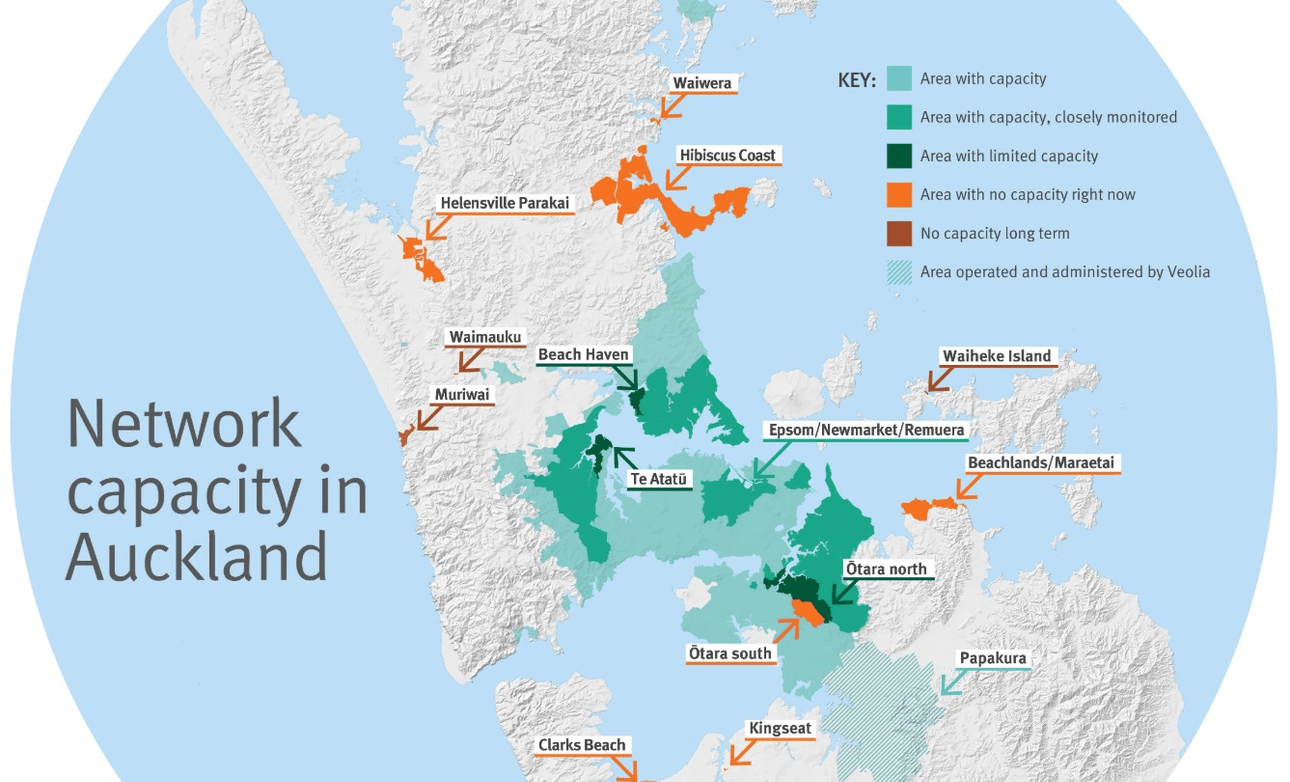
Yesterday the worriers got their wish. Thanks to a government backdown wrangled over chardonnays and summer barbecues, councillors are allowed to reduce the capacity in the new plan from two million to 1.6 million houses. Council’s policy and planning committee was meeting to decide where to make those cuts, and its chair Richard Hills started out explaining the staff recommendations to prioritise places 10km or more from the city centre. Asked why those areas should get first dibs on downzoning, council planner John Duguid was clear: it was because the land within 10km of the city centre had the best access to public transport, employment opportunities, regional amenities like parks and pools and three waters capacity, as measured by Watercare:

Map of Auckland showing water network capacity. Areas are shaded by capacity: green (with capacity), teal (closely monitored), blue-green (limited capacity), orange (no capacity now/long-term), and labeled locations.
Three waters capacity in the central areas is set to improve even more when the Central Interceptor comes online soon. (Image: Watercare)

It should have been a celebration. But what would you know, most of the people who were once so concerned about ensuring housing is near infrastructure weren’t happy. Instead they were stewing over the revelation that the places with the best infrastructure were in their well-to-do wards. North Shore councillor John Gillon had looked at the maps and found that a 10km radius from the city centre would include the entire area he represents. He moved an amendment, seconded by Fletcher, to delete the 10km clause, saying he was “concerned” about the figure.

Waitākere councillor Shane Henderson was having none of it. He pointed out that west and south Auckland had accepted the vast bulk of the new houses in Auckland since the Unitary Plan passed in 2016. As for strain on infrastructure, those areas have limited pipe capacity and less access to public transport, and we see the effects of that outside-in planning in rush-hour congestion, parking shortages and sewage overflows, he said. Henderson argued Fletcher and Gillon were engaged in “a poorly dressed up move to take away intensification from the best-equipped parts of the city”. “The intention is simple: to downzone wealthy suburbs. There is no sensible reason for excluding central isthmus communities – again –  from doing their part.”

The mayor was, if anything, more blunt. He said Gillon’s motion was aimed at putting housing in Pukekohe rather than areas close to “all the infrastructure”. “I don’t want to see endless sprawl just so nimbys in Parnell and politicians can get re-elected,” he said, in what appeared to be a shot at his political nemesis, Act leader David Seymour. “That’s disgraceful, I can’t vote for it.” ...

As Brown saw it, his colleagues’ first purpose was elitism. But if they had a second priority, it was delay. Gillon and Fletcher also put forward an amendment proposing to ask the government for more time to enact Plan Change 120. ...

The demand was familiar. Fletcher has asked for more consultation in just about every planning meeting for years, and the mayor was incensed. “I want to get out of this without further delay and dithering,” he said. “God almighty, it would be great to do something this three-year period.” ...

“For fuck’s sake, get on with it,” he said, as Fletcher spoke for the final time. ...

Afterward, Brown expanded on his frustration with Fletcher, saying the meeting was “one long filibuster to stop poor people living in her area.” 

Read the whole thing here. It's an entertaining lunchtime read.

[Pics from Spinoff]

Monday, 2 February 2026

"The point is not to get 2 million homes."

"Right now, Auckland Council’s zoning allows people to build about a million shops selling tasty pies. ... Can you imagine it? Auckland with a million pie shops – and hardly anything else.

"Of course it is ridiculous. ... The number of pie shops finds its own level, adjusting as demand changes. There is no 'right' number that can be determined on its own. The right number is found as entrepreneurs take punts and consumers make choices. ...

"When central government asked Auckland to zone to allow up to 2 million additional dwellings, it wasn’t a demand that Auckland build that many homes. Or even an expectation that anyone would ever try to build nearly that many.

"The point is not to get 2 million homes.

"When lots of places can turn into houses, townhouses and apartments when housing needs change, then new housing can just turn up when and where it is needed. Developers watch where people most want to live, look at the cost of developing in different places, and try their luck. ...

"[Councils however] have been reluctant to allow enough new housing to keep up with demand ... [so] as a way of resetting planning culture, central government has mandated that [councils] allow more housing, using numerical targets. ...

"For now, just remember that Auckland allows about a million pie shops. Look around. Do you see a million pie shops?

"Things being allowed does not cause them to exist. But allowing competition changes, and improves, what can exist."

~ Eric Crampton from his op-ed 'The misguided fuss over ‘2 million more’ houses for Auckland

Saturday, 31 January 2026

THOUGHT FOR THE DAY: "99% of boomer 'success' was just interest rates falling for 50 years"


"Ninety-nine percent of boomer 'success' was just interest rates falling for [forty] years because they destroyed the real economy."

PS: In case you're confused ...
PPS: In case you're still confused:
"How can stock market valuations be at or near historical highs while the average [person] is about as pessimistic as they’ve ever been?

"This contradiction is a perfect illustration of the financial fun house — and the extreme distortions that relentless money printing has pumped into the system.

"If fiat currency is a dishonest measuring stick — and it is — then how do we accurately measure the stock market?

"The best option is to measure value in gold, honest money that no politician can arbitrarily debase.

"If measuring in fiat is like looking into a fun-house mirror, then gold is a mirror of truth. And when we measure the stock market in gold, that truth becomes clear. Below is a chart of the S&P 500 measured in gold going back to 1950.

"Viewed through the lens of gold, the stock market tells a very different story than it does in fiat terms — and this chart makes that unmistakably clear.

"The most striking feature of the chart is what isn’t there: a sustained upward trend. The S&P 500 today is worth the same amount of gold it was in 1995.

"Despite decades of nominal gains, the stock market has repeatedly given back those gains when measured against gold. In other words, the rising stock market was more a reflection of currency debasement than of real wealth creation.

"This helps explain the disconnection at the heart of today’s market. In fiat terms, stock prices appear to be at record highs. But in gold terms — a unit that cannot be printed — the market looks far less extraordinary."

~ Nick Giambruno from his post 'The Melt-Up Trap: Why Stocks Must Rise Until the Dollar Breaks

Wednesday, 28 January 2026

The Minister for Epsom speaks

...
...
 

 "Depressing to see ACT—once upon a time at least ostensibly a pro-market party—apparently opposed to freeing up land use, and enabling urban land prices to fall a lot."

    ~ Michael Reddell

Wednesday, 21 January 2026

Another frickin' housing backflip!

Christopher bloody Luxon has now announced his fourth major housing policy backflip as National party leader.

I say "announced," but since the pissweak pipsqueak is too pusillanimous to even consider openly putting his head above that particular parapet, he's instead allowed news of his latest flip-flop to leak out from the likes of the oleaginous Matthew Hooton.

Sadly, since most of those backflips have come when Luxon's party is in government, the big loser here is anyone who wants sufficient certainty to plan, build, lend on, borrow against or borrow to buy a house. Let alone several houses. Which means: Almost all of us.

Ever wondered why the Auckland residential construction industry is in a hole? One big reason is the hole in Luxon's head that swings from NIMBY to YIMBY like a weather vane in a storm —making him first abandon bipartisan agreement on housing intensification, then talk about "going for growth," then abandon that again, then talk up Auckland's planned intensification, and now, apparently, abandon it once again. If it's certainty you're after to plan and build, then this Prime Minister and his weather-vane brain is not doing much for you.

Asked for details this morning of his latest backflip, suggesting a reduction in the requirement for Auckland Council to zone for a minimum two-million sites, the pissant Prime Minister spoke to Radio NZ for eight minutes while saying effectively nothing beyond we'll all just have to wait and see. So there.

Asked if it would make a difference if the two-million housing figure was pulled back to 1.5 million, [Scott] Caldwell [from the Coalition for More Housing] said lowering the two-million figure would undermine the feasible capacity of new homes.
And so it will.
“Any pulling back would be compromising Auckland’s housing affordability,” he said.
Which it will.
Caldwell said constant back and forth over new planning rules for more housing since 2020 inevitably meant more delays, and it could be the 2030s before more houses were delivered.
Which is true.
“Waiting until 2035 to deliver real cost-of-living wins is a generation too late for those struggling to find affordable housing in our largest city,” he said.
Which it is.

Tuesday, 2 December 2025

"High house prices are nature’s most reliable contraceptive"

"[A]dvanced economies are halving their populations every generation ... Naturally, everyone blames 'fertility.' As though biology suddenly went on strike sometime around 1992.

"But neither ovaries nor sperm unionised. The culprit is more prosaic—house prices. ... A new study confirmed what few were willing to admit. Housing costs explain more than half the baby drought. If housing had been more affordable in recent decades, decline in fertility would have been smaller by 51%. ...

"High house prices, it seems, are nature’s most reliable contraceptive."
~ Benno Blaschke from his post 'House prices are the new birth control'

Wednesday, 22 October 2025

Pay no attention to the (mad) men behind the curtain [updated]


Readers here might remember I got some stick for calling John Key a fucking moron a while back. A fucking moron, specifically, for repeated calls for the Reserve Bank to juice up house prices again, just so home-owning voters will feel better again. Feel better again, and then vote National.

"The guts of what’s wrong," explained the moron, "is that the housing market is going down, not up" — and "then you have a negative wealth effect," and voters feel bad. And when they feel bad, they vote for the other team.

Classic short-termism.  Stuff rocket fuel into the economy, and then all things will be jake for the governing political parties. This, by the way, was Key's "one simple trick" while Prime Minister: ensure massive house-price inflation, no matter the economic and social dislocation, and then sit back and watch home-owners fooled into feeling better off, and borrowing and consuming more, regardless of the economic consequences. (Consequences for which we're all still paying, by the way.)

In the US, the discredited "wealth effect" — "a gussied-up version of Keynesian stimulus, only targeted at the prosperous classes rather than the government’s client classes" — is generally felt in the stock market. Pundits there are starting to get nervous about a soaring stock market with anaemic growth in the economic system itself, with "important implications for the path of America’s stockmarket boom and its economy."
The good times could continue, at least for a bit longer [says 'The Economist']. ... [But] might a wealthier society also take a harder fall? Bears would point to the bursting of the dotcom bubble in 2000, when a brutal stockmarket slump pushed America into recession. ... The stockmarket might be more of the economy. It still is not all of it.
It's not. And nor is the housing market. We can't get rich just by selling each other houses. (And kudos to one National minister at least who understands that.)

Yet David Stockman is concerned that nothing has been learned from the last major crash
Roughly 15 years ago it was reasonably well understood that the Great Financial Crisis of 2008-2009 had been case of speculation run amuck on both Wall Street and main street alike. These credit and housing bubbles, in turn, had been fuelled by the massive money-printing sprees of the Greenspan and Bernanke Fed.

It might have been presumed, therefore, that the mad money-printers [at the US central bank] would have had second thoughts about the underlying cause of these great economic disasters—that is, the dubious Greenspan policy known as the “wealth effects” doctrine. In simple terms the latter held that if people felt richer owing to soaring home prices and their stock market winnings, they would spend more freely and fulsomely, thereby goosing the Keynesian cycle of ever more spending-sales-production-income-and spending, which was to be rinsed and repeated in an endless round of rising prosperity.

At the end of the day, of course, Greenspan and his heirs and assigns at the Fed turned out to be unreconstructed Keynesians and the wealth effects doctrine a monumental economic con job. The latter did not make society richer; it just made the rich richer. Or stated more directly, main street got inflation at the grocery store, gas pump and doctor’s office—even as the asset-holding class experienced unspeakable windfalls in their brokerage accounts.
Let's not repeat the same mistake again here — especially when local interest rates are already below our trading partners, with no noticeable effect on genuine economic progress. Please: pay no attention to the mad men behind the curtain.

UPDATE:
"The advocates of annual increases in the quantity of money never mention the fact that for all those who do not get a share of the newly created additional quantity of money, the government's action means a drop in their purchasing power which forces them to restrict their consumption. It is ignorance of this fundamental fact that induces various authors of economic books and articles to suggest a yearly increase of money without realising that such a measure necessarily brings about an undesirable impoverishment of a great part, even the majority, of the population."
~ Ludwig von Mises from an interview 'On Current Monetary Problems'

Thursday, 2 October 2025

"In New Zealand, moving a water tank on the marae can require council consent. Meanwhile, the Squamish are building apartment towers on their own land on their own authority."


"Canadian First Nations have transformed their economic fortunes. They have built thousands of new homes after gaining powers for planning, zoning, tax, and infrastructure finance. 'In New Zealand, moving a water tank on the marae can require council consent. Meanwhile, the Squamish are building apartment towers on their own land on their own authority,' ...

"The report ['Building Nations: What Canada’s First Nations can teach us about devolution and development'] highlights [this] stunning turnaround story that has been decades in the making.

"The Squamish Nation’s 6,000-apartment development in downtown Vancouver is helping to solve the city’s housing crisis on its own terms. An hour away from Vancouver, near Chilliwack, the Ch’íyáqtel (Tzeachten), has built over 1,600 homes. It has reversed its economic position from 90% reliance on government funding to 90% own-source revenue. ...

"Canada’s turnaround story started small. ... The path to autonomy was gradual, starting with one First Nation rather than a nationwide approach. ...

"New Zealand could learn from this. ... provid[ing] a practical path to realising a form of tino rangatiratanga, through local devolution, while delivering real benefits for all New Zealanders."

Wednesday, 17 September 2025

15 YEARS AGO: Houses are homes, not investments

A topical guest post from NOT PC first posted here from nearly 15 years ago (well, 13, close enough?) when house-price inflation was already rocketing ...

    Guest post by Vedran Vuk of Casey Research 

Recently, my parents were considering purchasing some real estate. As the financial professional in the family, they asked me, "What do you think? Will it go up in value? You know... not now, but eventually?" I've heard the same thing over and over again. In response, I shared my opinion: "Would you pay the current market price to live there even if its value never increased?" If the answer is yes, buy the property." Essentially, is the house worth it as a home, not as an investment?

In the past few decades, the concept of home ownership has been completely turned on its head. Previously, homes were considered a very long-term consumption good. Do you think anyone in the 18th, 19th, and prior centuries ever considered tripling the value of their homes by retirement time and selling them to move beachside? In the vast majority of cases, such ideas never crossed their minds.

Yet, somehow along the way, this became a reasonable investment expectation. Even today, home buyers still make their purchases with the hopes of escalating prices. But are homes really wise investments?

Consider the difference between your house and an investment such as Apple (NASDAQ: AAPL) stock. At a major company, the opportunities can be truly limitless. Apple can produce cashflows from computers, iPods, iPads, and future innovations that are just dreams and concepts today. If the local market is oversaturated, Apple has the option of spreading out all across the world. As a result, Apple's stock price has gone from $17 in 2005 to $540 today. Can your house do the same? Unless there's a hyperinflation ahead or your house is located in the New York City or London of the 21st century, the answer is no. Why? Because your house is ultimately a product--and products have an upper bound to their prices.

To understand this difference, there's no need to drag out the Case-Shiller Index or analyze complex statistics. Suppose one bought a single-family house over a decade ago for $200K. At the peak of the housing bubble, the price reached $500K; to his joy, the owner sold it and moved thereafter to retire in the Bay of Plenty. Can the house's price go higher from here? With Apple, the stock price can just keep climbing with greater profits and innovations. But is that true with real estate?

For the sake of argument, let's say that prices do keep rising. Eventually, the second owner sells to another buyer for $1 million a decade later. Guy number two also peacefully retires in bounty. Well, where does that leave the third guy? Unless real salaries make an incredible jump in the same time period, no one will be able to afford the home next. The median worker earning $51K won't be selling such a house for retirement; instead, it will take him until retirement to afford it. In many ways, this "investment" more closely resembles a Ponzi scheme. (Yes, Ponzi schemes work: for those who get in early and get out - as the recent real-estate bubble demonstrated.) Ultimately, there's an upper bound to housing prices - they can't continue rising perpetually with no end.

The same is true of any product. At $300 for the newest iPod Touch, Apple might be doing well, but at $10,000 per unit, there likely would be very few buyers. As a homeowner, you're not holding a company that can innovate, cut costs, and enter new markets. You're ultimately holding a product which must be either sold to the next user or leased to the next renter. Houses are a good created for a specific use - to put a roof over one's head. They are not magical money machines. Previous generations understood this very simple concept. One built a home as a place to live and escape the elements - and worse yet, the squalor of tenement housing. Homes were not retirement tools, but rather long-term goods.

Unfortunately, policy makers still view homes as investments and are always worried about low prices. But is it really healthy to play another round of the same Ponzi scheme? Suppose the Reserve Bank manages to inflate housing prices again. There will be another boom in which some folks will make a tremendous amount of money. Eventually, housing prices will hit an unrealistic upper bound. Again, home prices will violently drop, resulting in homeowners deeper underwater than now. Of course, the banks will again take a hit as the mortgage holders. As long as real incomes trail the rise in housing prices, there will ultimately be a correction of some sort.

So, do I think the current real estate market is just fine? No, of course not; but I don't think shocking houses prices back into a bubbly stratosphere is the solution. Ideally, I'd like to see increasing housing prices, but only at the pace of real growth in society's wealth. Over the last few decades, houses grew in value for good reasons and bad. On the good side, the economy had been expanding. On the bad side, central banks’ low-interest-rate bubble artificially inflated housing prices beyond what made sense for economies to sustain.

If US companies such as Apple are creating greater abundance in society, it makes sense for US housing prices to grow with greater wealth. But, bringing house prices higher on a wave of printed cash does not make anyone wise investors, but rather willing participants in a Ponzi scheme where someone else will be left holding the bag. Though that might be an attractive solution for those underwater on their mortgages, it's no solution for the economy as a whole--nor for the next buyer, or the next but one. 

Vedran Vuk is a senior research analyst with Casey Research

Wednesday, 6 August 2025

John Key is still a fucking moron

Cartoon by Richard McGrail from The Free Radical
I've been reminded this morning about what a clueless fucking moron we had as a Prime Minister for two-and-a-half terms. Back a few years ago when we were "rock stars." Remember that?

Anyway, here's John Fucking Key last month giving his considered analysis of what's wrong with New Zealand's economy now:

"The guts of what’s wrong is that the housing market is going down, not up,' he said.
    “When house prices go up, everybody tells the pollsters, ‘Oh that’s terrible, my son or daughter can’t buy a house. I feel really bad.’ The technical term for that is ‘bullshit’.
    “What they really do, is they say to their wife – or the wife says to her husband – ‘God, we paid $1 million for this house and it’s worth $1.7 million now.’ Quietly they go, ‘Oh, we feel rich’.
    “And then they go and borrow a bit from the ANZ and they go on holiday and they upgrade their kitchen, they feel good about life. So when you have a negative wealth effect, they feel bad.”
And I bet the roomful of home owners and property "investors" and National Party political advisors — no to mention all his former colleagues on the ANZ board —had a smug little chuckle into their at their man's shrewd witticisms. It's hard to know where to begin at his economic acumen however, 'cos apparently it's never begun.

Let's make it simple, since that's the best description of Key's grasp of things. Trump's been called a fucking moron for not understanding the economic destruction of tariffs. And rightly so. But Trump doesn't pretend to be in any way clued up about economics. Key does. And yet the fucking moron apparently knows nothing about a simple enough concept: capital consumption. It's a process of converting someone else’s wealth into your income.

And this is his one simple trick to fix the fucking economy.

You wouldn't believe it.

Here's what the fucking moron either doesn't know, or doesn't care to know.

That fucking "wealth effect" the moron talks about is paid for by one thing: it's paid for by eating the fucking seed corn. The seed corn is the part of your harvest you put aside to plant again next year. Without that seed corn, you have nothing to plant, and nothing further to harvest. What Key wants to "fix" the economy, the simple guts of it, is for is to eat the fucking seed corn. That's his recipe for success. 

Any fucking moron could get a "wealth effect" (and a poll bump) by consuming the seed corn.  But ultimately the farmer will pay a price; he'll no longer have anything to farm.

Fellow on the right enjoys Key's "wealth effect." Not so much farmers on the left.

But the difference in what Key proposes is even worse: he wants home owners to consumer other people's seed corn. Hayek used to call this "forced saving." Savers have to save more, or else, because the "seed corn" being consumed is theirs. 

Here's the thing: When mum and dad borrow a bit from the ANZ and go on holiday and upgrade their kitchen and put in another fucking ensuite, that's paid for by what was, or would have been, accumulated capital. The accumulated capital of those other savers. It's called "forced saving" because what pays for John Key's fucking borrowing is new counterfeit capital: i.e., new money that's been borrowed into existence to pay for the holiday, the new kitchen, the fucking ensuite. That counterfeit capital means savers are forced to save more just to keep up.

That's because this new borrowing is new money "injected into the economic system at a specific point" that advantages those consuming the counterfeit capital while disadvantaging those trying to save.
If the money or credit were evenly distributed among all economic agents, no “expansionary” effect would appear, except the decrease in the purchasing power of the monetary unit in proportion to the rise in the quantity of money. 
However if the new money enters the market at certain specific points, as always occurs, then in reality a relatively small number of economic agents initially receive the new loans. Thus these economic agents temporarily enjoy greater purchasing power, given that they possess a larger number of monetary units with which to buy goods and services at market prices that still have not felt the full impact of the inflation and therefore have not yet risen.

The purchasing power of these home-owners is paid for by the losses of savers. 

Hence the process gives rise to a redistribution of income in favour of those who first receive the new injections or doses of monetary units, to the detriment of the rest of society, who find that with the same monetary income, the prices of goods and services begin to go up. “Forced saving” affects this second group of economic agents (the majority), since their monetary income grows at a slower rate than prices, and they are therefore obliged to reduce their consumption, other things being equal.
In a nutshell Key's quick-fix for poll-driven success, and economic growth, is to grant home-owners purchasing power by quietly, secretly and unobserved, stealing from savers. ("By a continuing process of inflation, governments can confiscate, secretly and unobserved, an important part of the wealth of their citizens." ~ John Maynard Keynes)

Recall that he said something similar when the problem erupted of paying to repair leaky homes. He said quite bluntly, not to worry,  inflation would fix that. Remember that when housing unaffordability was bad before he took office, and he promised to fix it. He didn't, of course. Instead, he did everything he could to put rocket fucking fuel under house prices. It would, he claimed, 'fix" the problem of paying for the problem. 

This prick has form.

He's either a calculating Machiavellian.

Or he's pig ignorant.

My money's on the latter.

RELATED:

Monday, 28 July 2025

Removing barriers to overseas building products, one subclause at a time [updated]

BUILDING MINISTER CHRIS PENK IS surely mistaken (or misled) if he thinks he is going to see a quick remedy to high
building costs from his announcement, already signalled, that building products from overseas may now be used in New Zealand.

The problem, you see, is that regulations here around our approvals process make it prohibitively expensive to obtain official approval for any materials, local or imported, so that most would-be inexpensive imports just don't happen. (Around 90% of products used in building or building components here already are imported, but they're generally not the primary ones requiring approval by the grey ones.Why pay upwards of $250,000 to have your primary Euro-component approved here, when it's already selling like hotcakes in your Euro markets.) 

So Penk's idea is that materials or systems already approved by the grey ones in similar jurisdictions and standards environments to ours (such as Australia, Canada, UK, US and Western Europe) can be cited in documentation to the grey ones here— and then, with some fingers crossed, be approved for use in buildings here without the otherwise burdensome cost of obtaining formal approval upfront.

Cheaper materials: cheaper houses.

Nice idea. Shame if a bureaucracy somewhere were to ruin it.

The programme will be run by MoBIE. 

I attended a webinar run by MoBIE dicks recently outlining how they intend to run it. They called it 'Removing Barriers to Overseas Building Products.' Try not to laugh as I relate their intentions.

First of all, they've started a committee. And several working groups. Large ones. Large enough, I imagine, to fill at least one floor. It will be these newly-appointed bureaucrats that will decide which standards/regulation of which similar jurisdictions will be considered for approval by these bureaucrats. And this will of course take some time. 

First of all, of course, they have to meet to define regulatory criteria. And to issue new acronyms (things like BPS, BPIR, etc.)

This is how bureaucracies work.

The committee/working groups will then make recommendations to the CEO of MoBie which standards/regulations he may recognise. May. Those deemed unobjectionable are then added to something called Building Product Specifications — a "new regulatory instrument." [UPDATE: The inaugural Building Product Specifications document has just dropped today, but dn't get excited, it's simply a compilation of standards/regulations already cited in the NZ Building Code. Enjoy.]

Following which, MoBIE's dicks will then publish a "Recognition Notice" detailing which new standard/regulations have been recognised. Once a standard/regulation has been so recognised, it will then be added to the Building Product Specifications document.

They hope ("always hoping, hope is vain") to issue their first "Recognition Notice" by year's end. That will be for one regulation/standard from one jurisdiction for one building material or system. For which the Notice will be once piece of "evidence of compliance with the New Zealand Building Code."

Still, once that Notice is published, building importers may then decide to bring in a building material or system; builders and building designers may offer the imported product in plans and specifications based on it being "Recognised" as evidence it complies

Did you follow all that?

Note the process here: it's MoBIE who decides to decide. Not builders, not building designers, not building materials scientists or building materials importers — all of whom have a large interest in the process — and nor is it the building minister. No. It's MoBIE's dicks who decide to initiate the process,  and it's they who will grind slowly through all the world's standards, regulations, codes, guidelines, approval systems, benchmarks and norms, deciding which of them they might like to spend time taking through their process and (eventually) recognise.

So we can see how this is good for bureaucrats employed within MoBIE. 

But how does all this help builders, building materials importers, would-be building owners, and me as a building designer? 

Well, nothing at all will help until at least the start of next year, when the first "Recognition Notice" might (might) have been issued for the Australian Watermark Scheme — so importers et al can start taking advantage of Australian plumbing and drainage products.

And after that, the committee/working group/bunch of overpaid bureaucrats will then begin to meet and consider whether or not  the American Society for Testing and Materials (ASTM International) and the European Committee for Standardisation (CEN) may be considered for recognition.

Don't wait up.

They may be some time.

UPDATE:

Email from MoBIE this afternoon: 
"The newly released Building Product Specifications document lists 130 [already-recognised] product standards, including US, European and other international standards alongside New Zealand equivalents for products like plasterboard, cladding and insulation. ...
    "Soon [sic] other pathways will be in place for the Minister of Building and Construction to endorse overseas standards, and for MBIE to formally recognise certain products certified overseas as complying with the Building Code. Updates about these pathways will be made soon [sic]."

Monday, 2 June 2025

"But how much can you *do* with a 70 square-metre house?!"

THIS IS ONE OF THOSE rare things, a government announcement I can get behind:
“Last year the Government consulted on allowing\granny flats of up to 60 square metres to be built without building or resource consents. The proposal received huge support, and as a result the Government has agreed to go even further by increasing the maximum size to 70 square metres.”

This is great news!

And it does look like it may actually happen — with the announcement yesterday that " Granny flats of up to 70sqm, and papakāinga of up to 10 homes would be allowed without a consent on specific land zones."

Never mind the misnomer "granny flat," When/if this is introduced, any house with a decent sized-section will now give owners the opportunity to add one new minor dwelling. (Let's call it that, shall we, rather than the more popular but slightly derisive 'granny flat'.)  One minor dwelling in all the places that's possible can do amazing things for making dwellings more affordable — helping make up for three decades of cementing in the opposite trend.

"But," I hear you ask, "how much can you do with a 70 square-metre house?!" Answer: a lot. If you do it right, a minor dwelling might even become your major dwelling.

To give you some idea of that size, until recently, the average size of a New Zealand house was 200 square metres. Now that we've been overdosing on bland, cooky-cutter townhouses, it's just under 160 squares. 

So even with that drop, a house of just 70 squares represents a fairly drastic compression of space.

So ... how much can you do with a 70 square-metre house?

Turns out, with a knowledge of good spatial design and a little bit of cunning, an awful lot.

Yes, I know those of you living in homes with kitchens the size of a large double garage won't fit in. But, for the record, I live in a very workable house of just 45 square metres. So to me, 70 square metres looks like a luxurious surplus of useable space!

So let's have a look at what a little bit of ingenuity and exploiting a few legal loopholes can do.

Architect James Schildroth recently designed this artful 2-bedroom 756 square-foot house below (around 70.2 square metres) and will make it available to build. In the States (where the sun is a different way around and building is much cheaper), he reckons it would cost around US$270,000....

Despite the size, it has almost all a home needs. There are several space-saving measures here (smaller bedrooms and closets, minimal kitchen, etc.) and a number of 'tricks' that help space appear larger—most especially carefullly "nesting" spaces, and opening spaces up at the corners. That low roof corner outside the lounge is especially effective, offering privacy from a possible neighbour, while also suggesting to occupants that the edge of the main space is defined by the outside edge of those overhanging eaves, at once both sheltering and opening up.

These psychological "tricks" are important in every home, but especially important in one so small, when every square metre has to justify itself many times over — space that's not just flexible, but hard-working!
Floor plan & diagram overlay for Frank Lloyd Wright's Pope-Leighy House (above) suggests how 'nesting' 
spaces within even a small home can help produce an illusion of larger space by virtue of the shared 
spaces — the particular space experienced depending on the observer's location at any point in time


HERE'S ANOTHER: A 72 SQUARE-METRE home-office by (Organon Architecture) over two levels, the lower of which is just 55 square metres, but with extensive pergolas — and a hill!


And you can do a whole lot with even less, if you're cunning enough.

The key, really is breaking the box. Understanding how to play with the visual field to suggest a larger apparent space.  And to properly 'nest' spaces so that every square metre within works harder, and suggests more.

Prefabricated modules and the like are part of the thing, but not the main thing. It's how modules and spaces are arranged that becomes the main thing.

HERE ARE SEVERAL MORE EXAMPLES. 

Several years ago, when it looked like Auckland Council were about to relax rules around 60-square-metre "minor dwellings," I was commissioned to produce a few floor plans and systems for what, it was anticpated, could have become a modest business. Sadly, the relaxing of rules never happened, and my client instead decided to try for better things in Queensland. But the idea is there in each of these homes: that a modestly-sized home need not feel small if it is well laid out.  

The aim was to build these homes on a precast-prestressed concrete transportable deck — using a container module in order to show the many limitations of container design, and to allow factory-built homes to be fully transported if possible. They featured both "ceiling decks," to help with services and the manipulation of space,  and a "smart slab" in which dimensions were set for the builder and in which all main services were to be run as a "plug-and-play" system.

I did modify one of these designs to be built in a small town in Victoria. (See if you can work out which design...?)

Anyway, take a look. There were around a dozen ...


Like I say, you can do lot with sixty metres. Let alone what you can do with seventy!